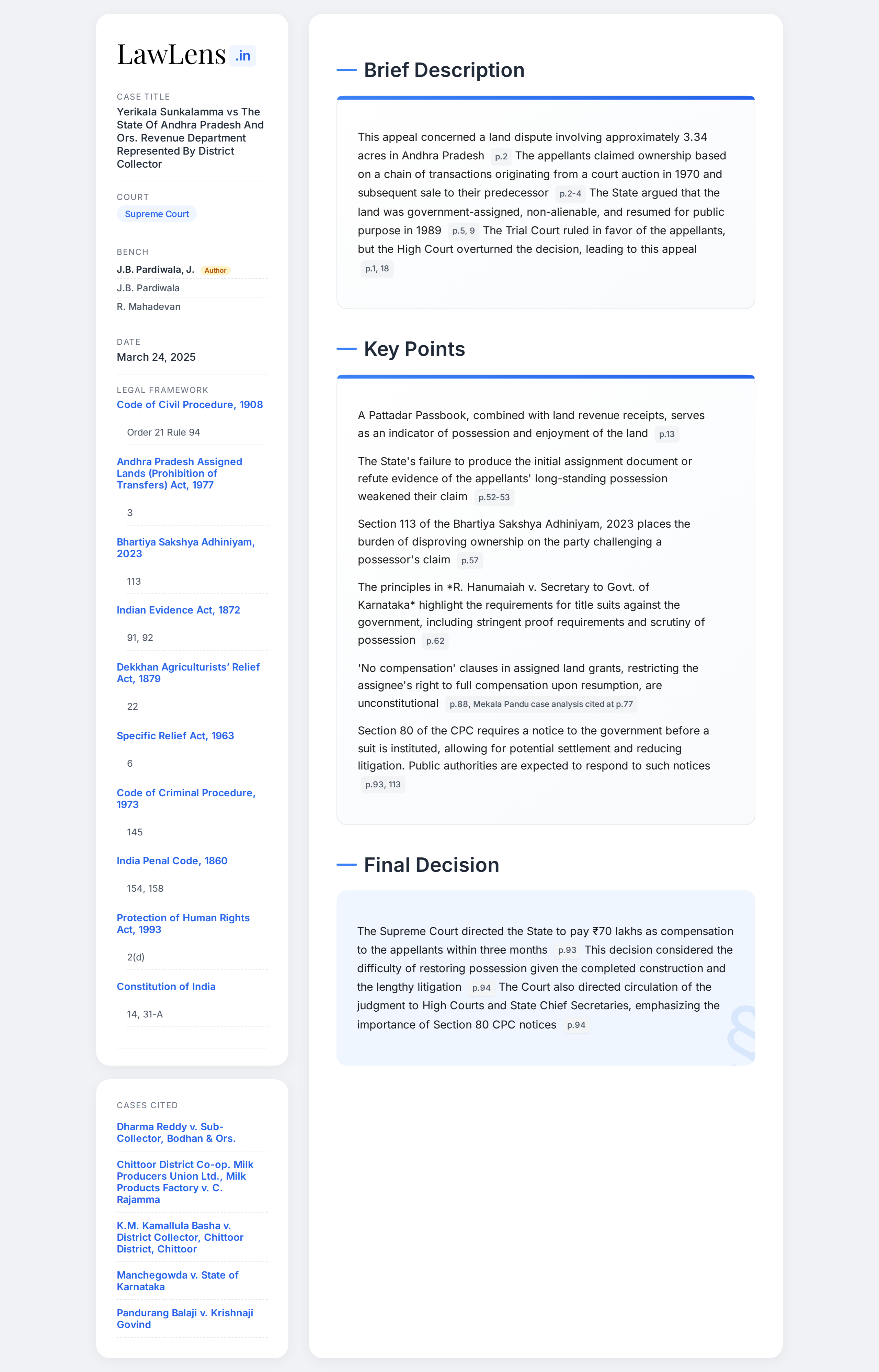
Yerikala Sunkalamma Vs State Of Andhra Pradesh 2025 INSC 383 - S.80 CPC Notice - Art.300A Constitution - Declaratory Title Suits Against Government

Code of Civil Procedure 1908- Section 80 -The primary objective behind Section 80 of the CPC is to provide the Government or a public officer with an opportunity to assess the legal merits of a claim and potentially settle it if it appears to be just and reasonable (Para 97)- A statutory notice holds significance beyond mere formality. Its purpose is to provide the Government or a public officer with an opportunity to reconsider the matter in light of established legal principles and make a decision in accordance with the law - A notice issued under Section 80 must include: i. The name, description, and place of residence of the person providing the notice. ii. A statement outlining the cause of action. iii. The relief sought by the plaintiff. - When determining whether the essential requirements of the Section have been met, the court should consider the following questions: (i) Has the notice provided adequate information to allow the authorities to identify the person issuing the notice? (ii) Have the cause of action and the relief sought by the plaintiff been sufficiently detailed? (iii) Has the written notice been delivered to or left at the office of the appropriate authority as specified in the section? (iv) Has the suit been initiated after the expiration of two months following the delivery or submission of the notice, and does the plaint include a statement confirming that such notice has been provided as required? (Para 103-105)
Declaratory title suits against the Government- Principles that govern the adjudication: i. Suits for declaration of title against the government differ from suits against private parties on two counts: a. First, there is a presumption in favour of the Government in such suits, as all lands which are unoccupied or not vested in any individual or local authority, are presumed to belong exclusively to the Government. b. Secondly, there is an additional burden of proof on the party seeking declaration of title against the Government. The plaintiff has to establish its possession over the land in question for a period of thirty years as opposed to twelve years in the case of adverse possession against a private party. ii. A decree declaring title against the Government must not be passed casually. Before granting any such decree, the trial court must ensure that the plaintiff has furnished adequate documentary evidence, either through title deeds tracing ownership for over thirty years or by establishing adverse possession for a period of thirty years. iii. The trial court must verify whether the name of the plaintiff has been recorded as the owner, holder, or occupant in the relevant revenue or municipal records for more than thirty years. iv. Finally, the trial court must carefully scrutinize the nature of the possession as may be asserted, determining whether the same is authorized or unauthorized, permissive or casual, furtive or clandestine, as well as open, continuous, and hostile, or implied by title, to ensure that public property is not inadvertently converted into private ownership by unscrupulous elements. (Para 88) Public Authorities must take statutory notice issued to them in all seriousness. The Public Authorities must not sit over such notices and force the citizens to the vagaries of litigation. They are expected to let the plaintiff know their stand within the statutory period or in any case before he embarks upon the litigation. In certain cases, courts may be obliged to draw adverse presumption against the Public Authorities for not acknowledging the notice or telling the plaintiff of its stand and in the absence of that, a stand taken during the course of trial may be considered as an afterthought. (Para 113)
Indian Evidence Act, 1872 - Section 110 ; Bharatiya Sakshya Adhiniyam 2023- Section 113 - Possession is prima facie proof of ownership. A person in possession is entitled to remain in possession until another person can disclose a better title under Section 113 of the BSA. Therefore, once the plaintiff proves that he has been in possession of the suit property, the burden of proving that the plaintiff is not the owner is on the defendant who affirms that the plaintiff is not the owner. The Section does not make a distinction between the Government and a private citizen. Section 113 is, therefore, equally applicable where a Government claims to be the owner or challenges the ownership of the plaintiff who is in possession of the property. It is not disputed that before the possession of the Subject Land was taken over, the plaintiffs were in possession of the property for more than twenty years. The onus, therefore, under section 113 of the BSA was on the State to prove that the Government had a subsisting title to the Subject Land. (Para 72)
Constitution of India - Article 300A - Under the Constitution, the Executive cannot deprive a person of his property of any kind without specific legal authority which can be established in Court of law, however laudable the motive behind such deprivation may be -In case of dispossession of property except under the authority of law, the owner may obtain restoration of possession by a proceeding for mandamus against the governmental authorities- The phrase “by authority of law” means by or under a law made by the competent Legislature