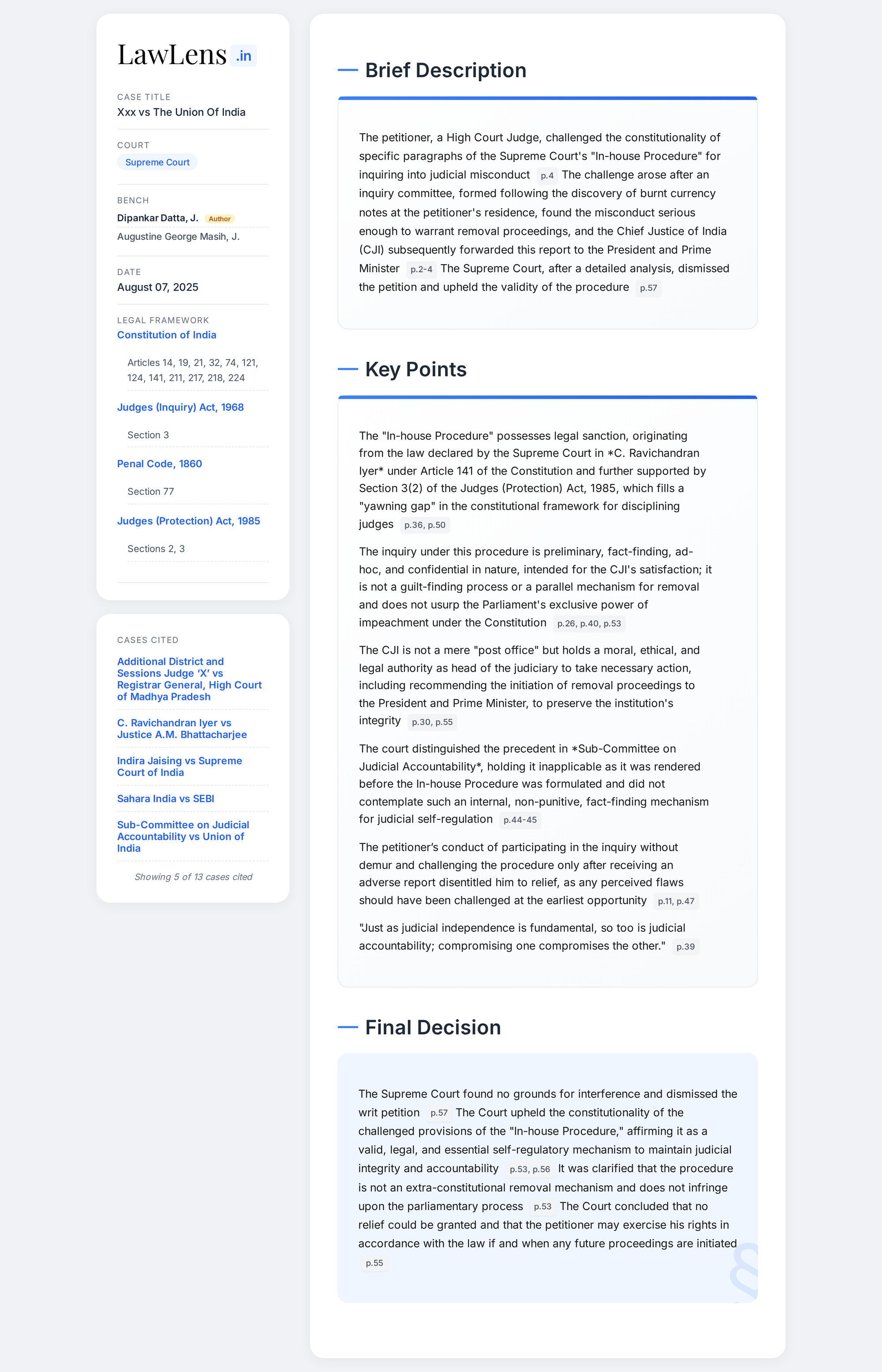
XXX vs Union of India 2025 INSC 943 - CJI - In-house Procedure - Judges (Protection) Act
"It is fallacious to argue that the PROCEDURE is a parallel and extra-constitutional mechanism for removal of a Judge.."

Constitution of India - Article 124,141; Judges (Protection) Act - Section 3 - In-house Procedure- The PROCEDURE has its roots in the law declared by this Court under Article 141 of the Constitution admits of no doubt. Accordingly, we hold that ‘law for the time being in force’ in sub-section (2) of Section 3 of the Protection Act would include law laid down by this Court and that the term ‘otherwise’ read in conjunction with ‘such action’, appearing in the said sub-section, is wide enough to encompass measures that the PROCEDURE contemplates.(Para 114) the in-house inquiry or its report forming part of the PROCEDURE in itself does not lead to removal of a Judge, unlike the constitutionally ordained procedure. Thus, the in-house inquiry is not a removal mechanism in the first place, much less an extra-constitutional mechanism. (Para 117) it is fallacious to argue that the PROCEDURE is a parallel and extra-constitutional mechanism for removal of a Judge - Report or no report, recommendation or no recommendation, whatever is the case, the Parliament’s power to initiate proceedings for removal of a Judge for alleged misbehaviour or incapacity remains unfettered. (Para 116) We see no reason to hold paragraph 7(ii) of the PROCEDURE as infringing either any provision of the Constitution or the concept of separation of powers. (Para 125)
Constitution of India - Article 124,141, 217,218 ; In-house Procedure- (Para 114) The PROCEDURE acts as a check on Judges’ unbridled freedom of action and thereby seeks to prevent outcomes that could be harmful or unjust - not all misbehaviour of Judges necessarily rise to the level of "proved misbehaviour" attracting Articles 217 and 218 read with clauses (4) and (5) of Article 124. The Constitution’s silence on cases that do not rise to the level of proven misbehaviour creates a significant structural vulnerability, which has since been addressed by the PROCEDURE (Para 85) CJI is not a mere post office between the COMMITTEE and the President/the Prime Minister that the REPORT is to be forwarded without any remarks/recommendation. The CJI is clearly an important person, if not the most, in the larger scheme of maintaining institutional interest and credibility to ascertain whether a Judge has indulged in misconduct. As per the PROCEDURE, after receiving a complaint against a Judge or a report from the Chief Justice of the High Court of which he is a Judge, the CJI has to apply his mind to the nature of complaint/report together with supporting materials, if any. If the CJI believes that the matter requires a deeper probe, he is required to constitute a Committee for an in-house inquiry. The report of inquiry may, or may not, find the allegations against the Judge to be serious, so as to call for any measure. However, if it does, the CJI is under an obligation to forward the report to the President and the Prime Minister. We see no justification to hold that in so forwarding, the CJI may not give his own views. (Para 64)
Judges (Protection) Act - Section 3 - Inclusion of the Central Government or the State Government or such other authority in sub-section (2) of Section 3 is for the simple reason that ‘Judge’, as defined in the Protection Act, is not limited to the Judges of the Supreme Court and/or the High Court but also includes judges conducting judicial and quasi-judicial proceedings in the Tribunals and quasi-judicial bodies, thereby ensuring that the protection granted under the Protection Act encompasses all such individuals having authority to exercise judicial power under the law.(Para 81) Section 3(1) is subject to Section 3(2) and does not expressly prohibit a departmental proceeding or otherwise but bars entertainment and continuance of civil or criminal proceedings against a Judge as defined in Section 2 for any act, thing or word committed, done or spoken by him when, or in the course of, acting or purporting to act in the discharge of his official or judicial duty or function- the PROCEDURE contemplating a fact-finding inquiry can and does very well fit in the mould of the word “otherwise” (Para 77). (Para 113) The Protection Act does not offend the constitutional scheme present; and, being in addition to the extant provisions, does not affect the Supreme Court’s authority to take such action, as deemed fit, against a Judge of a High Court who is alleged to have indulged in misconduct in terms of the PROCEDURE. (Para 82)
Chief Justice of India - While the CJI is no doubt primus inter pares – first among equals – and also does not exercise powers of superintendence over the High Courts and the Judges of the High Court, nonetheless, the CJI bears a significant moral responsibility as the foremost judicial officer to ensure that the judiciary of the 30 country functions in a transparent, efficient and constitutionally appropriate manner. (Para 61)
Constitution of India - Article 124 - The law that is referred to in clause (5) of Article 124 is the Inquiry Act. (Para 30)
Judiciary - The judiciary in India is characterised by judicial independence; however, judicial independence signifies flexibility of judicial thought and the freedom to adjudicate without external and internal pressure, and not unfettered liberty to act as one might wish. Just as judicial independence is fundamental, so too is judicial accountability; compromising one compromises the other. (Para 84)
Law of Precedents - Anything and everything said in a decision, while answering the questions which might arise, do not form a precedent- A decision is an authority for what it decides. What is of the essence in a decision is its ratio and not every observation found therein, nor what logically follows from every observation made in the decision. (Para 95)
Constitution of India - Constitution is not a static document. Constitutional Courts are obligated to interpret the Constitution in the light of evolving standards and institutional needs. (Para 95)
#SupremeCourt endorses the In-House Procedure in XXX vs UoI case. Rejects contention of @KapilSibal on behalf of XXX that it is a parallel and extra-constitutional mechanism for removal of a Judge. https://t.co/3nyZBOqAut pic.twitter.com/R7Y6vRzTnX
— CiteCase 🇮🇳 (@CiteCase) August 7, 2025
#SupremeCourt allowed an application to file writ petition without disclosing the name of the petitioner.
— CiteCase 🇮🇳 (@CiteCase) August 7, 2025
Then dismisses the writ petition by revealing that it is filed by a 'deeply anguished judge of the Allahabad High Court'. https://t.co/wRkBQlUtdP
“Just as judicial independence is fundamental, so too is judicial accountability; compromising one compromises the other." #SupremeCourt in XXX vs UoI ! https://t.co/3nyZBOqAut pic.twitter.com/ZVb2KbMqWJ
— CiteCase 🇮🇳 (@CiteCase) August 7, 2025
Judiciary/UPSC aspirants can expect a question from this in future exams:
— CiteCase 🇮🇳 (@CiteCase) August 7, 2025
How many MOTIONs for removal of a SC/HC Judges have been admitted by the Parliament and how many were carried out?#SupremeCourt answers here: https://t.co/3nyZBOqAut pic.twitter.com/suQbncn0TR
Suggested Readings:
 Namrata Banerjee