Vijay Krishnaswami v. Deputy Director of Income Tax (Investigation) 2025 INSC 1048 - Section 276C Income Tax Act

You can read our notes on this judgment in our Supreme Court Daily Digests. If you are our subscriber, you should get it in our Whatsapp CaseCiter Community at about 9pm on every working day. If you are not our subscriber yet, you can register by clicking here:
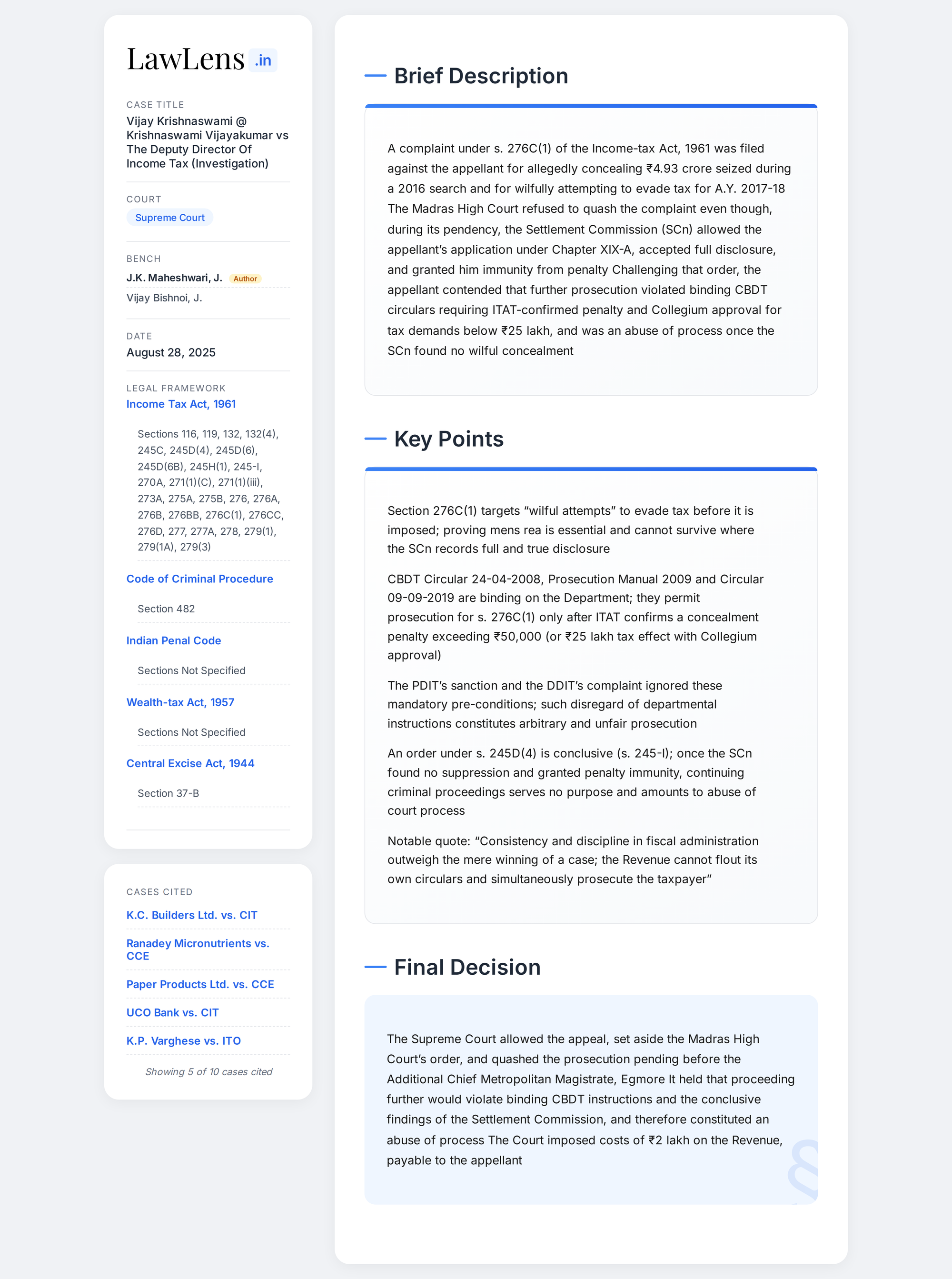
Income Tax Act, 1961 - Section 276C - Section 276C(1) is primarily intended to deter and penalize wilful and deliberate attempts by an assessee for evasion of taxes, penalties and interest prior to their imposition or charging. The provision applies where there is a conscious and intentional effort to evade tax liability, distinguishing such conduct from bona-fide errors or differences in interpretation. The gist of the offence under sub-section (1) of Section 276C lies in the wilful attempt to evade the very imposition of liability, and what is made punishable under this sub-section is not the ‘actual evasion’ but the ‘wilful attempt’ to evade as described in the proviso to Section 276C.- For an offence under Section 276C(1), for which a prosecution was lodged, wilful attempt to evade tax or penalty, which may be imposable or chargeable, mens rea of the assessee is required to be proved. In absence, lodging such prosecution would result into futility. (Para 18)
Income Tax Act, 1961 - Circulars issued by the Revenue are binding on the authorities, and can tone down the rigour of the statutory provision. (Para 31)
Case Info
The case is Vijay Krishnaswami v. Deputy Director of Income Tax (Investigation), neutral citation: 2025 INSC 1048.
Case Name and Neutral Citation
- Case Name: Vijay Krishnaswami @ Krishnaswami Vijayakumar v. The Deputy Director of Income Tax (Investigation)
- Neutral Citation: 2025 INSC 1048
Coram
- Coram: J.K. Maheshwari, J. and Vijay Bishnoi, J.
Judgment Date
- Date of Judgment: August 28, 2025
Caselaws and Citations Referred
- M/s K.C. Builders Ltd Vs CITCitation: (2004) 2 SCC 731Principle: If penalty for concealment fails, prosecution on the same material must also fail.
- Ranadey Micronutrients Vs. CCECitation: (1996) 10 SCC 387Principle: Departmental circulars are binding on revenue authorities.
- Paper Products Ltd. Vs. CCECitation: (1999) 7 SCC 84Principle: Circulars issued by the Board are binding on the Department.
- UCO Bank Vs. CITCitation: (1999) 4 SCC 599Principle: CBDT circulars are legally binding on the Revenue.
- K.P. Varghese v. ITOCitation: (1981) 4 SCC 173Principle: Circulars issued by CBDT under Section 119 are binding.
- Keshavji Ravji and Co. v. CITCitation: (1990) 2 SCC 231Principle: Beneficial circulars are binding on authorities.
- Commissioner of Central Excise, Bolpur Vs. Ratan Melting & Wire IndustriesCitation: (2008) 13 SCC 1Principle: Circulars are binding on authorities, but not on courts.
- J.K. Lakshmi Cement Limited Vs. Commercial Tax Officer, PaliCitation: (2016) 16 SCC 213Principle: Circulars can tone down the rigour of law, are binding on tax authorities.
- Commissioner of Central Excise and Service Tax, Rohtak Vs. Merino Panel Product LimitedCitation: (2023) 2 SCC 597Principle: CBEC Circulars are binding on the Revenue.
Statutes/Laws Referred
- Income Tax Act, 1961
- Section 276C(1): Wilful attempt to evade tax, etc.
- Section 132: Search and seizure
- Section 132(4): Statement during search
- Section 279(1): Prosecution to be at instance of Principal Chief Commissioner or Chief Commissioner
- Section 245C: Application for settlement of cases
- Section 245D(4): Procedure on receipt of an application under Section 245C
- Section 245H: Power of Settlement Commission to grant immunity from prosecution and penalty
- Section 245-I: Order of settlement to be conclusive
- Section 271(1)(C): Penalty for concealment
- Section 119: Power of CBDT to issue instructions
- Code of Criminal Procedure, 1973
- Section 482: Powers of High Court to quash proceedings
- Indian Penal Code, 1860 (mentioned in context of immunity from prosecution)
Departmental Circulars and Manuals
- CBDT Circular dated 24.04.2008: Guidelines for prosecution under Direct Tax law.
- Prosecution Manual, 2009: Procedure for launching prosecution.
- CBDT Circular dated 09.09.2019: Procedure for identification and processing of cases for prosecution under Direct Tax Laws.
#SupremeCourt on Section 276C(1) Income Tax Act: https://t.co/pgijTdl4Yz pic.twitter.com/zd46CRcYdS
— CiteCase 🇮🇳 (@CiteCase) August 28, 2025


Justice JK Maheshwari and Justice Vijay Bishnoi