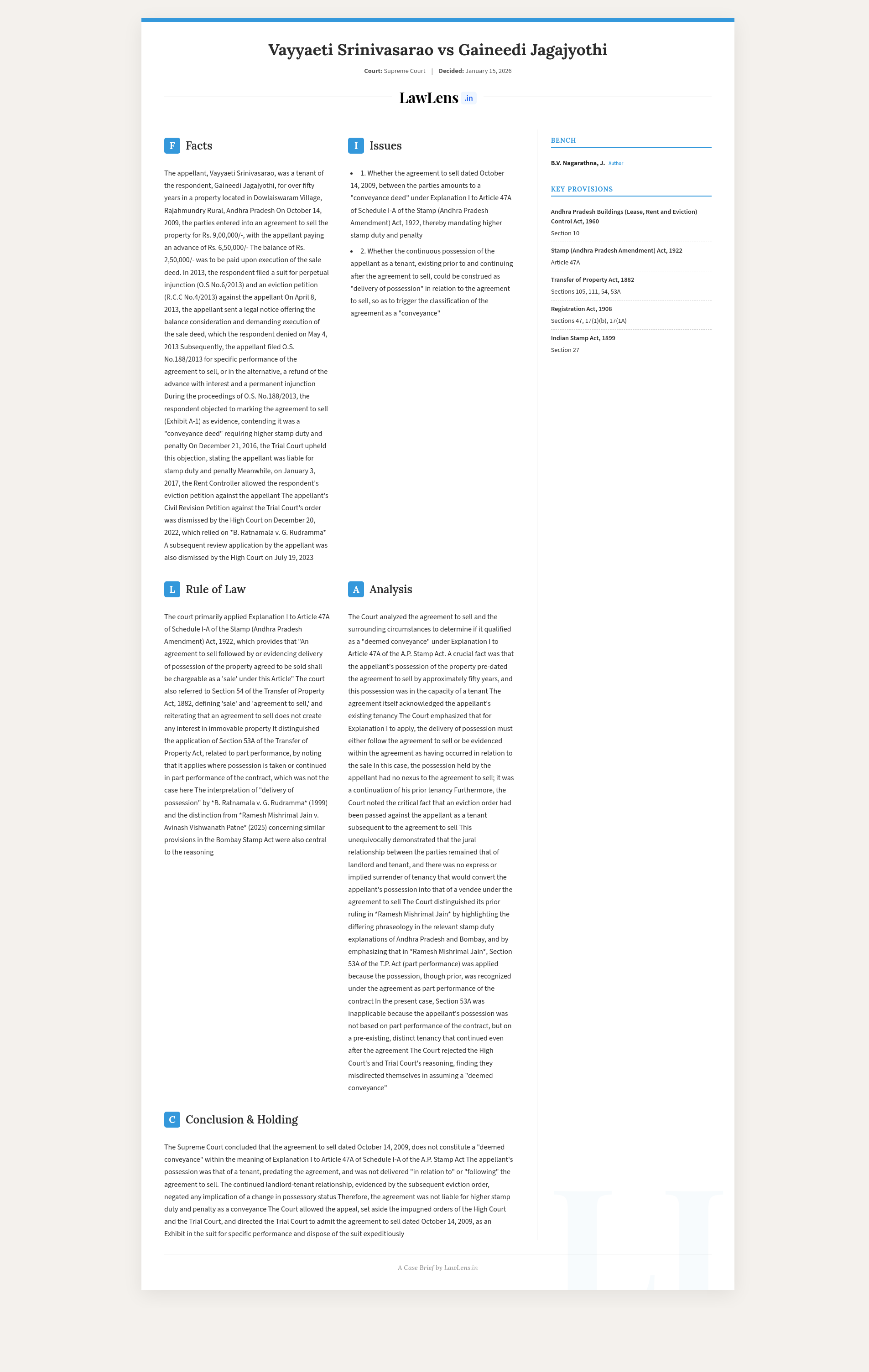
Vayyaeti Srinivasarao v. Gaineedi Jagajyothi; 2026 INSC 59 - Transfer of Property Act - Stamp Act

You can read our notes on this judgment in our Supreme Court Daily Digests. If you are our subscriber, you should get it in our Whatsapp CaseCiter Community at about 9pm on every working day. If you are not our subscriber yet, you can register by clicking here:
Transfer of Property Act 1882- Section 54 - A contract for sale (agreement to sell) would not confer any title nor transfer any interest in an immovable property (except to the limited right granted under Section 53A of the Act). Thus, an agreement to sell or a contract for sale with or without possession is not a conveyance deed. Therefore, a sale of immovable property can only be made by a registered instrument and that an agreement of sale does not create any interest or charge on its subject matter. (Para 5.10)
Transfer of Property Act 1882- Section 53A- Section 53A applies to a person who contracts to transfer immovable property in writing. If the proposed transferee in the agreement has taken possession of the property or he continues in possession thereof being already in possession in part 26 performance of the contract and has done some act in furtherance of the contract and transferee has performed or is willing to perform his part of the contract, the transferor shall be debarred from enforcing any right in respect of the property- In a case where a person claims benefit of part performance, evidence that he was inducted into possession for the first time subsequent to the contract, would be a strong piece of evidence regarding the contract and of possession changing hands pursuant to the contract. Continuous possession of a tenant in the suit property even after entering into the sale agreements would not by itself amount to a part-performance, putting the tenant in possession of the suit properties pursuant to the sale agreements. (Para 5.12-13)
Transfer of Property Act 1882- Section 111 - Distinction between an express and implied surrender - While express surrender is a matter of intention of the parties, implied surrender is by implication of the law. An implied surrender is the act of the law and takes place independently of and in some cases even in spite of the intention of the parties. (Para 5.7)
Case Info
- Case name and neutral citation: Vayyaeti Srinivasarao v. Gaineedi Jagajyothi; 2026 INSC 59.
- Coram: B.V. Nagarathna, J.; R. Mahadevan, J.
- Judgment date: January 15, 2026.
- Caselaws and citations referred:
- Ramesh Mishrimal Jain v. Avinash Vishwanath Patne, 2025 SCC OnLine SC 329.
- B. Ratnamala v. G. Rudramma, 1999 SCC OnLine AP 438.
- M.A. Gafoor v. Mohd. Jani, 1998 SCC OnLine AP 848.
- Suraj Lamp and Industries Pvt. Ltd. (2) v. State of Haryana, (2012) 1 SCC 656.
- Shashi Kapila v. R.P. Ashwin, (2002) 1 SCC 583.
- Chinnaraj v. Sheik Davood Nachair, AIR 2003 Mad 89.
- B. Paramashivaiah v. M.K. Shankar Prasad, AIR 2009 Kar 88.
- Veena Hasmukh Jain v. State of Maharashtra, (1999) 5 SCC 725.
- Shyamsundar Radheshyam Agrawal v. Pushpabai Nilkanth Patil, (2024) 10 SCC 324.
- Statutes/laws referred:
- Transfer of Property Act, 1882: Sections 5, 54, 53A, 105, 111(e) and 111(f).
- Registration Act, 1908: Sections 17(1)(b), 17(1A), 47.
- Indian Stamp Act, 1899: Section 27 (as referenced for scheme).
- Stamp (Andhra Pradesh Amendment) Act, 1922: Article 47A, Schedule I-A, Explanation I.
- Bombay Stamp Act, 1958: Article 25, Schedule I, Explanation 1; Sections 32-A, 34.
- Andhra Pradesh Buildings (Lease, Rent and Eviction) Control Act, 1960.
- Maharashtra Ownership Flats Act, 1963.
- Maharashtra Apartment Ownership Act, 1971.