Vaneeta Patnaik v. Nirmal Kanti Chakrabarti 2025 INSC 1106 - POSH Act - Limitation

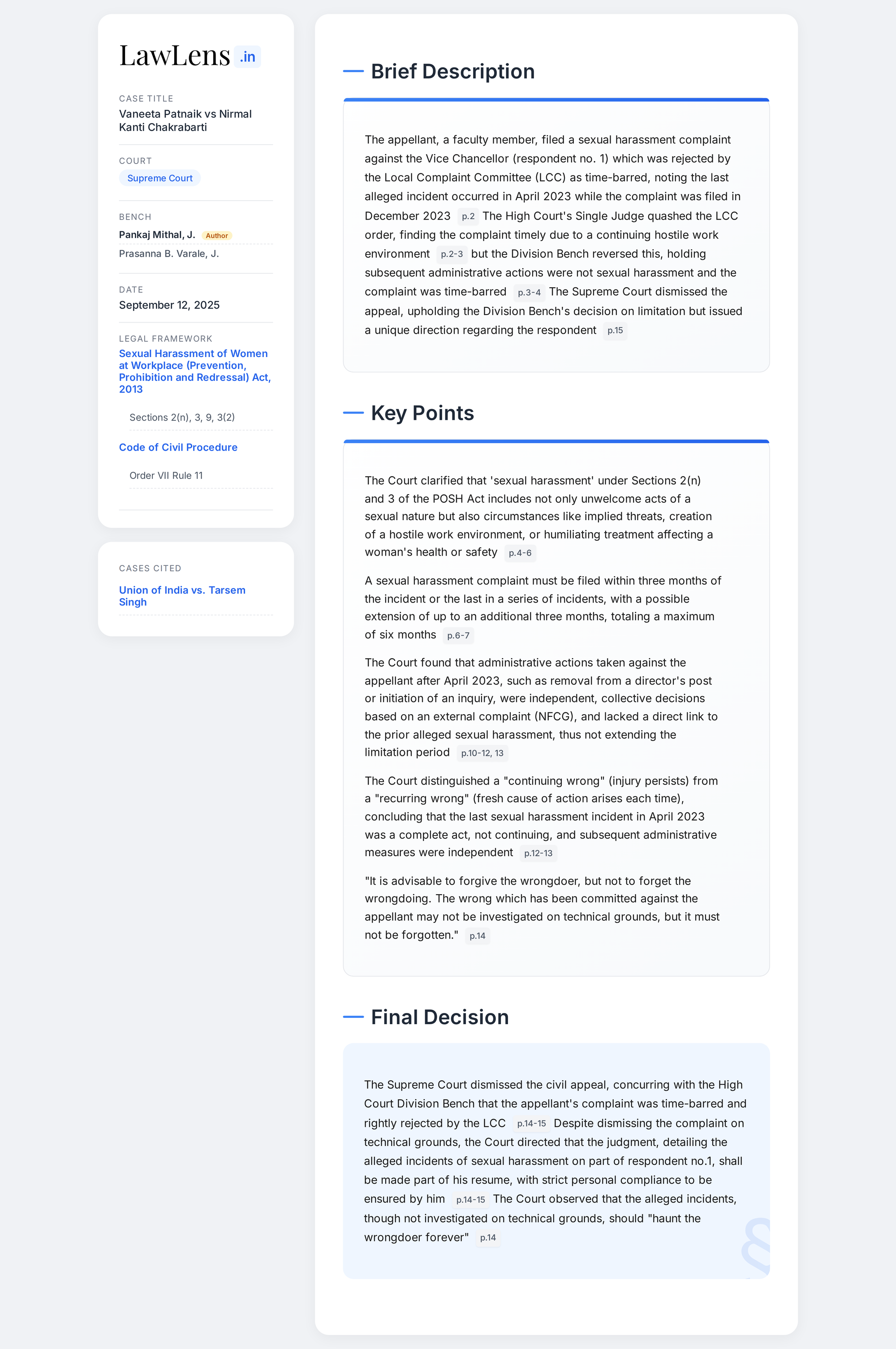
Sexual Harassment of Women at Workplace (Prevention, Prohibition and Redressal) Act, 2013 - Section 9- A complaint of sexual harassment is mandatorily required to be filed within a period of three months from the date of the last incident of such harassment or within a further extended period of three months, i.e., within a maximum period of six months from the date of the last incident of sexual harassment- The issue of limitation is ordinarily a mixed question of fact and law and it may not be possible to throw out a complaint at the threshold without collecting material on the factual aspects relating to the limitation- Where a complaint on the simple reading of the averments made therein appears to be patently barred by limitation, it can be rejected at the very first instance on the analogy of Order VII Rule 11 CPC, without even calling the other side to participate in the proceedings. (Para 15)
Sexual Harassment of Women at Workplace (Prevention, Prohibition and Redressal) Act, 2013 - Section 2(n), 3 - Not only the unwelcome act or behaviour in the form of physical contact or advances, a demand or request for sexual favours, making sexually coloured remarks, showing pornography or any unwelcome physical, verbal or non-verbal conduct of sexual nature but also any other circumstances connected with the act or behaviour of sexual harassment, like implied or explicit promise of preferential treatment in employment, threat about the present and future employment status, interference with work or creating an intimidating, offensive or hostile work environment or subjecting to humiliating treatment which may likely affect her health or safety, would also amount to acts or behaviour of sexual harassment - The expressions “in relation to” or “connected with” used in Section 3(2) : The use of the above expression clearly demonstrates that there has to be a direct link between the action complained of and an overt act of sexual harassment
Limitation - Distinction between a “continuing wrong” and a “recurring wrong”- a “continuing wrong” is when the injury itself persists, whereas a “recurring wrong” is when a fresh cause of action arises each time. (Para 28)
Quotes -.It is advisable to forgive the wrongdoer, but not to forget the wrongdoing. (Para 33)
Case Info
Case Name and Neutral Citation
- Case Name: Vaneeta Patnaik v. Nirmal Kanti Chakrabarti & Ors.
- Neutral Citation: 2025 INSC 1106
Coram (Judges)
- Justice Pankaj Mithal
- Justice Prasanna B. Varale
Judgment Date
- Date: September 12, 2025
Caselaws and Citations Referred
- Union of India vs. Tarsem SinghCitation: (2008) 8 SCC 648
Statutes/Laws Referred
- Sexual Harassment of Women at Workplace (Prevention, Prohibition and Redressal) Act, 2013 (POSH Act)
- Section 2(n): Definition of sexual harassment
- Section 3: Circumstances amounting to sexual harassment
- Section 9: Limitation period for filing complaints
- Order VII Rule 11, Code of Civil Procedure (CPC)(Referenced for analogy regarding rejection of complaints at the threshold)
#SupremeCourt held that a complaint of sexual harassment under POSH Act is mandatorily required to be filed within a period of three months from the date of the last incident of such harassment or within a further extended period of three months, i.e., within a maximum period of… https://t.co/NWQr1VhUOp pic.twitter.com/Tqz29arlXM
— CiteCase 🇮🇳 (@CiteCase) September 12, 2025