State of U.P. v. Ajmal Beg 2025 INSC 1435 - Dowry Prohibition Act

You can read our notes on this judgment in our Supreme Court Daily Digests. If you are our subscriber, you should get it in our Whatsapp CaseCiter Community at about 9pm on every working day. If you are not our subscriber yet, you can register by clicking here:
Dowry Prohibition Act 1961-The Act does not distinguish between demand made prior to or after marriage- Any property or valuable security given by either party to a marriage to the other, or by any other person to the party to marriage, or to any other person, on the day of marriage, before or at any time after marriage, shall be considered to be dowry. (Para 23)
Dowry - Dowry is not a feature only amongst the Hindus, but it can also be found in other communities professing different faiths and religions. (Para 4) Although the law sought to prohibit the practice, dowry has persisted in society, slipping through the statutory definition, cloaked as “gifts” and social expectations. This practice is, at the most basic level, at odds with the values enshrined in the Constitution, i.e., the constitutional ethos of justice, liberty, and fraternity, and more particularly, Article 14, which guarantees equality before the law and equal protection of the laws, a principle directly undermined by a system that treats women as a source of financial extraction and reinforces structural discrimination. (Para 7) Eliminating dowry is not only a matter of enforcing the DPA 1961 but a constitutional imperative. It fulfills the Republic’s promise that every woman should enter marriage as an equal citizen and not as the bearer of an unjust financial burden. (Para 9) Directions issued. (Para 26)
Mehr - In Islam, dowry, stricto senso, is prohibited. What is prescribed is, in fact, the reverse. ‘mehr’ is a compulsory gift that the groom is required to give to the bride at the time of marriage. It is an essential part of the nikah (marriage contract), without which the contract is considered incomplete. The mehr can take many forms - money, jewellery, property, or any valuable as agreed upon by the couple - but what defines it is that it belongs solely to the bride and cannot be taken back by the husband or his family. The purpose of mehr is both symbolic and practical: it signifies respect for the woman and ensures her financial security in the marriage. (Para 4) In many Muslim marriages in India, mehr continues to be stipulated, but often only in nominal terms. The real financial transfers flow from the bride’s family to the groom, effectively hollowing out the protective function of mehr. (Para 6)
Case Info
Key details
- Case name: State of U.P. v. Ajmal Beg etc.
- Neutral citation: 2025 INSC 1435
- Coram: Justice Sanjay Karol; Justice Nongmeikapam Kotiswar Singh
- Judgment date: December 15, 2025
Caselaws and citations
- Pawan Kumar v. State of Haryana, (1998) 3 SCC 309.
- Ashok Kumar v. State of Haryana, (2010) 12 SCC 350.
- Tarsem Singh v. State of Punjab, (2008) 16 SCC 155; (2010) 4 SCC (Cri) 27.
- Devender Singh v. State of Uttarakhand, (2022) 13 SCC 82.
- Parvati Devi v. State of Bihar, (2022) 14 SCC 500.
- Bansi Lal v. State of Haryana, (2011) 11 SCC 359; (2011) 3 SCC (Cri) 188.
- Maya Devi v. State of Haryana, (2015) 17 SCC 405; (2018) 1 SCC (Cri) 768.
- G.V. Siddaramesh v. State of Karnataka, (2010) 3 SCC 152; (2010) 2 SCC (Cri) 19.
- Aluri Venkata Ramana v. Aluri Thirupathi Rao, 2024 SCC OnLine SC 5473.
- S. Gopal Reddy v. State of A.P., (1996) 4 SCC 596.
- Surajdeo Mahto v. State of Bihar, (2022) 11 SCC 800.
- Ramaniklal Gokaldas v. State of Gujarat, (1976) 1 SCC 6.
- Nadodi Jayaraman v. State of T.N., 1992 Supp (3) SCC 161.
- Banwari Ram v. State of U.P., (1998) 9 SCC 3.
- Sohrab v. State of M.P., (1972) 3 SCC 751.
- Radha Mohan Singh v. State of U.P., (2006) 2 SCC 450.
- Hari v. State of U.P., (2021) 17 SCC 111.
- Ravasaheb v. State of Karnataka, (2023) 5 SCC 391.
- Bhagwant Singh v. Commr. of Police, (1983) 3 SCC 344.
- Enforcement and Implementation of Dowry Prohibition Act, 1961, In re, (2005) 4 SCC 565.
Statutes/laws referred
- Indian Penal Code, 1860: Section 304-B (Dowry death); Section 498-A (Cruelty).
- Indian Evidence Act, 1872: Section 113-B (Presumption as to dowry death).
- Code of Criminal Procedure, 1973: Section 313; Section 374.
- Dowry Prohibition Act, 1961: Sections 2 (Definition of “dowry”), 3 (Penalty for giving/taking dowry), 4 (Penalty for demanding dowry), 8B (Dowry Prohibition Officers).
- Constitution of India: Article 136; Article 14.
- Hindu Succession Act, 1956 (referenced in Objects and Reasons of DPA, 1961).
- Muslim Personal Law (Shariat) (referenced in DPA Section 2 exclusion for dower/mahr).
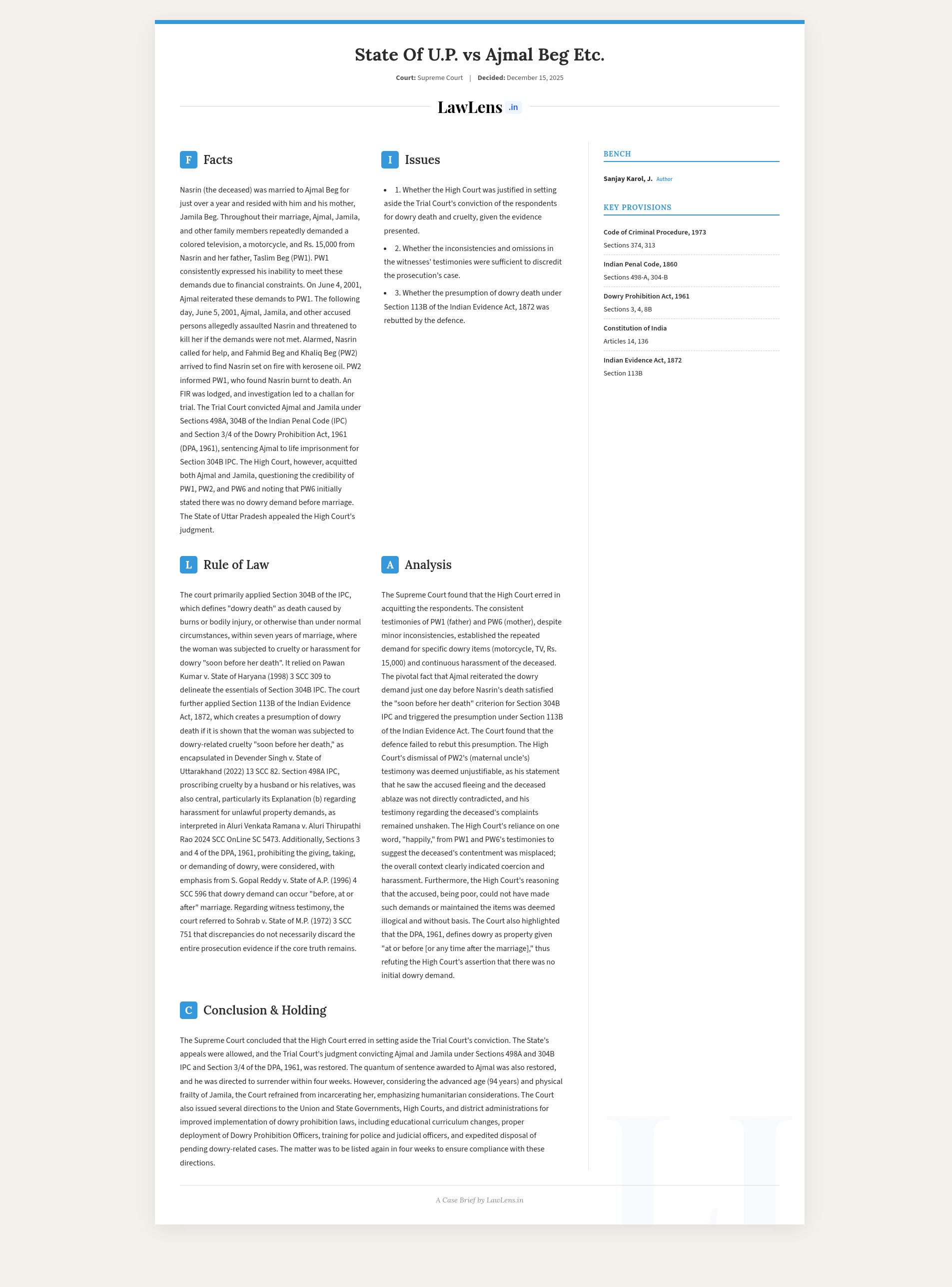
While restoring conviction of a Muslim Man in a Dowry Death Case, #SupremeCourt notes that in many Muslim marriages in India, mehr continues to be stipulated, but often only in nominal terms.
— CiteCase 🇮🇳 (@CiteCase) December 15, 2025
The real financial transfers flow from the bride’s family to the groom, effectively… https://t.co/X0aTCudL8h pic.twitter.com/TrhuAheo1s
"In Islam, dowry, stricto senso, is prohibited. What is prescribed is, in fact, the reverse. "#SupremeCourt describes the concept of ‘mehr’: https://t.co/X0aTCudL8h pic.twitter.com/VEDx9FSy6Q
— CiteCase 🇮🇳 (@CiteCase) December 15, 2025
“Every woman should enter marriage as an equal citizen and not as the bearer of an unjust financial burden." #SupremeCourt observes that the eradication of dowry is an urgent constitutional and social necessity. https://t.co/X0aTCudL8h pic.twitter.com/U47cxm4kS1
— CiteCase 🇮🇳 (@CiteCase) December 15, 2025
When #SupremeCourt summarized facts in a dowry death case. https://t.co/X0aTCudL8h pic.twitter.com/fptLDw3jFf
— CiteCase 🇮🇳 (@CiteCase) December 15, 2025
#SupremeCourt on present day Dowry Practices based on “groom price theory”: https://t.co/X0aTCudL8h pic.twitter.com/LoXvQYSi4N
— CiteCase 🇮🇳 (@CiteCase) December 15, 2025