Singamasetty Bhagavath Guptha v. Allam Karibasappa (D) 2025 INSC 1159 - CPC - First Appeal - Provincial Insolvency Act

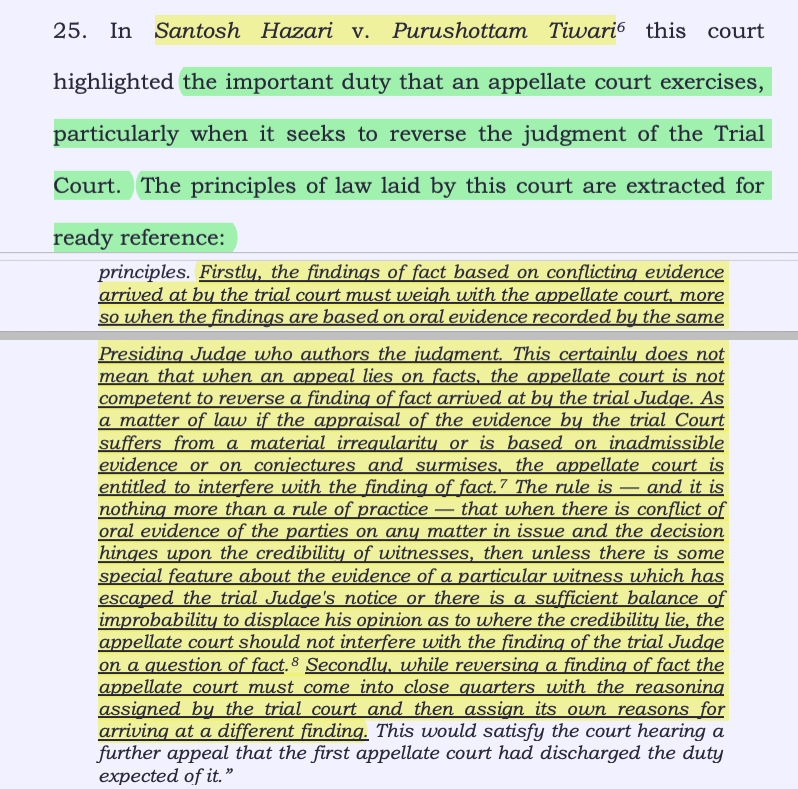
Code of Civil Procedure 1908 - Section 96 - Important duty that an appellate court exercises, particularly when it seeks to reverse the judgment of the Trial Court -Quoted from Santosh Hazari v. Purushottam Tiwari: Firstly, the findings of fact based on conflicting evidence arrived at by the trial court must weigh with the appellate court, more so when the findings are based on oral evidence recorded by the same Presiding Judge who authors the judgment. This certainly does not mean that when an appeal lies on facts, the appellate court is not competent to reverse a finding of fact arrived at by the trial Judge. As a matter of law if the appraisal of the evidence by the trial Court suffers from a material irregularity or is based on inadmissible evidence or on conjectures and surmises, the appellate court is entitled to interfere with the finding of fact. The rule is — and it is nothing more than a rule of practice — that when there is conflict of oral evidence of the parties on any matter in issue and the decision hinges upon the credibility of witnesses, then unless there is some special feature about the evidence of a particular witness which has escaped the trial Judge's notice or there is a sufficient balance of improbability to displace his opinion as to where the credibility lie, the appellate court should not interfere with the finding of the trial Judge on a question of fact. Secondly, while reversing a finding of fact the appellate court must come into close quarters with the reasoning assigned by the trial court and then assign its own reasons for arriving at a different finding.
Provincial Insolvency Act, 1920 - Section 37 - It is only upon a conclusion that the transactions and orders of the court and the receiver are valid and attained finality that the property shall not revert to the debtor upon annulment of adjudication under Section 37 of the Act - For operation of Section 37, it is fundamental that there must in fact be a finality of transactions. In other words, there must be conclusion of sales, dispositions of property and/or the payments made in that regard. Section 37 proceedings cannot partake the character of a civil court deciding a suit for specific performance of an agreement. (Para 17,18, 22)
Case Info
Case Name and Neutral Citation
- Case Name: Singamasetty Bhagavath Guptha & Anr. v. Allam Karibasappa (D) by LRs./Allam Doddabasappa (D) by LRs. & Ors.
- Neutral Citation: 2025 INSC 1159
Coram
- Justices: Pamidighantam Sri Narasimha and Atul S. Chandurkar
Judgment Date
- Date: September 25, 2025
Caselaws and Citations Referred
- Babu Ram alias Durga Prasad v. Indra Pal Singh
- Citation: (1998) 6 SCC 358
- Arora Enterprises Ltd. v. Indubhushan Obhan
- Citation: (1997) 5 SCC 366
- Santosh Hazari v. Purushottam Tiwari
- Citation: (2001) 3 SCC 179
- Madhusudan Das v. Narayanibai
- Citation: (1983) 1 SCC 35
- Sarju Pershad Ramdeo Sahu v. Jwaleshwari Pratap Narain Singh
- Citation: AIR 1951 SC 120
Statutes/Laws Referred
- Provincial Insolvency Act, 1920
- Section 4
- Section 5
- Section 35
- Section 37
- Section 43
- Section 55
- Code of Civil Procedure, 1908
- Section 151
- Section 144
- Section 94
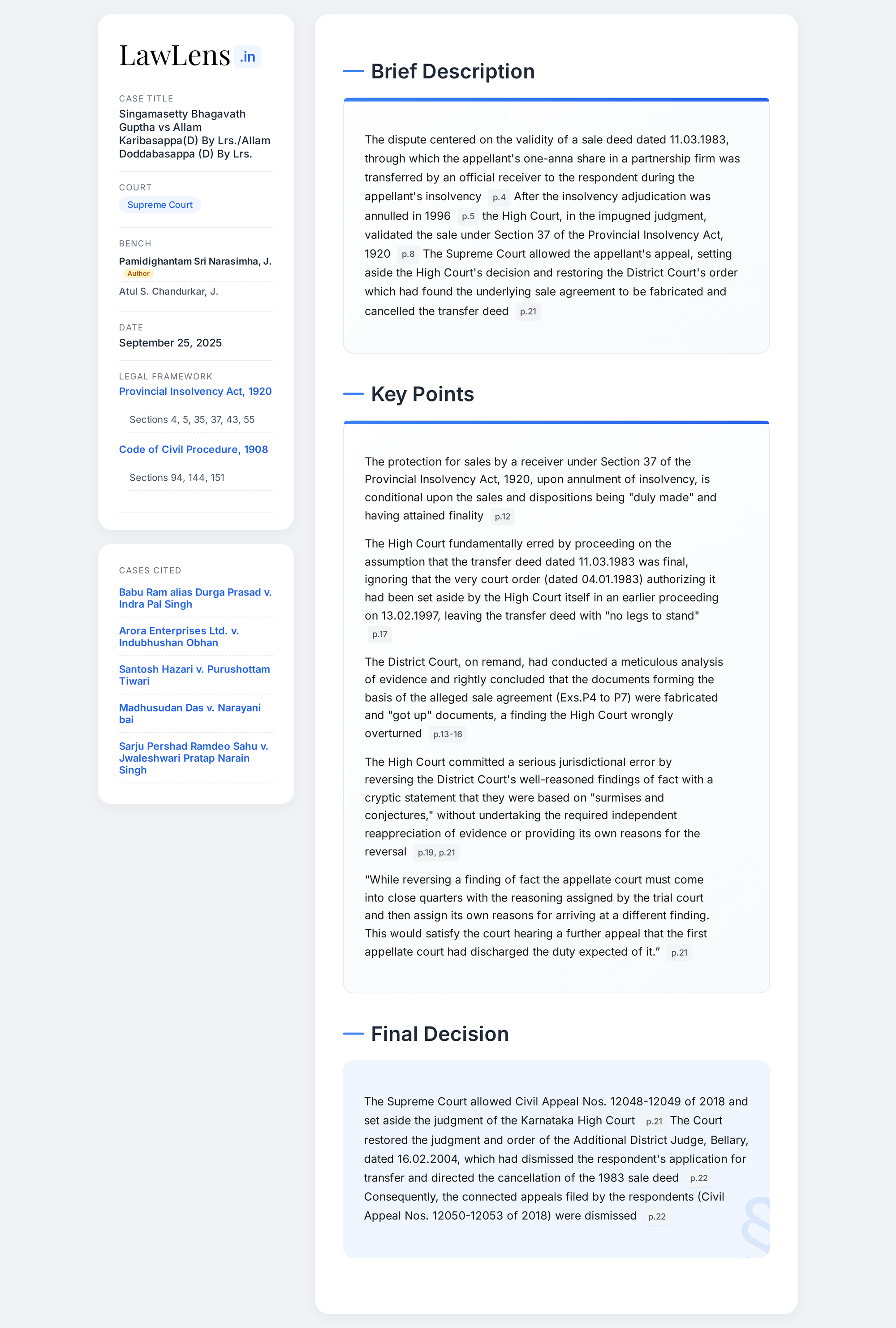
#SupremeCourt on important duty of Appellate Court when it seeks to reverse Trial Court judgment: https://t.co/zkv7SReyfK pic.twitter.com/1zhW55uSdn
— CiteCase 🇮🇳 (@CiteCase) September 26, 2025
 LIVELAW NEWS NETWORK