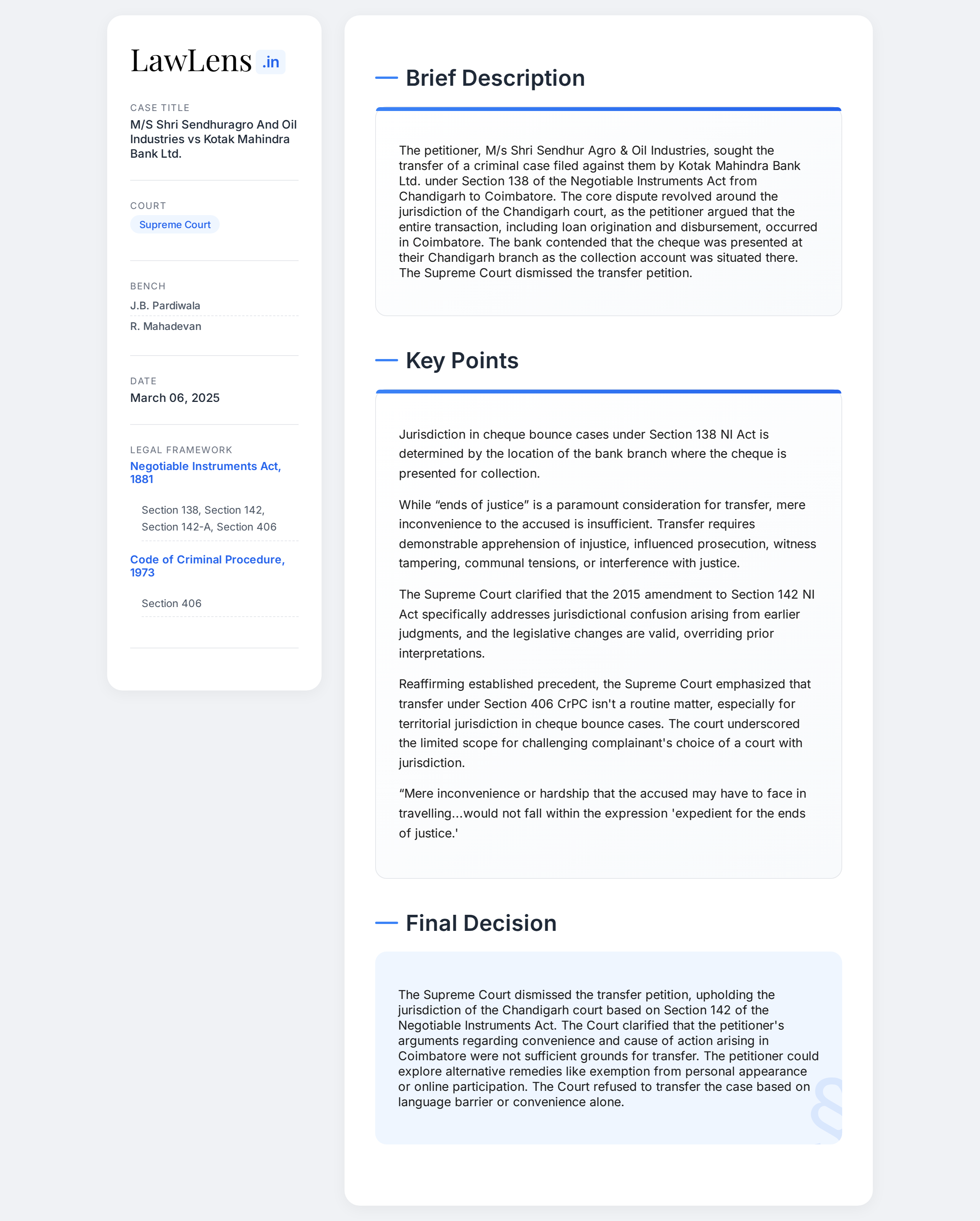
Shri Sendhur Agro & Oil Industries vs Kotak Mahindra Bank Ltd. 2025 INSC 328 - S. 142 NI Act - S. 406 CrPC - Transfer Petition

Code Of Criminal Procedure 1973 - Section 406 ; Negotiable Instruments Act 1881 - Section 138, 142- Section 142 of the N.I. Act in clear terms, provides the complainant with the right to lodge a complaint, before a court, within whose jurisdiction, the branch of the bank where the cheque is delivered for collection, is situated. Therefore, the argument that another court might also be empowered to take cognizance of the matter under Section 142, since the cause of action arose within that jurisdiction, cannot by itself be a ground for seeking transfer under Section 406 of the Cr.P.C. (Para 55)
Negotiable Instruments Act 1881 - Section 138, 142- The complainant can file a complaint before the courts within whose jurisdiction the collection branch of the bank falls (para 63) - The word ‘delivered’ used in Section 142(2)(a) of the N.I. Act has no significance. What is of significance is the expression ‘for collection through an account’- The delivery of the cheque takes place where the cheque was issued and presentation of the cheque will be through the account of the payee or holder in due course, and the said place is decisive to determine the question of jurisdiction.(Para 62)
Code Of Criminal Procedure 1973 - Section 406 - It is only the Supreme Court that has the power to transfer a case pending in a Court subordinate to one High Court to be tried by a Court subordinate to another High Court - A case is transferred by virtue of the powers under Section 406 if there is a reasonable apprehension on the part of a party to a case that justice will not be done. There, however, must be reliable material from which it can be inferred that there are impediments that are interfering or likely to interfere, either directly or indirectly, with the cause of justice.(Para 31) - Some of the broad factors which could be kept in mind while considering an application for transfer of the trial are: (i) when it appears that the State machinery or prosecution is acting hand in glove with the accused, and there is likelihood of miscarriage of justice due to the lackadaisical attitude of the prosecution; (ii) when there is material to show that the accused may influence the prosecution witnesses or cause physical harm to the complainant; (iii)comparative inconvenience and hardships likely to be caused to the accused, the complainant/the prosecution and the witnesses, besides the burden to be borne by the State exchequer in making payment of travelling and other expenses of the official and non-official witnesses; (iv)a communally surcharged atmosphere, indicating some proof of inability in holding a fair and impartial trial because of the accusations made and the nature of the crime committed by the accused; and (v) existence of some material from which it can be inferred that some persons are so hostile that they are interfering or are likely to interfere, either directly or indirectly, with the course of justice. (Para 49)- Mere inconvenience or hardship that the accused may have to face in travelling would not fall within the expression “expedient for the ends of justice”. (Para 65)
Code Of Criminal Procedure 1973 - Sections 461,462 - If an offender is tried by a Magistrate not empowered by law in that behalf, his proceedings shall be void under Section 461. Section 462 does not make the principle contained therein to have force notwithstanding anything contained in Section 461.(Para 38)
Cause of action- The whole bundle of material facts which it is necessary for the plaintiff to prove in order to entitle him to succeed in the suit.” To ascertain whether the bundle of facts give rise to the cause of action and to determine whether one or more of those facts had occurred within the territorial jurisdiction of the Court, the entire plaint needs to be looked into and taken into consideration. (Para 56)
Suggested Readings: