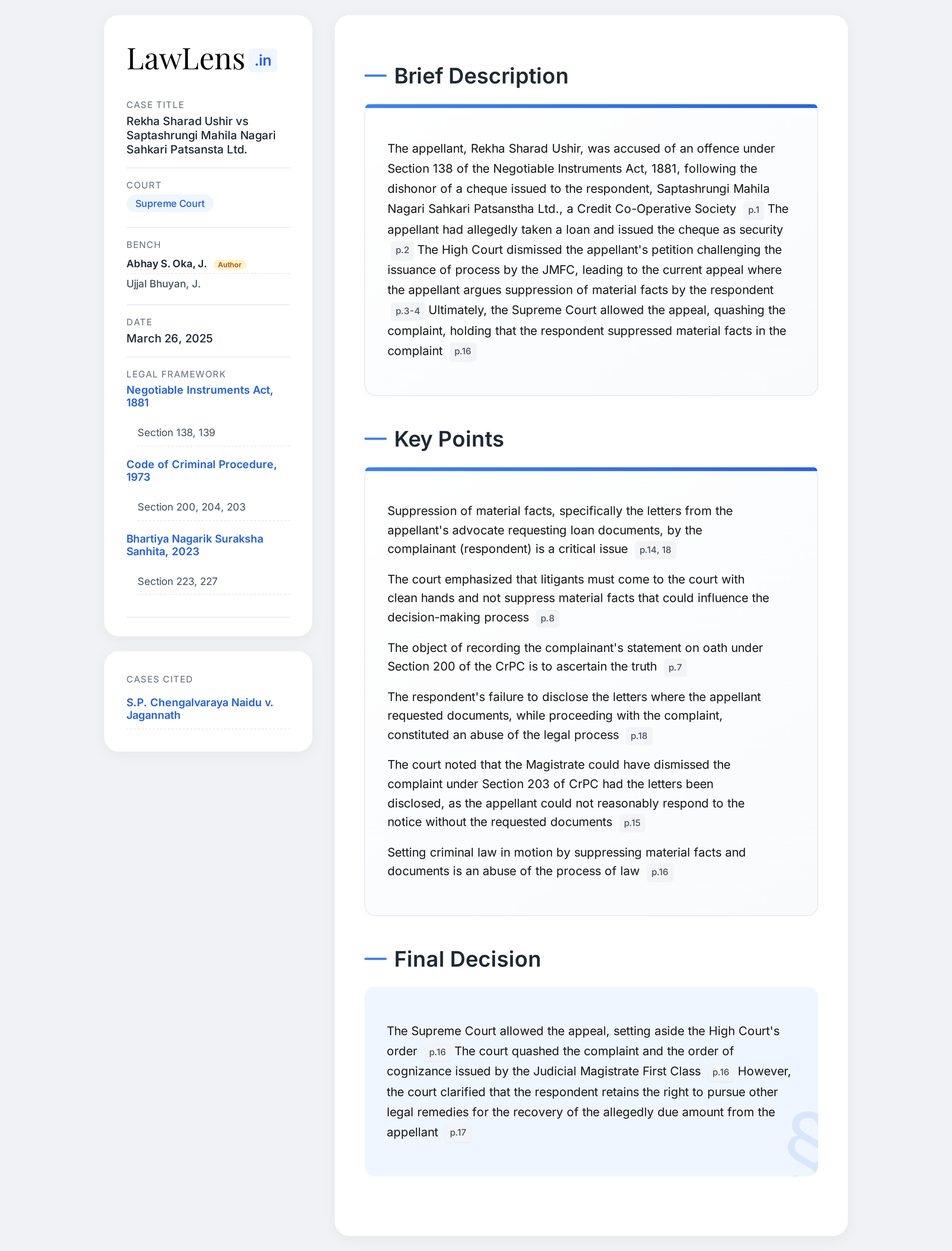
Rekha Sharad Ushir vs Saptashrungi Mahila Nagari Sahkari Patsansta Ltd. 2025 INSC 399 - S. 138 NI Act - S. 200 CrPC - Suppression Of Material Facts

Code of Criminal Procedure 1973 - Section 200 - Negotiable Instruments Act - Section 138 -While filing a complaint under Section 200 of CrPC and recording his statement on oath in support of the complaint, if the complainant suppresses material facts and documents, he cannot be allowed to set criminal law in motion based on the complaint (Para 21)- [Context: Notice issued to accused - Accused replied to notice calling upon the complainant to provide documents relied upon in the notice and that she would reply to the demand notice after receiving the documents- SC Held: Thus, this was a case where very material documents in the form of two letters addressed by the appellant were suppressed in the complaint and the statement on oath under Section 200. (Para 13-20)]
Negotiable Instruments Act - Section 138 - Firstly, the cheque has been presented to the bank within a period of six months from the date on which it is drawn or within the period of its validity, whichever is earlier. Secondly, if a cheque is returned by the bank unpaid, the payee or the holder in due course must make a demand for payment of the amount of money covered by the cheque by issuing a notice in writing within 30 days of receipt of information from the bank regarding the return of the cheque as unpaid. The third condition is that the drawer of the cheque must fail to make payment of the amount covered by the cheque within 15 days of the receipt of the notice. (Para 12)
Code of Criminal Procedure 1973 - Section 200 - Setting criminal law in motion by suppressing material facts and documents is nothing but an abuse of the process of law- Recording the complainant's statement on oath under Section 200 of the CrPC is not an empty formality. The object of recording the complainant's statement and witnesses, if any, is to ascertain the truth. The learned Magistrate is duty-bound to put questions to the complainant to elicit the truth. The examination is necessary to enable the Court to satisfy itself whether there are sufficient grounds to proceed against the accused. (Para 10)
Litigation - A litigant who, while filing proceedings in the court, suppresses material facts or makes a false statement, cannot seek justice from the court. The facts suppressed must be material and relevant to the controversy, which may have a bearing on the decision making. Cases of those litigants who have no regard for the truth and those who indulge in suppressing material facts need to be thrown out of the court. (Para 10)