Ramji Prasad Jaiswal @ Ramjee Prasad Jaiswal vs State Of Bihar 2025 INSC 738 - S. 313 CrPC - Juvenile Justice

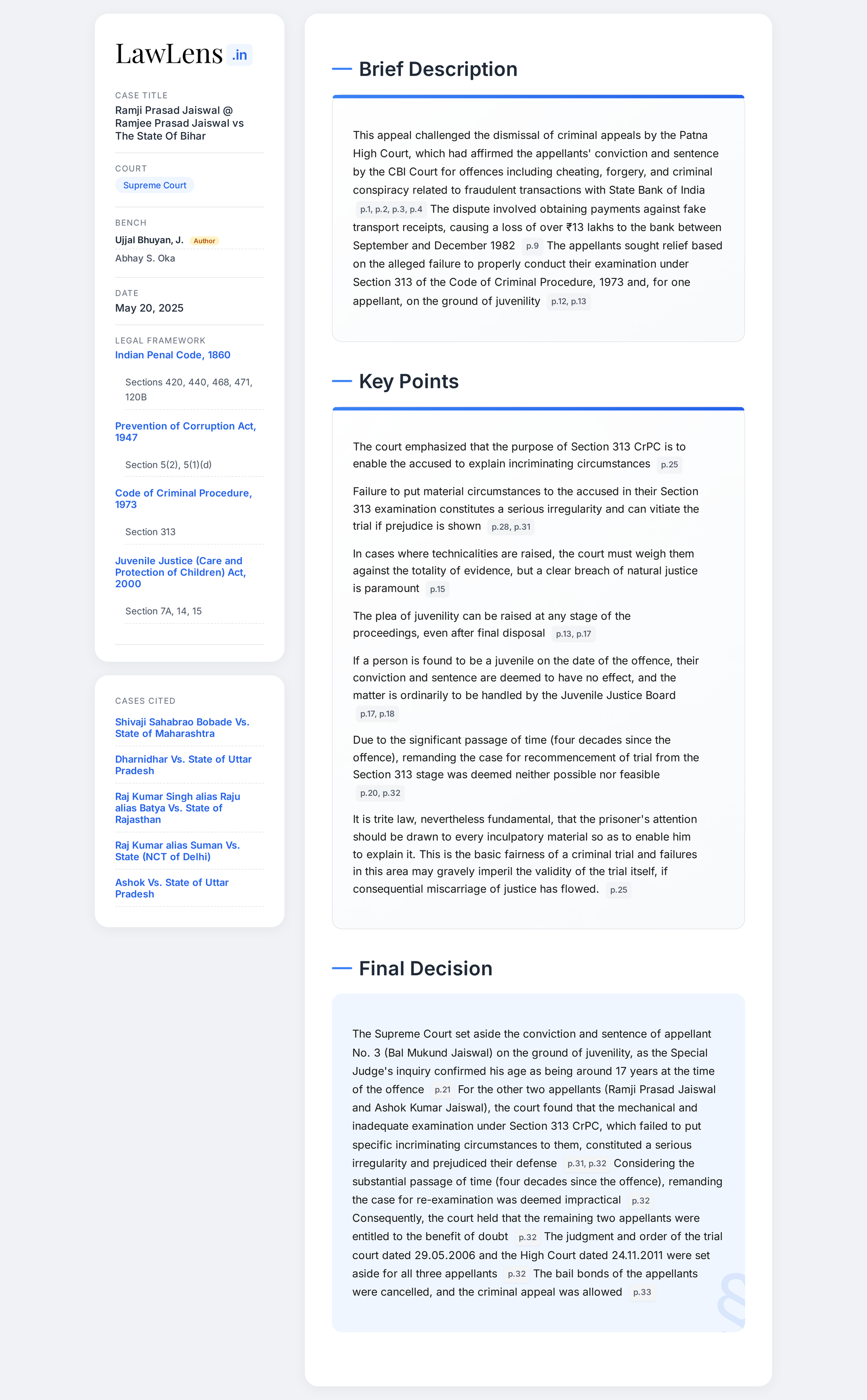
Code of Criminal Procedure 1973- Section 313 [Section 351 BNSS]- Principles discussed - Referred to Raj Kumar alias Suman Vs. State (NCT of Delhi) (2023) 17 SCC 95 , Ashok Vs. State of Uttar Pradesh (2025) 2 SCC 381. (Para 29-34) [Context: In this case, SC noticed that all the incriminating evidence were not put to the notice of the accused, it is a clear breach of Section 313 CrPC as well as the principle of audi alteram partem- SC held: Such omission, which is a serious irregularity, has completely vitiated the trial.]
Juvenile Justice (Care and Protection of Children) Act, 2000 - Section 7A - When a claim of juvenility was raised or if the court was of the opinion that a person was a juvenile on the date of commission of the offence, the court was mandated to make an inquiry and after taking such evidence as might be necessary, was mandatorily required to record a finding whether the person was a juvenile or a child or not, stating his age as nearly as possible. As per the proviso, a claim of juvenility could be raised before any court and at any stage. If upon such inquiry, court found the person to be a juvenile on the date of commission of the offence, it had to forward the juvenile to the Juvenile Justice Board for passing appropriate orders and the sentence if any, passed by a court, would be deemed to have no effect. Where a juvenile charged with an offence was produced before a Juvenile Justice Board then in terms of Section 14(1) of the JJ Act, the Juvenile Justice Board was required to hold an inquiry in accordance with the provisions of the JJ Act and make such order in relation to the juvenile as it deemed fit. If the Juvenile Justice Board found that the juvenile had committed an offence then Section 15 of the JJ Act kicked in. Under Section 15 of the JJ Act, the Juvenile Justice Board could take various steps as contemplated thereunder and under sub-section (1)(g) had the discretion to make an order directing the juvenile to be sent to a special home for a period of 3 years, which period could be reduced in an appropriate case in terms of the proviso. (Para 20-21)