Pinky Meena vs High Court Of Judicature For Rajasthan 2025 INSC 756 - Women in Judiciary - Probationer Rights

Judiciary - A greater representation of women in the judiciary, would greatly improve the overall quality of judicial decision making and this impacts generally and also specifically in cases affecting women. (Para 29) Advancing women’s greater participation in the judiciary also plays a role in promoting gender equality in broader ways: a. Female judicial appointments, particularly at senior levels, can shift gender stereotypes, thereby changing attitudes and perceptions as to appropriate roles of men and women. b. Women’s visibility as judicial officers can pave the way for women’s greater representation in other decision-making positions, such as in legislative and executive branches of government. c. Higher numbers, and greater visibility, of women judges can increase the willingness of women to seek justice and enforce their rights through the courts - The country will greatly benefit from a judicial force that is competent, committed and most importantly, diverse. (Para 30)
Probationer - Even though a probationer has no right to hold a post, it would not imply that the mandate of Articles 14 and 16 of the Constitution could be violated inasmuch as there cannot be any arbitrary or discriminatory discharge or an absence of application of mind in the matter of assessment of performance and consideration of relevant materials. Thus, in deciding whether, in a given case, a termination was by way of punishment or not, the courts have to look into the substance of the matter and not the form. (Para 26 ) The services of a probationer could result either in a confirmation in the post or ended by way of termination simpliciter. However, if a probationer is terminated from service owing to a misconduct as a punishment, the termination would cause a stigma on him. If a probationer is unsuitable for a job and has been terminated then such a case is non-stigmatic as it is a termination simpliciter. Thus, the performance of a probationer has to be considered in order to ascertain whether it has been satisfactory or unsatisfactory. If the performance of a probationer has been unsatisfactory, he is liable to be terminated by the employer without conducting any inquiry. No right of hearing is also reserved with the probationer and hence, there would be no violation of principles of natural justice in such a case. if a termination from service is not visited with any stigma and neither are there any civil consequences and nor is founded on misconduct, then, it would be a case of termination simpliciter. On the other hand, an assessment of remarks pertaining to the discharge of duties during the probationary period even without a finding of misconduct and termination on the basis of such remarks or assessment will be by way of punishment because such remarks or assessment would be stigmatic. According to the dictionary meaning, stigma is indicative of a blemish, disgrace indicating a deviation from a norm. Stigma might be inferred from the references quoted in the termination order although the order itself might not contain anything offensive. Where there is a discharge from service after prescribed probation period was completed and the discharge order contain allegations against a probationer and surrounding circumstances also showed that discharge was not based solely on the assessment of the employee’s work and conduct during probation, the termination was held to be stigmatic and punitive. (Para 24-25)


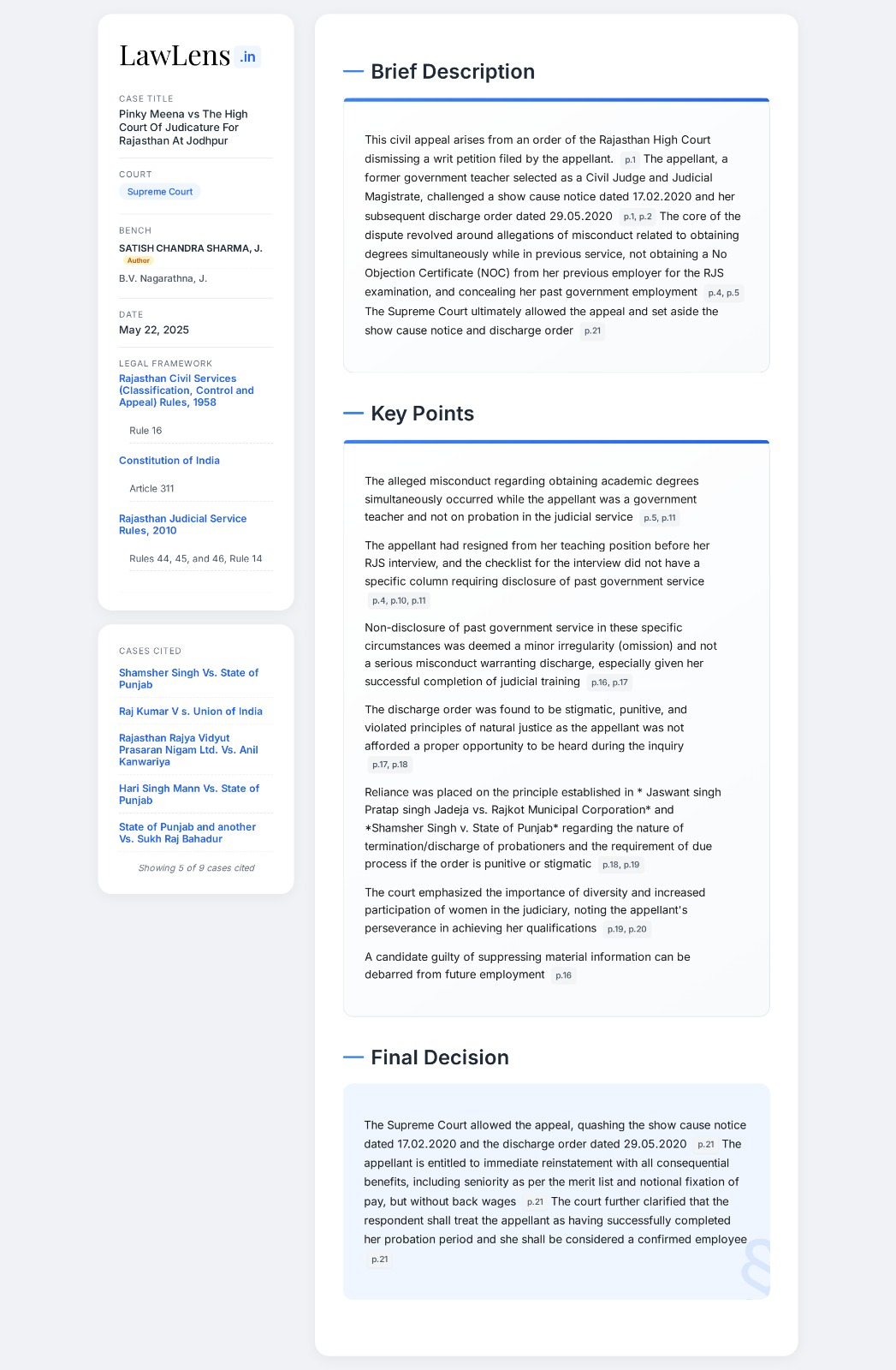
Supreme Court notes that a greater representation of women in the judiciary, would greatly improve the overall quality of judicial decision making. https://t.co/ny1thKtZ2T pic.twitter.com/TKkpjaR8mF
— CiteCase 🇮🇳 (@CiteCase) May 29, 2025