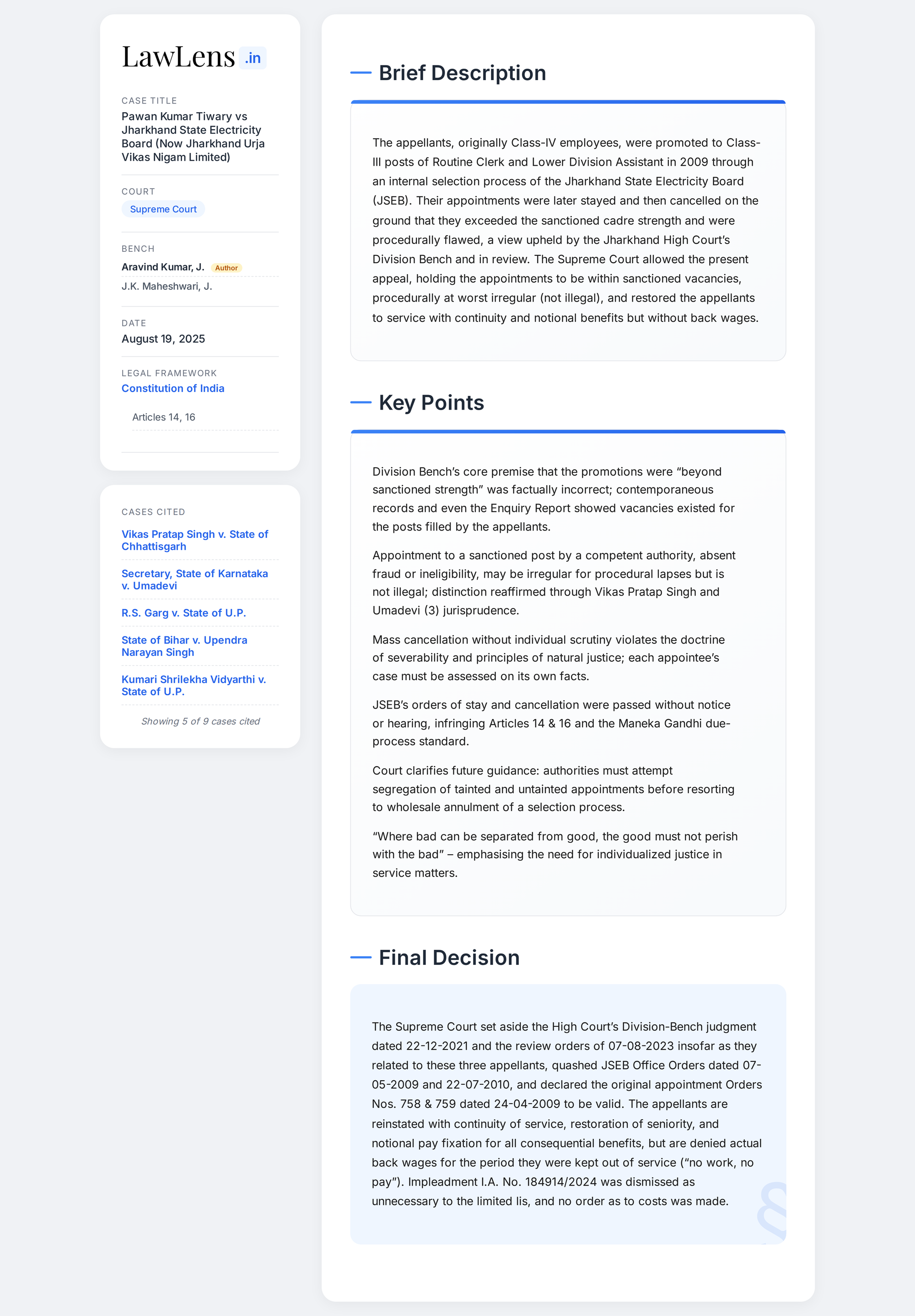
Pawan Kumar Tiwary & Ors. v. Jharkhand State Electricity Board 2025 INSC 1000 - Service - Multiple Appointment Challenge - Doctrine Of Severability

You can read our notes on this judgment in our Supreme Court Daily Digests. If you are our subscriber, you should get it in our Whatsapp CaseCiter Community at about 9pm on every working day. If you are not our subscriber yet, you can register by clicking here:
Service Law -Where multiple appointments are challenged on general grounds, authorities and courts must undertake a detailed fact-specific analysis before concluding that all such appointments are void. The doctrine of severability must guide real administrative action and judicial reasoning in service matters (Para 49) When appointments of large numbers of persons are questioned, courts and authorities must: (i) Separate the legally sustainable from the unsustainable (ii) Apply the test of eligibility and sanctioned strength (iii) Assess whether there was fraud or misrepresentation (iv) Provide an opportunity of hearing before cancellation (Para 32)- The validity of an individual appointment must be assessed on the basis of the appointee's own merit, eligibility, and conformity to the applicable rules. Courts must resist the tendency to issue blanket invalidations of entire batches of appointments merely on the basis of procedural infirmities that affect only a portion of the appointments. The principles of fairness, proportionality, and individual justice are foundational to administrative law and demand that a case-by-case analysis be undertaken before issuing sweeping orders of cancellation- when appointments are found to be irregular, the inquiry must focus on whether such irregularity amounts to illegality, and whether the appointee had any role or knowledge of the deviation. If not, and the appointee was otherwise eligible, qualified, and appointed against a sanctioned vacancy, there is no justification for nullifying such appointment. (Para 24-25) An irregular appointment is one where procedure is not strictly followed but the appointee is otherwise qualified and the post is sanctioned. An illegal appointment, on the other hand, is void ab initio, such as where the appointee is ineligible or the post does not exist. When appointments are questioned on grounds of irregularity, the inquiry must not end with detecting the infirmity but must proceed further to distinguish those whose appointments are unimpeachable. Justice demands separation, not erasure. (Para 31) Referred to State of West Bengal v. Baishakhi Bhattacharyya (Chatterjee): The Baishakhi principle rightly recognizes that where the recruitment process is irredeemably marred by pervasive fraud or institutional malaise, the Court may be compelled albeit reluctantly to nullify the entire selection process in the larger interest of constitutional integrity. In such cases, exception to the principle of natural justice would not lead to potential injustice to untainted candidates and the necessity of maintaining public confidence in institutional processes ought to take precedence. (Para 40-41)
Doctrine of severability - The rule is grounded in equity and legal logic: where bad can be separated from good, the good must not perish with the bad– The doctrine is not merely a tool of constitutional adjudication but a principle of fairness. In service law, it protects deserving employees from the fallout of administrative missteps not attributable to them. (Para 26,27)
Constitution of India - Article 14,16 - The right to employment, though not a fundamental right, is nevertheless protected under Article 14 and 16 of the Constitution insofar as it requires fair, just, and non-arbitrary treatment of similarly situated individuals. (Para 30)
Service Law - Seniority and other service benefits can be protected through notional fixation, even if back wages are not granted- The doctrine of "no work, no pay" does not preclude the grant of notional service benefits, particularly where the fault lies not with the employee but with the administration. (Para 46)
Case Info
Case Name and Neutral Citation
- Case Name: Pawan Kumar Tiwary and Others v. Jharkhand State Electricity Board (now Jharkhand Urja Vikas Nigam Limited) and Others
- Neutral Citation:
Coram (Judges)
- Justice J.K. Maheshwari
- Justice Aravind Kumar
Judgment Date
- August 19, 2025
Caselaws and Citations Referred
- Vikas Pratap Singh & Others v. State of Chhattisgarh & Others
- Citation: (2013) 14 SCC 494
- Secretary, State of Karnataka and Others v. Umadevi (3) and Others
- Citation: (2006) 4 SCC 1
- R.S. Garg v. State of U.P. and Others
- Citation: (2006) 6 SCC 430
- State of Bihar v. Upendra Narayan Singh and Others
- Citation: (2009) 5 SCC 65
- Kumari Shrilekha Vidyarthi and Others v. State of U.P. and Others
- Citation: (1991) 1 SCC 212
- Maneka Gandhi v. Union of India and Another
- Citation: (1978) 1 SCC 248
- State of West Bengal v. Baishakhi Bhattacharyya (Chatterjee) and Others
- Citation: (2025) SCC OnLine SC 719
- Union of India and Others v. K.V. Jankiraman and Others
- Citation: (1991) 4 SCC 109
- Gowramma C. (Dead) by legal representatives v. Manager (Personnel), Hindustan Aeronautical Limited and Another
- Citation: (2022) 11 SCC 794
Statutes / Laws Referred
- Article 14 and Article 16 of the Constitution of India (Equality before law and equality of opportunity in public employment)
- Principles of Natural Justice
- Standing Order No. 812 (Bihar State Electricity Board, Patna)
- Resolution No. 7305 dated 02.12.1998 (Bihar State Electricity Board, Patna)
The 1000th judgment of the #SupremeCourt of this year may be helpful for 1000s of public employment aspirants:#SupremeCourt held that that when appointments of large numbers of persons are questioned, courts and authorities must be careful and should not invalidate entire… https://t.co/UCPm3VSOKI pic.twitter.com/TTu5O1jwPk
— CiteCase 🇮🇳 (@CiteCase) August 20, 2025
#SupremeCourt’s lucid definition of Doctrine of Severability: Where bad can be separated from good, the good must not perish with the bad. https://t.co/UCPm3VSOKI pic.twitter.com/gp4rCCF0Mi
— CiteCase 🇮🇳 (@CiteCase) August 20, 2025