Life Insurance Corporation of India v. Vita; 2025 INSC 1419 - Public Premises (Eviction of Unauthorised Occupants) Act vs Rent Control Acts

You can read our notes on this judgment in our Supreme Court Daily Digests. If you are our subscriber, you should get it in our Whatsapp CaseCiter Community at about 9pm on every working day. If you are not our subscriber yet, you can register by clicking here:
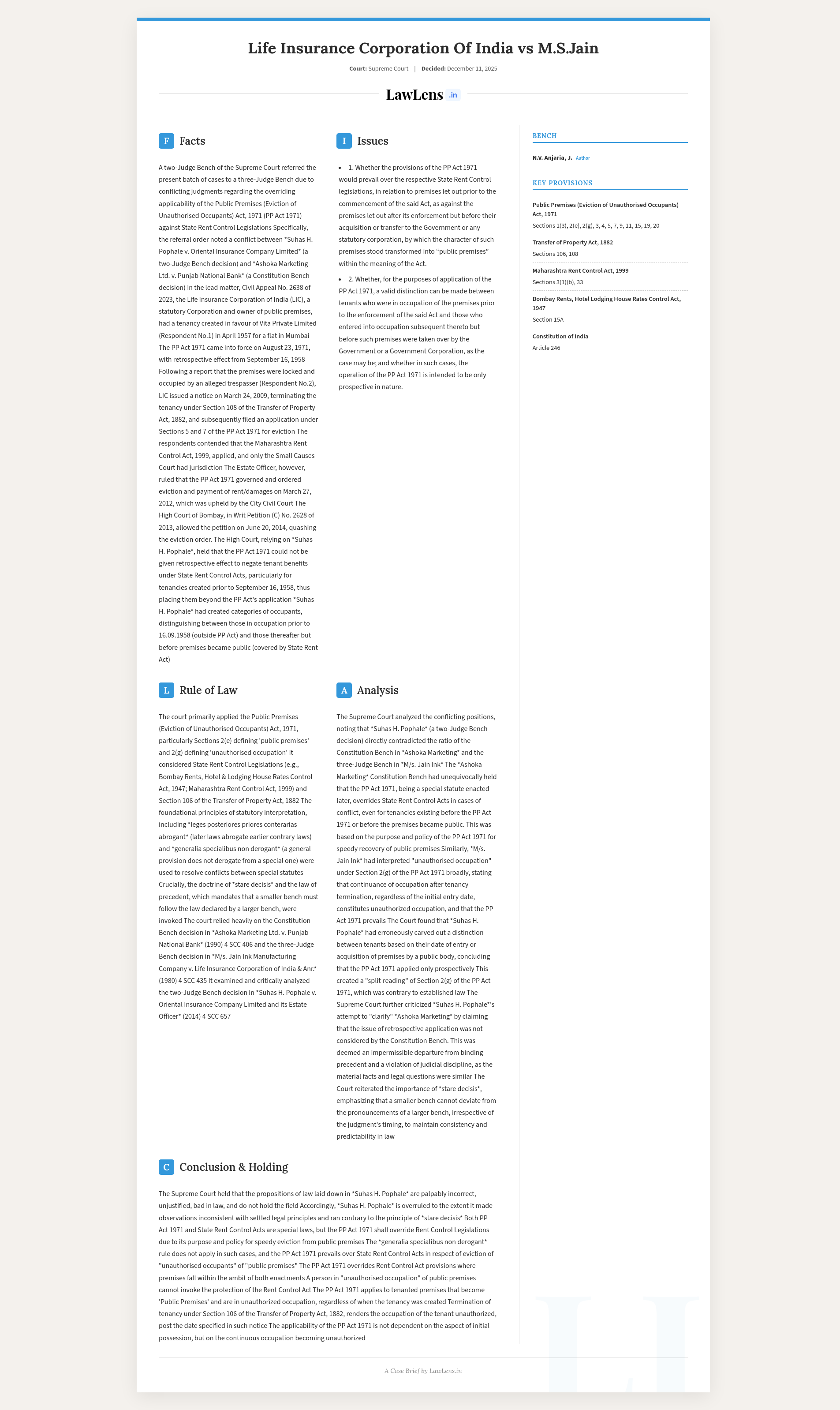
Public Premises (Eviction of Unauthorised Occupants) Act, 1971 - The provisions of the PP Act 1971 shall override the provisions in the Rent Control Legislations - The provisions of PP Act 1971, to the extent they cover the premises falling within the ambit of Rent Control Act, override the provisions of the Rent Control Act- A person in unauthorised occupation of ‘Public Premises’ under Section 2(e) of the Act cannot invoke the protection of the Rent Control Act-In cases where the tenanted premises are claimed to be governed by the State Rent Control Act and the same have also become ‘Public Premises’ within the meaning in Section 2(e) of the PP Act 1971, for their unauthorised occupation, the PP Act 1971 will have the application. (Para 13)
Public Premises (Eviction of Unauthorised Occupants) Act, 1971 -The statutory machinery envisaged under the PP Act 1971, could be activated for recovery of possession of public premises by any Government or public entity mentioned in the definition-The PP Act 1971 will apply to the tenancies which may have been created and in existence either before coming into force of the Act or which may have been created subsequent to coming into the force of the Act-Two conditions must be satisfied for the applicability as above. Firstly, the tenanted premises must fall within the purview of definition under Section 2(e) of the PP Act 1971. Secondly, the premises should have been in unauthorised occupation-Termination of tenancy of ‘Pubic Premises’ by issuing notice under Section 106 of the Transfer of Property Act, 1882 is one of the modes which would render the occupation of the tenant unauthorised, post the date specified in such notice. This would hold true in respect of tenancies created before or after coming into force of the PP Act 1971-Invocation and applicability of the provisions of the PP Act 1971 is not dependent upon the aspect of possession. What is material is the occupation of the premises which has become unauthorised occupation. The occupation is a continuous concept. (Para 13)
Precedent -The precedential value is determined by virtue of the hierarchical position or the number of Judges delivering the judgment (Para 10.1). The ratio decidendi by the Bench of larger strength is binding on the Bench of the smaller strength, irrespective of the fact whether the judgment by the Bench of the larger strength is apriori or posterior, in point of time - A Bench of the smaller strength cannot mark a departure from the decision of the Bench of larger strength, so as to vary the ratio of the Bench of larger strength, in guise of explaining the decision of the larger Bench. (Para 12) Not following the law laid down by larger Bench under the cloak of a purported exercise of clarification, cannot be countenanced (Para 8.2)- Doctrine of Stare Decisis- The doctrine of stare decisis embodies the foundational principle that precedents must be observed with institutional fidelity, not merely by the High Courts or subordinate courts, but by this Court as well. It enjoins that a Bench of lesser or coequal strength must follow the law declared by a larger Bench, in recognition of the binding authority of such pronouncements. This adherence to precedent is not a matter of mere formality, but of judicial discipline and constitutional propriety. The underlying purpose for respecting and following the decisions of the Bench consisting of greater number of Judges and even of the Bench of co-equal strength, is part of judicial discipline. It ensures certainty, predictability and dependability in the operation and application of law. (Para 10)
Interpretation of Statutes - When both statues are special laws,Rule generalia specialibus non derogant will not apply- In order to determine as to which Act will apply in case of conflict, reference has to be made to the purpose and policy underlying the two enactments and the clear intendment conveyed by the language of the relevant provisions therein. (Para 13)
Case Info
Case Details
- Case name: Life Insurance Corporation of India & Anr. versus Vita
- Neutral citation: 2025 INSC 1419
- Coram: Justice Vikram Nath; Justice Sandeep Mehta; Justice N.V. Anjaria
- Judgment date: December 11, 2025
Caselaws and Citations
- Ashoka Marketing Ltd. & Another v. Punjab National Bank & Ors., 1990 (4) SCC 406
- Suhas H. Pophale v. Oriental Insurance Co. Ltd. & its Estate Officer, 2014 (4) SCC 657
- Kaiser-i-Hind Pvt. Ltd. & Anr. v. National Textile Corpn. (Maharashtra North) Ltd. & Ors., (2002) 8 SCC 182
- M/s. Jain Ink Manufacturing Co. v. Life Insurance Corporation of India & Anr., (1980) 4 SCC 435
- Shri Ram Narain v. Simla Banking & Industrial Co. Ltd., AIR 1956 SC 614
- Mattulal v. Radhe Lal, (1974) 2 SCC 365
- General Manager, Telecom v. A. Srinivasa Rao & Ors., (1997) 8 SCC 767
- Sub-Divisional Inspector of Post v. Theyyam Joseph, (1996) 8 SCC 489
- Bangalore Water Supply & Sewerage Board v. A. Rajappa, (1978) 2 SCC 213
- Bombay Telephone Canteen Employees’ Assn. v. Union of India, (1997) 6 SCC 723
Statutes/Laws Referred
- Public Premises (Eviction of Unauthorised Occupants) Act, 1971
- Life Insurance Corporation Act, 1956
- Banking Companies (Acquisition and Transfer of Undertakings) Act, 1970
- Bombay Rents, Hotel & Lodging House Rates Control Act, 1947
- Maharashtra Rent Control Act, 1999
- Delhi Rent Control Act, 1958
- Transfer of Property Act, 1882 (Sections 106, 108)
- Presidency Small Cause Courts Act, 1882 (Section 41)
- Companies Act, 2013 (Section 2(20), Section 3 referenced)
- Metro Railway (Operation and Maintenance) Act, 2002 (Section 2(1)(i))
- Major Port Trusts Act, 1963
- Punjab Reorganisation Act, 1966 (Sections 79, 80)
- Cantonments Act, 1924
- New Delhi Municipal Council Act, 1994
- Delhi Municipal Corporation Act, 1957
- Enemy Property Act, 1968
- Constitution of India (Article 246; Seventh Schedule Entries 6, 7, 13, 32, 46)
#BREAKING #SupremeCourt holds that the Public Premises (Eviction of Unauthorised Occupants) Act overrides the provisions in the Rent Control Legislations.
— CiteCase 🇮🇳 (@CiteCase) December 11, 2025
This means that, a person in unauthorised occupation of ‘Public Premises’ under PP Act cannot invoke the protection of the… https://t.co/Hs6guk19lT pic.twitter.com/3iO7FUgs2m
Doctrine of Stare Decisis is too settled in law that many judges breach it 😇 https://t.co/Hs6guk19lT pic.twitter.com/pJ8vH6mSyz
— CiteCase 🇮🇳 (@CiteCase) December 11, 2025
Tell us, has any #SupremeCourt judgment accused an earlier bench of judicial indiscipline/impropriety for not following the mandate of law of precedent? https://t.co/Hs6guk19lT pic.twitter.com/bb52FwWJpt
— CiteCase 🇮🇳 (@CiteCase) December 11, 2025