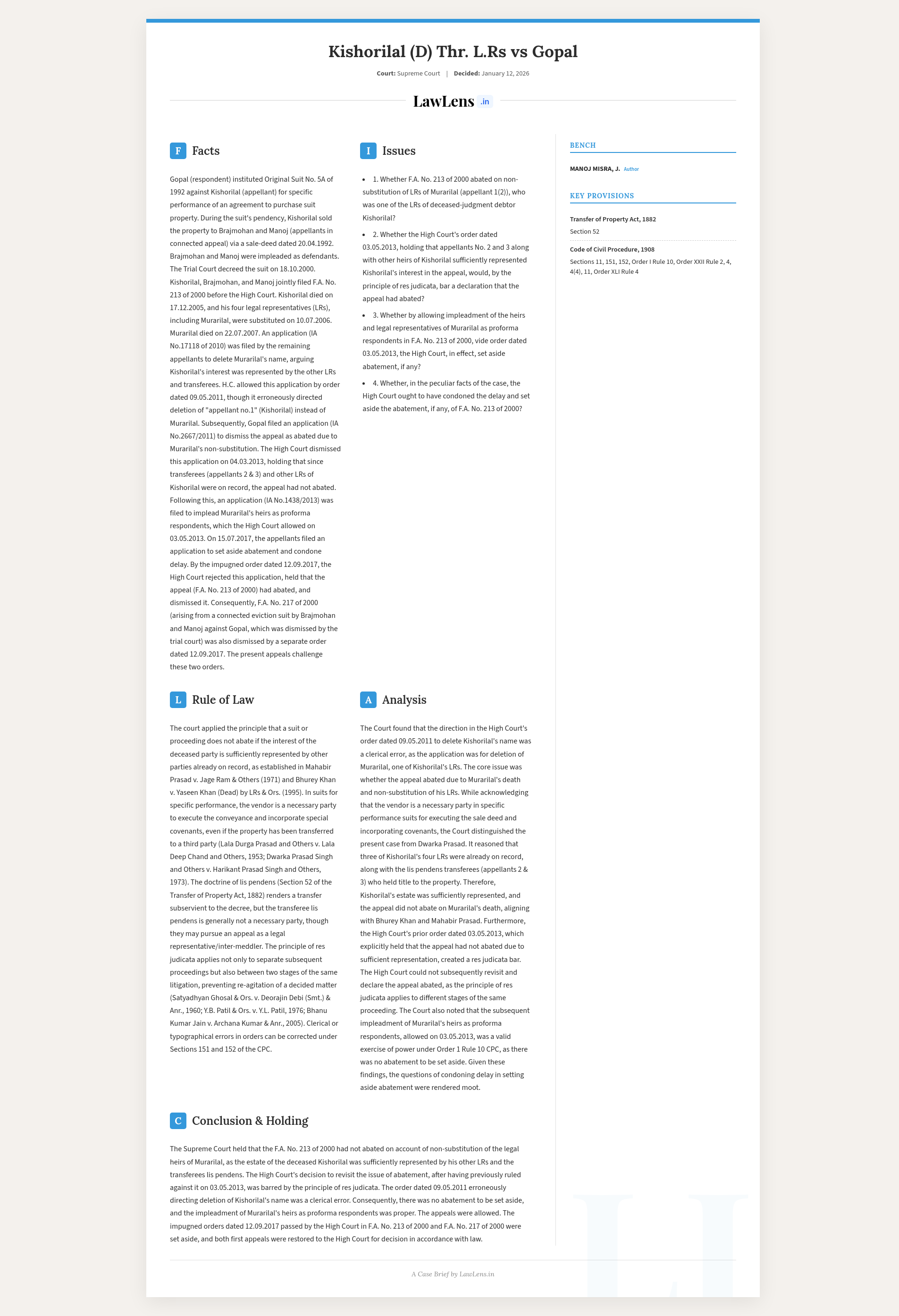
Kishorilal (D) v. Gopal 2026 INSC 48 - CPC - Abatement - Specific Performance Suit - Res Judicata - Lis Pendens

You can read our notes on this judgment in our Supreme Court Daily Digests. If you are our subscriber, you should get it in our Whatsapp CaseCiter Community at about 9pm on every working day. If you are not our subscriber yet, you can register by clicking here:
Code of Civil Procedure, 1908: Order XXII - Abatement- Before declaring a suit or proceeding to have abated on ground of non-substitution of the heirs/ legal representatives of a deceased party, the Court must examine whether the interest of the deceased party qua the subject matter of the proceeding is sufficiently represented by other parties already on record. If the interest of the deceased party is sufficiently represented by other parties already on record, and the decree/order eventually passed in the suit or proceeding would not be rendered non-executable for absence of that party, the suit or proceeding would not abate. (Para 38(1))
Specific Performance Suit- In a suit for specific performance of an agreement for sale of an immovable property, vendor is a necessary party notwithstanding he has transferred his interest in the property to a third party. As a sequitur, a suit or an appeal emanating from such a suit would abate if, upon death of the vendor, his legal heirs/ representatives are not substituted. (Para 38(2))
Transfer of Property Act 1882- Section 52 - Lis Pendens - Though a transfer lis pendens is not always void, such transferee’s title is subservient to the decree that may ultimately be passed in the pending suit. (Para 38(3))
Code of Civil Procedure, 1908 - Order I- A transferee lis pendens is not a necessary party in a suit for specific performance. (Para 38(3))
Code of Civil Procedure, 1908 - Order I- A transferee lis pendens may pursue the appeal against a decree of specific performance against the vendor, as a legal representative/ inter-meddler of the estate of the vendor- The vendor would have to be impleaded as a party in the appeal and on his death, on non-substitution of his heirs /legal representatives, the appeal would abate. (Para 38(4))
Code of Civil Procedure, 1908: Order I Rule 10- Specific Performance Suit - the vendor is a necessary party in a suit for specific performance of an agreement for sale, notwithstanding that vendor has transferred his interest in the subject matter of the agreement to a third party. Reason being that the transferee/ third party cannot be subjected to special covenants, if any, between the vendor and the plaintiff-purchaser. Besides that, the object of the decree of specific performance is to put the person who has agreed to purchase the property in the same position which he would have obtained in case the contracting parties i.e., vendor and the purchaser had, pursuant to the agreement, executed a deed of sale and completed it in every way.
Res Judicata -The principle applies also as between two stages in the same litigation to the extent that a court, whether the trial court or a higher court having at an earlier stage decided a matter in one way will not allow the parties to reagitate the matter again at a subsequent stage of the same proceedings. However, what is important is that this does not preclude the appellate court or a higher court to test the correctness of that decision. (Para 31)
Summary
Case Background
- Initial Suit: Gopal (respondent) filed a suit against Kishorilal for specific performance regarding property that Kishorilal had sold lis pendens to Brajmohan and Manoj (appellants).
- Lower Court Decision: The trial court decreed the suit in favor of Gopal in 2000.
- Death of Parties: During the first appeal, Kishorilal died and was substituted by four legal heirs (LRs), including his son Murarilal.Later, Murarilal also died.
- High Court Ruling: The High Court eventually dismissed the appeal as abated, concluding that because Murarilal's heirs were not substituted within the limitation period, the entire appeal lapsed.
Key Issues and Legal Questions
The Supreme Court examined whether the non-substitution of one heir (Murarilal) caused the entire appeal to abate, especially since other heirs of the original vendor were already on record.
Supreme Court’s Findings
1. Sufficient Representation (No Abatement)
The Court held that the appeal did not abate. It clarified a distinction between:
- Total non-substitution of a deceased party's LRs. 9
- Non-substitution of just one heir when others are already on record. Because three other heirs of Kishorilal and the lis pendens purchasers (who represent the estate as intermeddlers) were present, the estate was sufficiently represented.
2. Res Judicata within the Same Proceeding
The Court noted that the High Court had previously passed orders (in 2013) stating the appeal had not abated and allowing impleadment.Under the principle of res judicata, the High Court could not later revisit and reverse this decision at a subsequent stage of the same litigation.
3. Necessary Parties in Specific Performance
The Court reaffirmed that in specific performance suits:
- The vendor is a necessary party because they must execute the sale deed to fulfill contractual covenants.
- While the lis pendens purchaser is not strictly necessary, they are bound by the decree.
Final Conclusion
The Supreme Court set aside the High Court's dismissal, ruling that the direction to delete Kishorilal was a mere typographical error and that the estate remained protected by the surviving heirs on record. Both related appeals were restored to the High Court for a decision on their merits.
Would you like me to draft a more detailed breakdown of the specific precedents cited by the Court in this judgment?
Case Info
Kishorilal (D) Thr. L.Rs & Ors. v. Gopal & Ors., 2026 INSC 48; Coram: Manoj Misra & Ujjal Bhuyan, JJ; Judgment date: January 12, 2026.
Case name and neutral citation: Kishorilal (D) Thr. L.Rs & Ors. v. Gopal & Ors., 2026 INSC 48.
Coram: Manoj Misra, J.; Ujjal Bhuyan, J.
Judgment date: January 12, 2026.
Caselaws and citations:
- Lala Durga Prasad v. Lala Deep Chand, (1953) 2 SCC 509.
- R.C. Chandiok v. Chuni Lal Sabharwal, (1970) 3 SCC 140.
- Dwarka Prasad Singh v. Harikant Prasad Singh, (1973) 1 SCC 179.
- Satyadhyan Ghosal v. Deorajin Debi, 1960 SCC OnLine SC 15; AIR 1960 SC 941.
- Maharaja Moheshur Singh v. Bengal Government, (1859) 7 MIA 283.
- Y.B. Patil v. Y.L. Patil, (1976) 4 SCC 66.
- Bhanu Kumar Jain v. Archana Kumar, (2005) 1 SCC 787.
- Mahabir Prasad v. Jage Ram, (1971) 1 SCC 265.
- Bhurey Khan v. Yaseen Khan, 1995 Supp (3) SCC 331.
- Shivshankara v. H.P. Vedavyasa Char, (2023) 13 SCC 1.
- Mohammad Arif v. Allah Rabbul Alamin, (1982) 2 SCC 455.
- K. Naina Mohamed v. A.M. Vasudevan Chettiar, (2010) 7 SCC 603.
- Mithailal Dalsangar Singh v. Annabai Devram Kini, (2003) 10 SCC 691.
- Madhukar Nivrutti Jagtap v. Pramilabai Chandulal Parandekar, (2020) 15 SCC 731.
Statutes/laws referred:
- Code of Civil Procedure, 1908: Order XXII Rules 2, 4(4), 11; Order I Rule 10; Order XLI Rule 4; Sections 151 and 152.
- Transfer of Property Act, 1882: Section 52 (lis pendens).
- Limitation Act (context of substitution/abatement timelines, not specifically section-numbered in text).