K. Purushottam Reddy vs. Union of India 2025 INSC 894 - Delimitation Notification - Andhra Pradesh - Art.170 Constitution

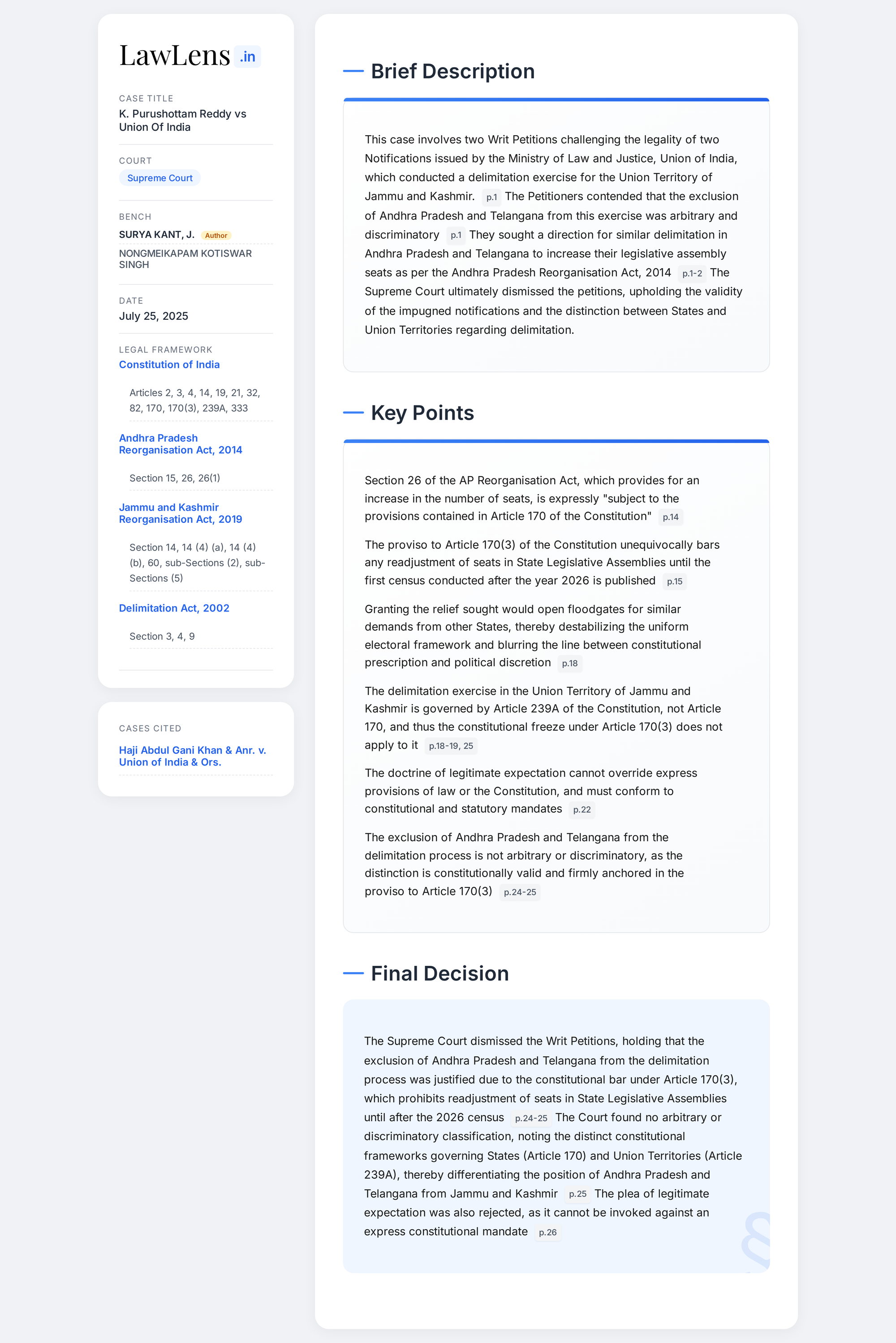
Constitution of India - Article 170- Legality of Notification Nos. SO No. 1015(E) dated 06.03.2020 (2020 Notification) - The exclusion of the States of Andhra Pradesh and Telangana from the purview of the delimitation process under the Impugned Notifications does not suffer from the vice of arbitrariness or discrimination. The proviso to Article 170 (3), which expressly bars any readjustment in the total number of seats in the Legislative Assemblies of States until the first census after the year 2026- Article 170 has no application to Union Territories, including the Union Territory of Jammu and Kashmir- The delimitation exercise carried out in Jammu and Kashmir—being governed by a distinct constitutional and statutory regime—cannot be analogically extended to States that are explicitly bound by the constitutional restraint imposed under Article 170(3). (Para 22,29) Section 26 of the AP Reorganization Act is expressly made “subject to” the mandate contained in Article 170 of the Constitution. (Para 15)
Doctrine of Legitimate Expectation - It arises when a public authority, either through a consistent past practice, an express promise, or a statutory policy, creates an expectation in the mind of an individual or class of persons that a certain course of action will be followed. While such expectation does not amount to a legal right in the strict sense, courts have consistently held that it may nonetheless warrant judicial protection where its denial results in manifest unfairness or arbitrariness, thereby violating the fundamental principles of natural justice- The doctrine of legitimate expectation cannot override an express provision of law or the Constitution- The expectation must be legitimate, in the sense that it is not only reasonable but also legally sustainable within the structure of the governing statute or constitutional scheme. In the event of any conflict between an expectation and the existing legal framework, the expectation has to run hand in hand with the legal intent and not against it. The doctrine of legitimate expectation is not a rigid rule and must be conceded where a superseding public interest or a statutory or constitutional bar exists. Thus, while legitimate expectation may guide how discretionary powers are exercised, it cannot be invoked to compel an authority to act contrary to a binding legal or constitutional command- The doctrine of legitimate expectation, while forming an integral part of the jurisprudence on fairness in administrative action, does not clothe a party with an enforceable right in itself. It operates within the bounds of legality and must necessarily conform to constitutional and statutory mandates. (Para 33-35)
Case Info
Case Name and Neutral Citation
- Case Name: K. Purushottam Reddy v. Union of India and Ors.
- Neutral Citation: 2025 INSC 894
Coram
- Justice Surya Kant
- Justice Nongmeikapam Kotiswar Singh
Judgment Date
- 25 July 2025
Caselaws and Citations
- Haji Abdul Gani Khan & Anr. v. Union of India & Ors.
- Citation: (2023) 11 SCC 432
Statutes/Laws Referred
- Constitution of India
- Article 2
- Article 3
- Article 4
- Article 14
- Article 19
- Article 21
- Article 82
- Article 170 (including clause (3) and its provisos)
- Article 239A
- Article 333
- Andhra Pradesh Reorganisation Act, 2014
- Section 15
- Section 26
- Jammu and Kashmir Reorganisation Act, 2019
- Section 14 (including sub-sections (3), (4)(a), (4)(b))
- Section 60
- Delimitation Act, 2002
- Section 3
- Sections 4 and 9
- Notifications
- SO No. 1015(E) dated 06.03.2020
- SO 1023(E) dated 03.03.2021
#SupremeCourt upholds notifications which excluded States of Andhra Pradesh and Telangana from the purview of the delimitation process. https://t.co/ffbBvviELn pic.twitter.com/xRXHiftlw2
— CiteCase 🇮🇳 (@CiteCase) July 25, 2025
#SupremeCourt reiterates that the Doctrine of Legitimate Expectation cannot be invoked to compel an authority to act contrary to a binding legal or constitutional command and it does not clothe a party with an enforceable right in itself. https://t.co/ffbBvviELn pic.twitter.com/qkUuqg4jxR
— CiteCase 🇮🇳 (@CiteCase) July 25, 2025
Suggested Readings: