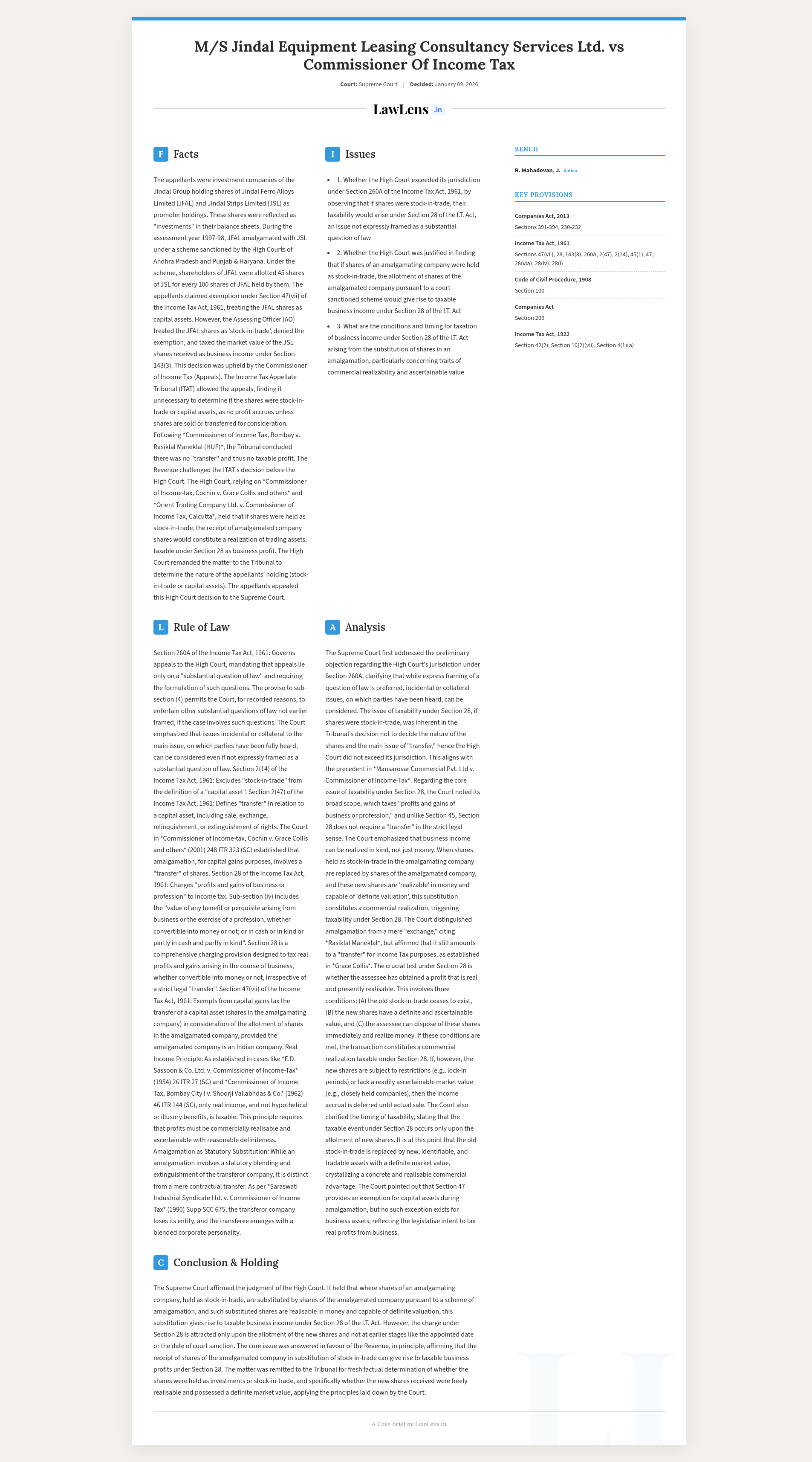
Jindal Equipment Leasing Consultancy Services Ltd v. Commissioner of Income Tax, Delhi–II, New Delhi; 2026 INSC 46- S.28 Income Tax Act - Amalgamation - Receipt Of Shares

You can read our notes on this judgment in our Supreme Court Daily Digests. If you are our subscriber, you should get it in our Whatsapp CaseCiter Community at about 9pm on every working day. If you are not our subscriber yet, you can register by clicking here:
Income Tax Act, 1961 - Section 28 - Receipt of shares of the amalgamated company in substitution of stock-in-trade can give rise to taxable business profits under Section 28.. (Para 31) -The enquiry for the Court is whether, as a result of the amalgamation, the assessee has in fact realised a profit in the commercial sense. This assessment may turn on whether: (A) The old stock-in-trade has ceased to exist in the assessee’s books; (B) The shares received in the amalgamated company possess a definite and ascertainable value; and (C) The assessee, immediately upon allotment, is in a position to dispose of such shares and realise money- If these conditions are satisfied, the substitution bears the character of a commercial realisation and the profit may be taxed under Section 28. Where, however, the allotment of shares is merely a statutory substitution mandated by the scheme of amalgamation, without yielding an immediately realisable benefit, no income can be said to accrue or be received at that stage, and taxability arises only upon the eventual sale of the shares (Para 18)
Income Tax Act, 1961 - Section 260-A -Scope - Limits higher appellate interference to questions of law, while at the same time, permitting the Court to deal with necessary or incidental questions that arise, provided reasons are recorded and parties are heard -Merely because a specific substantial question of law was not framed, it cannot be concluded that prejudice was caused to the parties, if both parties had the opportunity to address the issues in dispute. (Para 9)
Income Tax Act, 1961 -Difference between a charging provision and an exemption provision: A provision that enables the levy of tax on a particular transaction is a charging provision. Only a transaction that is covered by a charging provision is taxable. Only if the transaction is taxable can there be an exemption. (Para 12.1)
Amalgamation - Amalgamation, in corporate law, signifies the statutory blending of two or more undertakings into one. It is distinct from winding up: while the transferor company ceases to exist as a separate corporate entity, its business, assets, and liabilities are absorbed into and continue within the transferee -The transferor company ceases to exist, and the transferee emerges with a blended corporate personality, inheriting all rights and liabilities. (Para 16) Companies Act, 2013 contains no express definition of amalgamation. Amalgamation – ordinarily effected through a scheme of compromise or arrangement sanctioned by the Court or Tribunal – is founded on agreement between shareholders and creditors, but its legal effect is statutory: upon sanction, all assets, rights, and liabilities of the transferor vest in the transferee by operation of law. In other words, amalgamation is more than a mere contractual transfer; it is a statutory process of substitution. (Para 16.1)
Summary
The Supreme Court held that when shares held as stock-in-trade in an amalgamating company are replaced by shares of the amalgamated company, taxable business income under Section 28 can arise if the new shares are of definite market value and presently realisable, with taxability triggered upon allotment, not merely on the appointed or sanction date. It affirmed that Section 47(vii) exempts capital asset transfers in amalgamations, but does not shield business stock, and clarified that the High Court acted within Section 260A by remanding to determine whether the shares were capital assets or stock-in-trade, applying the real income doctrine. The Court upheld the High Court’s remand to the Tribunal to decide factual questions—nature of holding and realisability—while endorsing the legal principle that real, commercially realisable gains in kind are taxable as business profits.
Case Info
- Case name and neutral citation: M/S Jindal Equipment Leasing Consultancy Services Ltd v. Commissioner of Income Tax, Delhi–II, New Delhi; With M/S Nalwa Investment Ltd; M/S Abhinandan Tradex Ltd; M/S Mansarover Tradex Ltd. Neutral citation: 2026 INSC 46.
- Coram: J.B. Pardiwala, J. and R. Mahadevan, J.
- Judgment date: January 09, 2026.
- Caselaws and citations referred:
- Commissioner of Income Tax, Bombay v. Rasiklal Maneklal (HUF) (1989) 177 ITR 198; (1989) 2 SCC 454.
- Commissioner of Income-tax, Cochin v. Grace Collis (2001) 248 ITR 323 (SC); (2001) 3 SCC 430.
- Orient Trading Company Ltd. v. Commissioner of Income Tax, Calcutta (1997) 224 ITR 371 (SC); (1997) 3 SCC 340.
- Shiv Raj Gupta v. Commissioner of Income-Tax, Delhi (2020) 425 ITR 420 (SC).
- Vania Silk Mills P. Ltd v. Commissioner of Income-Tax (1991) 191 ITR 647 (SC).
- Commissioner of Income-Tax, Andhra Pradesh v. Motors & General Stores (P) Ltd (1967) 66 ITR 692 (SC).
- E.D. Sassoon & Co. Ltd v. Commissioner of Income-Tax (1954) 26 ITR 27 (SC).
- Commissioner of Income Tax, Bombay City I v. Shoorji Vallabhdas & Co. (1962) 46 ITR 144 (SC).
- State Bank of Travancore v. Commissioner of Income-Tax, Kerala (1986) 158 ITR 102 (SC).
- Godhra Electricity Co. Ltd v. Commissioner of Income-Tax (1997) 225 ITR 746 (SC).
- Commissioner of Income-Tax v. Excel Industries Ltd. (2013) 358 ITR 295 (SC).
- Hindustan Lever v. State of Maharashtra (2004) 9 SCC 438.
- Royal Insurance Co. Ltd v. Stephen, 14 Tax Cases 22 (UK).
- Kanchanganga Sea Foods Ltd v. Commissioner of Income Tax (2010) 11 SCC 144.
- Commissioner of Income Tax v. T.V. Sundaram Iyengar & Sons Ltd. (1996) 222 ITR 344 (SC).
- Commissioner of Income Tax v. Meghalaya Steels Ltd (2016) 383 ITR 217 (SC).
- Commissioner of Income Tax, Delhi v. Woodward Governor India P. Ltd (2009) 312 ITR 254 (SC); (2009) 13 SCC 152.
- Saraswati Industrial Syndicate Ltd v. Commissioner of Income Tax 1990 Supp SCC 675.
- Commissioner of Income Tax v. Mahagun Realtors (P) Ltd (2022) 19 SCC 133.
- Religare Finvest Ltd. v. State (NCT of Delhi) (2024) 1 SCC 797.
- R. Nagaraj v. Rajamani, 2025 LiveLaw SC 416.
- Mansarovar Commercial Pvt. Ltd v. Commissioner of Income-Tax (2023) 454 ITR 1 (SC).
- Commissioner of Customs v. Dilip Kumar & Company (2018) 9 SCC 1.
- Ujagar Prints v. Union of India (1989) 3 SCC 488.
- Mazagaon Dock Ltd v. Commissioner of Income Tax AIR 1958 SC 861.
- Commissioner of Income Tax v. Express Newspapers Ltd MANU/SC/0126/1964; 1964 INSC 152.
- Raja Raghunandan Prasad Singh v. Commissioner of Income Tax (1933) 1 ITR 113 (PC).
- Raja Mohan Raja Bahadur v. Commissioner of Income Tax (1967) 66 ITR 378.
- Californian Copper Syndicate Ltd v. Inland Revenue, 5 TC 159 (Scotland).
- Westminster Bank Ltd. v. Osler (1933) 1 ITR 65 (HL).
- British South Africa Co. v. Varty (1966 AC 381).
- General Radio & Appliances Co. Ltd. v. M.A. Khader (1986) 2 SCC 656.
- Bhagwan Dass Chopra v. United Bank of India 1987 Supp SCC 536.
- Singer India Ltd. v. Chander Mohan Chadha (2004) 7 SCC 1.
- Commissioner of Income Tax v. Ashokbhai Chimanbhai (1965) 56 ITR 42.
- Turner Morrison & Co. Ltd. v. Commissioner of Income Tax (1955) 23 ITR 152.
- Statutes/laws referred:
- Income Tax Act, 1961: Sections 2(1B) (Amalgamation), 2(14) (Capital asset), 2(47) (Transfer), 28(i), 28(iv), 28(vi-a), 45(1) (Capital gains), 47(vii), 49(1)(iii)(e), 143(3), 260A, 234A.
- Companies Act: Sections 391–394 (legacy references in text) and Sections 230–232 (Companies Act, 2013).
- Code of Civil Procedure, 1908: Section 100 (analogy for substantial questions of law).
- Accounting and valuation: Section 145(2) IT Act; Companies Act Section 209 (mercantile accounting) noted contextually.
- Rule 11UAB (valuation rules) referenced.