Dr. Sohail Malik v. Union of India 2025 INSC 1415 - S.11 POSH Act

You can read our notes on this judgment in our Supreme Court Daily Digests. If you are our subscriber, you should get it in our Whatsapp CaseCiter Community at about 9pm on every working day. If you are not our subscriber yet, you can register by clicking here:
Sexual Harassment of Women at Workplace (Prevention, Prohibition and Redressal) Act, 2013 - POSH Act - Section 11- Internal Complaints Committee (ICC) constituted at the aggrieved woman’s workplace can exercise jurisdiction over an employee of a different workplace.- Any person against whom a complaint is filed by the aggrieved woman before the ICC constituted at her workplace under Section 9, is a ‘respondent’ under the POSH Act and as per the scheme of Section 11(1), if the ‘respondent’ is an ‘employee’, his service rules shall apply and in the absence of service rules, inquiry shall be conducted as prescribed, but the ‘respondent’ need not necessarily be an employee of the same ‘workplace’.(Para 49) The phrase ‘where the respondent is an employee’ as contained in Section 11 of the POSH Act, cannot be interpreted to mean that ICC proceedings against a ‘respondent’ may only be instituted before the ICC constituted at the workplace of the ‘respondent’. (Para 72)
POSH Act - Section 13,19-Under Section 13 of the POSH Act, the recommendations and report of the ICC are to be sent to the ‘employer’ which shall then take a decision with respect to initiation of disciplinary action. In light of the OM dated 16.07.2025, the ICC has a dual-role – to conduct the preliminary / factfinding inquiry under the POSH Act and to act as the inquiry authority in the formal disciplinary proceedings under the CCS CCA Rules, 1965 as discussed, since nothing prevents the ICC constituted at the Department of the aggrieved woman from conducting the preliminary / fact-finding inquiry and upon receiving the report of the said ICC, if the employer initiates disciplinary proceedings, the ICC constituted at the Department of the ‘respondent’ shall act as the inquiry authority in the disciplinary proceedings - In case the ICC constituted at the aggrieved woman’s workplace is conducting a fact-finding inquiry under the POSH Act, the employer of the ‘respondent’, even if it is a different department, must abide its duties under Section 19(f) of the POSH Act to swiftly cooperate and make available information upon a request by the ICC of the aggrieved woman’s workplace. (Para 72)
POSH Act - Section 19(h)- It is a duty of the employer to facilitate the initiation of action under the IPC if the aggrieved woman so desires, it is not in derogation or exclusion of the power to initiate proceedings under the POSH Act. Even where the ‘respondent’ is not an employee anywhere, criminal proceedings may be initiated and such initiation of criminal proceedings must be facilitated by the employer. (Para 50)
Interpretation of Statutes - Language employed in a statute is the best aid for statutory interpretation. The first and primary rule of construction is the intention of the Legislature and the same must be found in the words used by the Legislature itself - However, where there is doubt or ambiguity about the meaning of the words used, interpretation must be made keeping in mind the object and purpose of the statute. Therefore, both text and context of a statute have their own relevance while interpreting provisions of a statute. (Para 32) a part of a section cannot be read in isolation, the construction of the entire section must be made as a sum of its parts and no word or phrase thereof can be picked out in isolation to give a certain meaning to the section as a whole. (Para 35)
Case Info
Dr. Sohail Malik v. Union of India & Anr.;
Key Details
- Case name: Dr. Sohail Malik v. Union of India & Anr.
- Neutral citation: 2025 INSC 1415
- Coram: Justice J.K. Maheshwari and Justice Vijay Bishnoi
- Judgment date: December 10, 2025 (New Delhi)
Caselaws and citations
- Vishaka v. State of Rajasthan, (1997) 6 SCC 241
- Medha Kotwal Lele v. Union of India, (2013) 1 SCC 311
- Kanai Lal Sur v. Paramnidhi Sadhukhan, 1957 SCC OnLine SC 8
- RBI v. Peerless General Finance & Investment Co. Ltd., (1987) 1 SCC 424
- Eera v. State (NCT of Delhi), (2017) 15 SCC 133
- Balasinor Nagrik Coop. Bank Ltd. v. Babubhai Shankerlal Pandya, (1987) 1 SCC 606
- S.G. Glass Works (P) Ltd. v. CCE, (1995) 1 SCC 680
- House of Lords: Davies Jenkins & Co. Ltd. v. Davies (Inspector of Taxes), [1968] AC 1097
Statutes, rules, and instruments referred
- Sexual Harassment of Women at Workplace (Prevention, Prohibition and Redressal) Act, 2013 (POSH Act): Sections 2(a), 2(f), 2(g), 2(h), 2(m), 2(n), 2(o)(v); Sections 3, 9, 10, 11, 13, 18, 19
- POSH Rules, 2013
- Indian Penal Code, 1860: Sections 354, 354D, 506, 509, 201, 204
- Information Technology Act, 2000: Section 67
- Central Civil Services (Conduct) Rules, 1964: Rule 3C
- Central Civil Services (Classification, Control and Appeal) Rules, 1965: Rule 14(2) and proviso
- Code of Civil Procedure, 1908: Civil court powers referenced in Section 11(3) POSH
- CEDAW (Convention on the Elimination of All Forms of Discrimination Against Women)
- Government of India OM dated 16.07.2015 (F No. 11013/2/2014-Estt (A-III)) on POSH inquiry procedure
- Notification No. 11012/5/2001-Estt.A dated 01.07.2004; Gazette G.S.R. 225 dated 10.07.2004
.
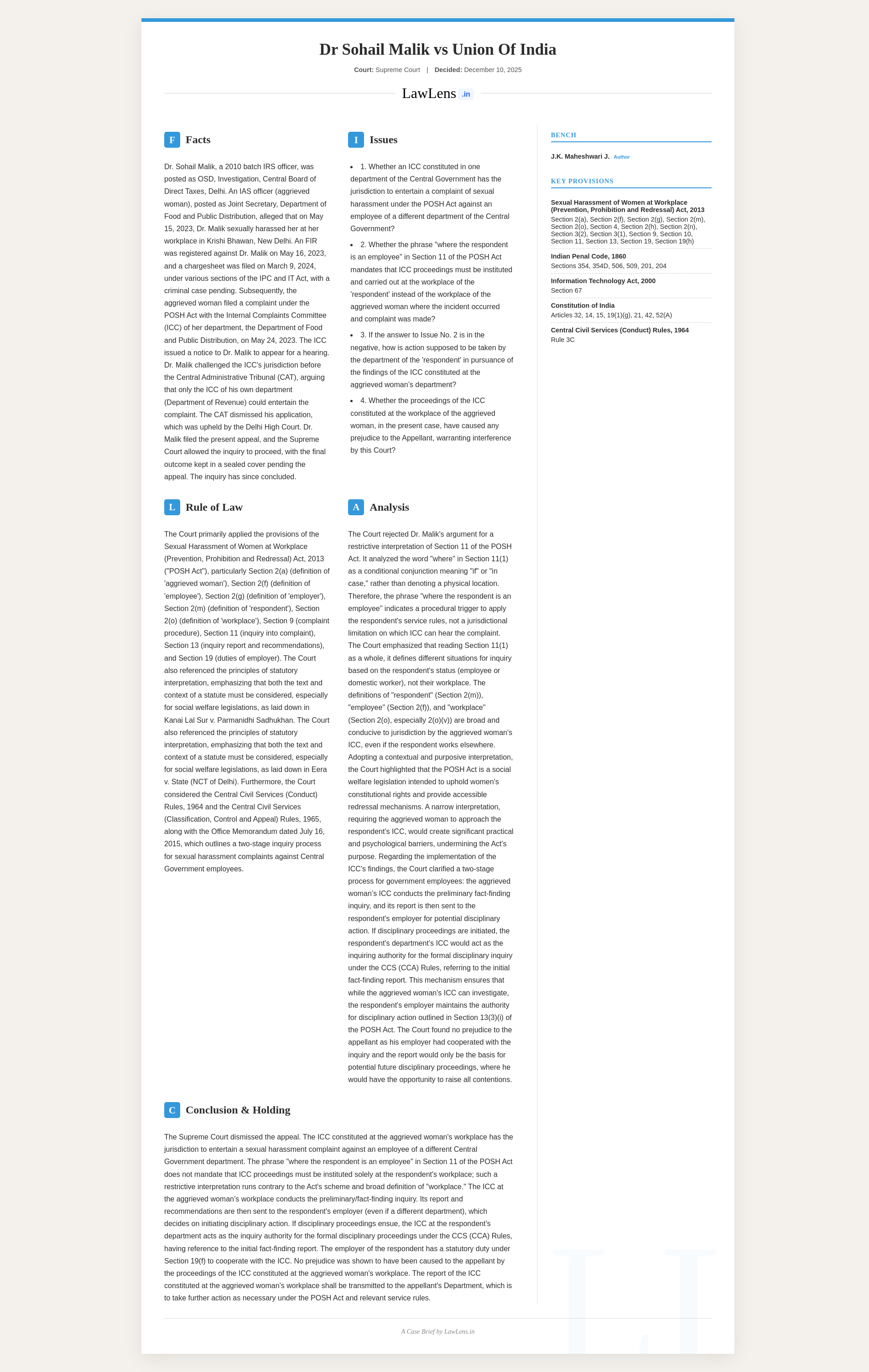
Very important #SupremeCourt judgment interpreting the phrase ‘where the respondent is an employee’ in Section 11 POSH Act: https://t.co/XtAj0YWctI pic.twitter.com/4fPU5lxyVo
— CiteCase 🇮🇳 (@CiteCase) December 10, 2025
#SupremeCourt holds that Internal Complaints Committee (ICC) constituted at the aggrieved woman’s workplace can exercise jurisdiction over an employee of a different workplace. https://t.co/XtAj0YWctI pic.twitter.com/NurK2V0XI0
— CiteCase 🇮🇳 (@CiteCase) December 10, 2025