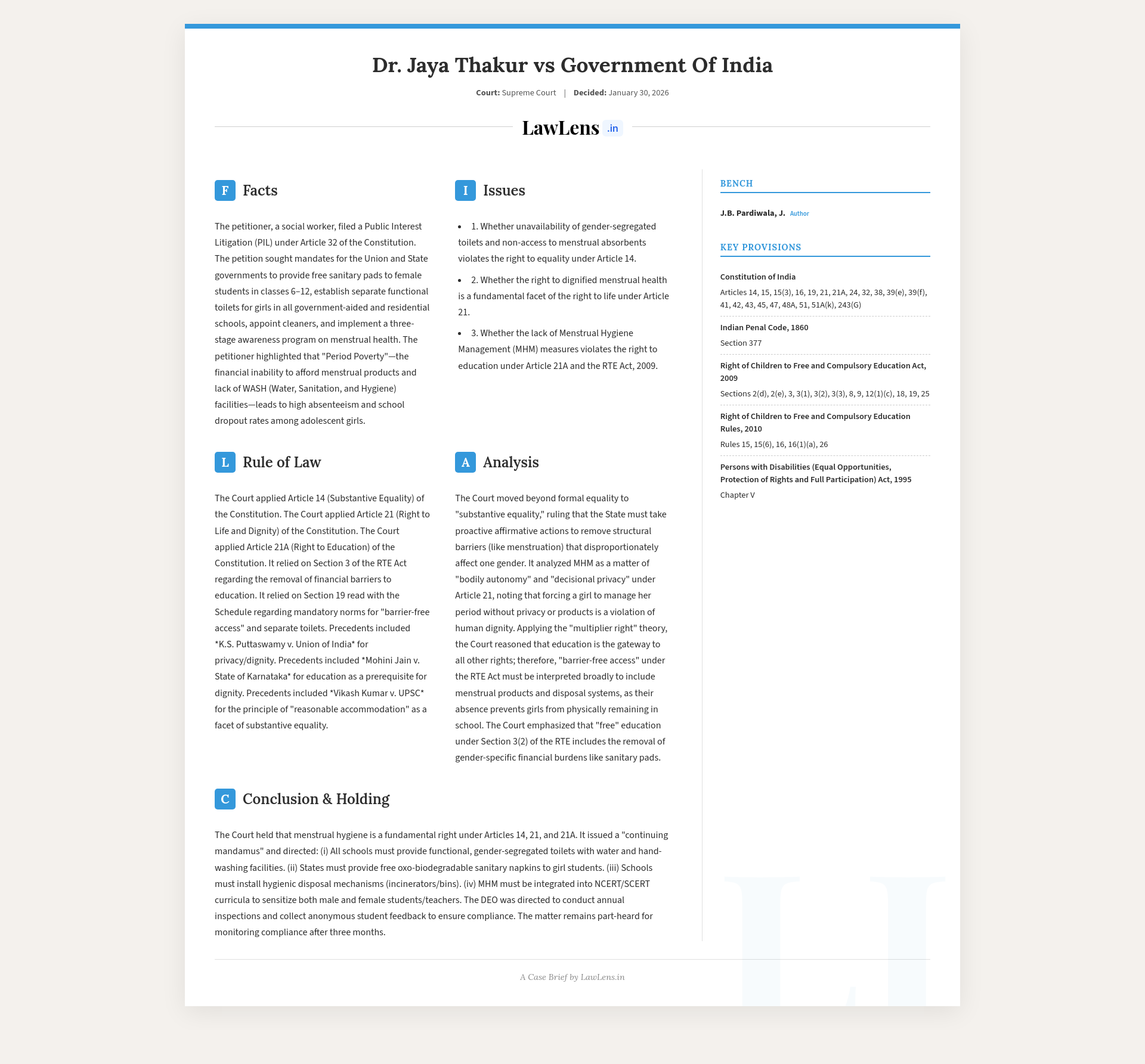
Dr. Jaya Thakur v. Government of India 2026 INSC 97 - Fundamental Right To Menstrual Health - School Girls
Fundamental Right To Menstrual Health: Supreme Court Issues Directives To Schools

You can read our notes on this judgment in our Supreme Court Daily Digests. If you are our subscriber, you should get it in our Whatsapp CaseCiter Community at about 9pm on every working day. If you are not our subscriber yet, you can register by clicking here:
Constitution of India - Article 21, 21A - The right to life under Article 21 of the Constitution includes the right to menstrual health. Access to safe, effective, and affordable menstrual hygiene management measures helps a girl child attain the highest standard of sexual and reproductive health. The right to healthy reproductive life embraces the right to access education and information about sexual health- . Inaccessibility of menstrual hygiene management measures undermines the dignity of a girl child, as dignity finds expression in conditions that enable individuals to live without humiliation, exclusion, or avoidable suffering. (Para 172)
Right of Children to Free and Compulsory Education Act, 2009 (RTE Act)- Section 19 - All schools, whether run by the appropriate Government or privately managed, must act in accordance with the norms and standards laid down in Section 19. In case of a school not established, owned, or controlled by the appropriate Government or the local authority is found to be in contravention of the provisions of the RTE Act, it would be de-recognized and the consequences therefrom would follow. Insofar as a school established, owned, or controlled by the appropriate Government or the local authority is found to be in contravention of the provisions of the RTE Act, the State would be held accountable. (Para 172)
Right of Children to Free and Compulsory Education Act, 2009 (RTE Act)- Section 3 -Section 3 of the RTE Act is not restricted to the formal entitlement of enrolment in a school. The right it guarantees is one of effective and continuous access to education. Section 3 incorporates the requirement that education shall be provided in conditions consistent with dignity and equality. The absence of sanitary napkins and safe disposal mechanisms compels menstruating girls to stay away from school for several days each month. When such circumstances continue to persist, it is an indication that the State has failed in ensuring regular attendance and continuity of education. This results in direct denial of the right guaranteed under Section 3. (Para 144)
Constitution of India - Article 21 - The right to privacy entails a duty on the State to not only refrain from violating privacy but an accompanying ligation on the State to take necessary measures to protect the privacy of an individual.(Para 172)
Constitution of India - Article 21A -The fundamental right to education comprises free, compulsory, and quality education. Free education includes all kinds of charges or expenses that would prevent a child from pursuing and completing elementary education. The right to education has been termed as a ‘multiplier right’ as it enables exercise of other human rights. The right to education forms part of the broader framework of the right to life and human dignity, which cannot be realized without access to education. (Para 172)
Constitution of India - Article 14, 15,16 -The substantive approach to equality under Article 14 demands that treatment be accorded with due regard to the individual, institutional, systemic, and contextual barriers that impede the translation of rights in reality. At the same time, the State, as a benefactor, is under an obligation to remedy such structural disadvantages. The right to equality is expressed through the right to participate on equal terms. At the same time, equality of opportunity necessitates that everyone has a fair chance to acquire the skills necessary to access benefits (Para 172) Article 15 and 16 constitute a substantive framework of equality that goes beyond formal non-discrimination. It seeks to ensure meaningful participation of disadvantaged and marginalized communities in social, educational, and public life. (Para 101)
Constitution of India - Article 21,47 - To secure the right to health is not merely a right enshrined under Article 21 but also a duty on the State under Article 47 of the Constitution. Article 47 enjoins the State to improve public health as its primary duty. (Para 98)
Constitution of India - Preamble - The opening declaration of the Constitution, “We, the People”, illustrates that the Constitution and its principles thrive on participation. (Para 99)
Case Info
Case name: Dr. Jaya Thakur v. Government of India & Ors.Neutral citation: 2026 INSC 97
Coram:Justice J.B. Pardiwala and Justice R. Mahadevan
Judgment date:30 January 2026 (as stated at the end of the judgment)
Key case laws and citations referred:
- Brown v. Board of Education of Topeka Shawnee County Kan Briggs, 1954 SCC OnLine US SC 44
- Plyler v. Doe (Texas), 1982 SCC OnLine US SC 118
- Bandhua Mukti Morcha v. Union of India, (1984) 3 SCC 161
- Mohini Jain v. State of Karnataka, (1992) 3 SCC 666
- Unni Krishnan, J.P. v. State of A.P., (1993) 1 SCC 645
- T.M.A. Pai Foundation v. State of Karnataka, (2002) 8 SCC 481
- Minister of Health v. Treatment Action Campaign, 2002 SCC OnLine ZACC 17
- R.D. Upadhyay v. State of A.P., (2007) 15 SCC 337
- Governing Body of the Juma Musjid Primary School v. Ahmed Asruff Essay N.O., 2011 SCC OnLine ZACC 13
- Vishaka v. State of Rajasthan, (1997) 6 SCC 241
- Vellore Citizens Welfare Forum v. Union of India, (1996) 5 SCC 647
- Apparel Export Promotion Council v. A.K. Chopra, (1999) 1 SCC 759
- Indra Sawhney v. Union of India, 1992 Supp (3) SCC 217
- Joseph Shine v. Union of India, (2019) 3 SCC 39
- Janhit Abhiyan v. Union of India (EWS Reservation), (2023) 5 SCC 1
- Gaurav Kumar v. Union of India, (2025) 1 SCC 641
- Jane Kaushik v. Union of India, (2026) 1 SCC 336
- Rajiv Raturi v. Union of India, (2024) 16 SCC 654
- Om Rathod v. Director General of Health Services, 2024 SCC OnLine SC 3130
- Jeeja Ghosh v. Union of India, (2016) 7 SCC 761
- Ravinder Kumar Dhariwal v. Union of India, (2023) 2 SCC 209
- Vikash Kumar v. UPSC, (2021) 5 SCC 370
- Common Cause v. Union of India, (2018) 5 SCC 1
- K.S. Puttaswamy (Privacy‑9J) v. Union of India, (2017) 10 SCC 1
- Navtej Singh Johar v. Union of India, (2018) 10 SCC 1
- Nipun Malhotra v. Sony Pictures Films India (P) Ltd., 2024 SCC OnLine SC 1639
- Sukanya Shantha v. Union of India, (2024) 15 SCC 535
- Lakshmi Kant Pandey v. Union of India, (1984) 2 SCC 244
- Consumer Education & Research Centre v. Union of India, (1995) 3 SCC 42
- Devika Biswas v. Union of India, (2016) 10 SCC 726
- Suchita Srivastava v. Chandigarh Admn., (2009) 9 SCC 1
- Independent Thought v. Union of India, (2017) 10 SCC 800
- X2 v. State (NCT of Delhi), (2023) 9 SCC 433
- M. Nagaraj v. Union of India, (2006) 8 SCC 212
- State of A.P. v. P.B. Vijaykumar, (1995) 4 SCC 520
- Society For Enlightenment & Voluntary Action v. Union of India, 2024 SCC OnLine SC 2922
- Maniben Maganbhai Bhariya v. Distt. Development Officer, Dahod, (2022) 16 SCC 343
- Avinash Mehrotra v. Union of India, (2009) 6 SCC 398
- State of T.N. v. K. Shyam Sunder, (2011) 8 SCC 737
- Pramati Educational & Cultural Trust v. Union of India, (2014) 8 SCC 1
- Society for Unaided Private Schools of Rajasthan v. Union of India, (2012) 6 SCC 1
- State of Karnataka v. Appa Balu Ingale, 1995 Supp (4) SCC 469
- Indian Medical Assn. v. Union of India, (2011) 7 SCC 179
(Plus various High Court decisions: Radha Shekhawat v. State of Rajasthan, Setupati HSS v. State of T.N., Deepak Rana v. State of Uttarakhand, State of W.B. v. Krishnendu Biswas, St Mary’s English Medium School v. State of Kerala, Justice for All v. State (NCT of Delhi), Master Manjunath v. Union of India, Kadambur Higher Secondary School v. KSCPCR, etc.)
Statutes / laws and instruments referred:
- Constitution of India: Articles 14, 15(3), 16, 19, 21, 21A, 24, 38, 39(e) & (f), 41, 42, 43, 45, 47, 51, 243(G), 30(1)
- Right of Children to Free and Compulsory Education Act, 2009 (RTE Act), especially Sections 3, 8, 9, 18, 19 and Schedule
- Right of Children to Free and Compulsory Education Rules, 2010, especially Rules 15, 16, 26
- Rights of Persons with Disabilities Act, 2016, Section 3
- Persons with Disabilities (Equal Opportunities, Protection of Rights and Full Participation) Act, 1995
- National Trust for Welfare of Persons with Autism, Cerebral Palsy, Mental Retardation and Multiple Disabilities Act, 1999
- Commissions for Protection of Child Rights Act, 2005, Sections 15, 24
- Solid Waste Management Rules (and related sanitary waste norms)
- Universal Declaration of Human Rights, Article 26
- International Covenant on Economic, Social and Cultural Rights, Article 13 and General Comment 13 & 22
- UNESCO Constitution and Right to Education handbook
- Convention on the Elimination of All Forms of Discrimination against Women (CEDAW)
- Convention on the Rights of the Child (CRC), Articles 28–29 and CRC General Comment No. 1
- Various national schemes/programmes (Samagra Shiksha, Swachh Bharat Mission, Jan Aushadhi Suvidha napkins, etc., as listed in the judgment)