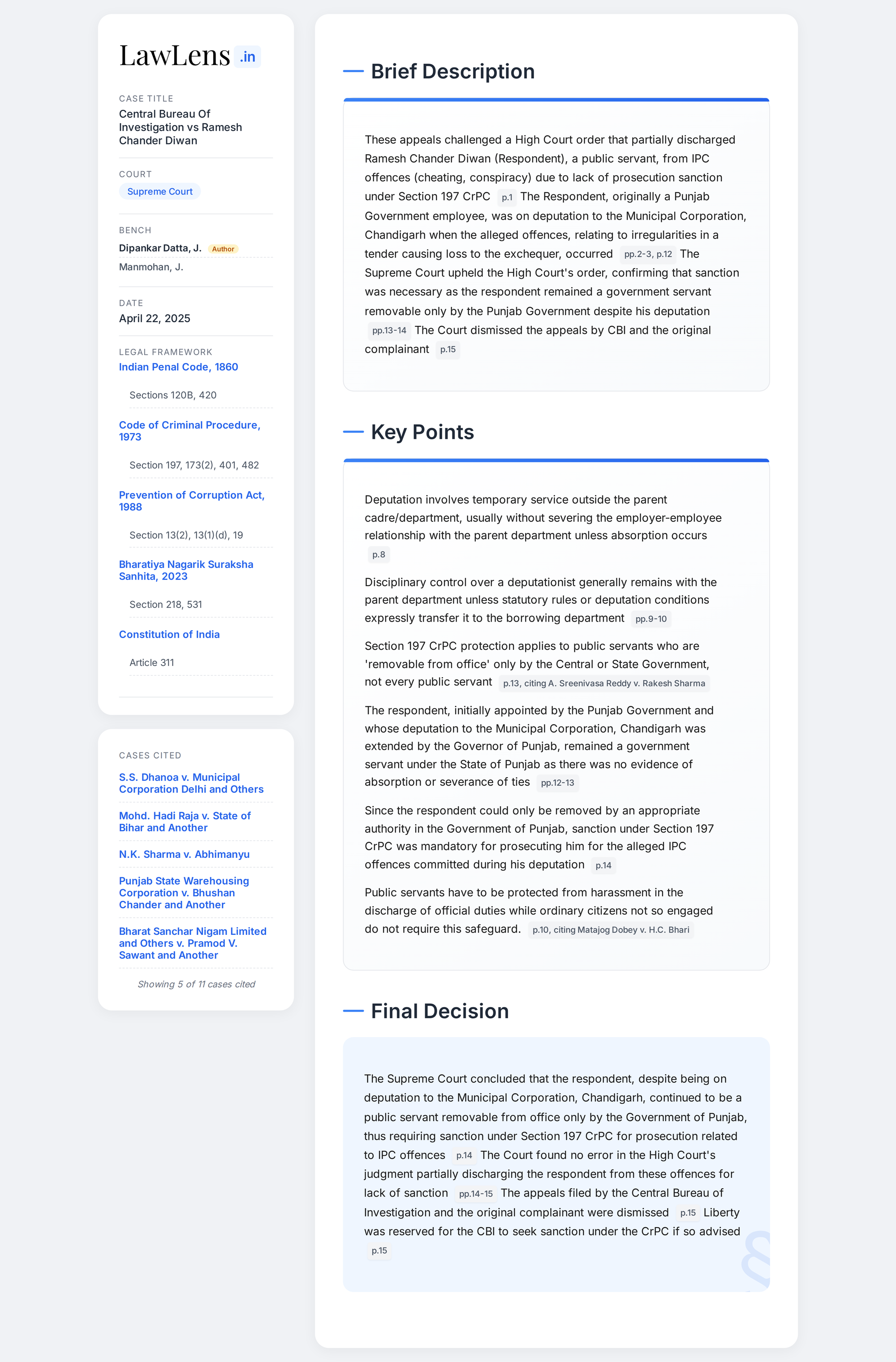
Central Bureau Of Investigation vs Ramesh Chander Diwan 2025 INSC 539 -S. 197 CrPC - Deputation

Code of Criminal Procedure 1973 - Section 197- Protection of sub-section (1) of Section 197, Cr. PC is available only to such public servants whose appointing authority is the Central Government or the State Government and not to every public servant. (Para 26)
Service Law - Deputation - Where exigency of public service requires the parent department (lending authority) to send its employee on deputation to the receiving department (borrowing authority) and such an arrangement is preceded by a consensus among the three, i.e., the lending authority, the borrowing authority and the officer/employee, the statutory rules do normally provide for his repatriation. In such a case, there can be no severance of relationship with the parent department. However, during the period the officer/employee is sent on deputation to the receiving department, the parent department may fill up the post vacated by the deputationist in accordance with law under the category of ‘deputation vacancy’, which also is not unknown in public service law, but it is only for a limited period till the officer/employee is repatriated- Insofar as disciplinary control over a deputationist is concerned, such control generally vests with the appropriate authority in the parent department in which the substantive appointment is held. However, it cannot be gainsaid that by statutory rules or by conditions contained in the order of deputation, it can be provided that the deputationist, for the period he is serving on deputation, will be subject to the disciplinary control of the department to which he is deputed. Should there be a provision in this behalf, the deputationist may be proceeded against, if the occasion therefore arises, by the appropriate authority in the receiving department. Although generally an employee is supposed to have one master, in the context of deputation there could be a plurality of masters. Nonetheless, it is the statutory rules which would be the deciding factor. If the rules indicate that disciplinary control is retained by the parent department, the receiving department would have no jurisdiction to exercise such control. (Para 20-21)