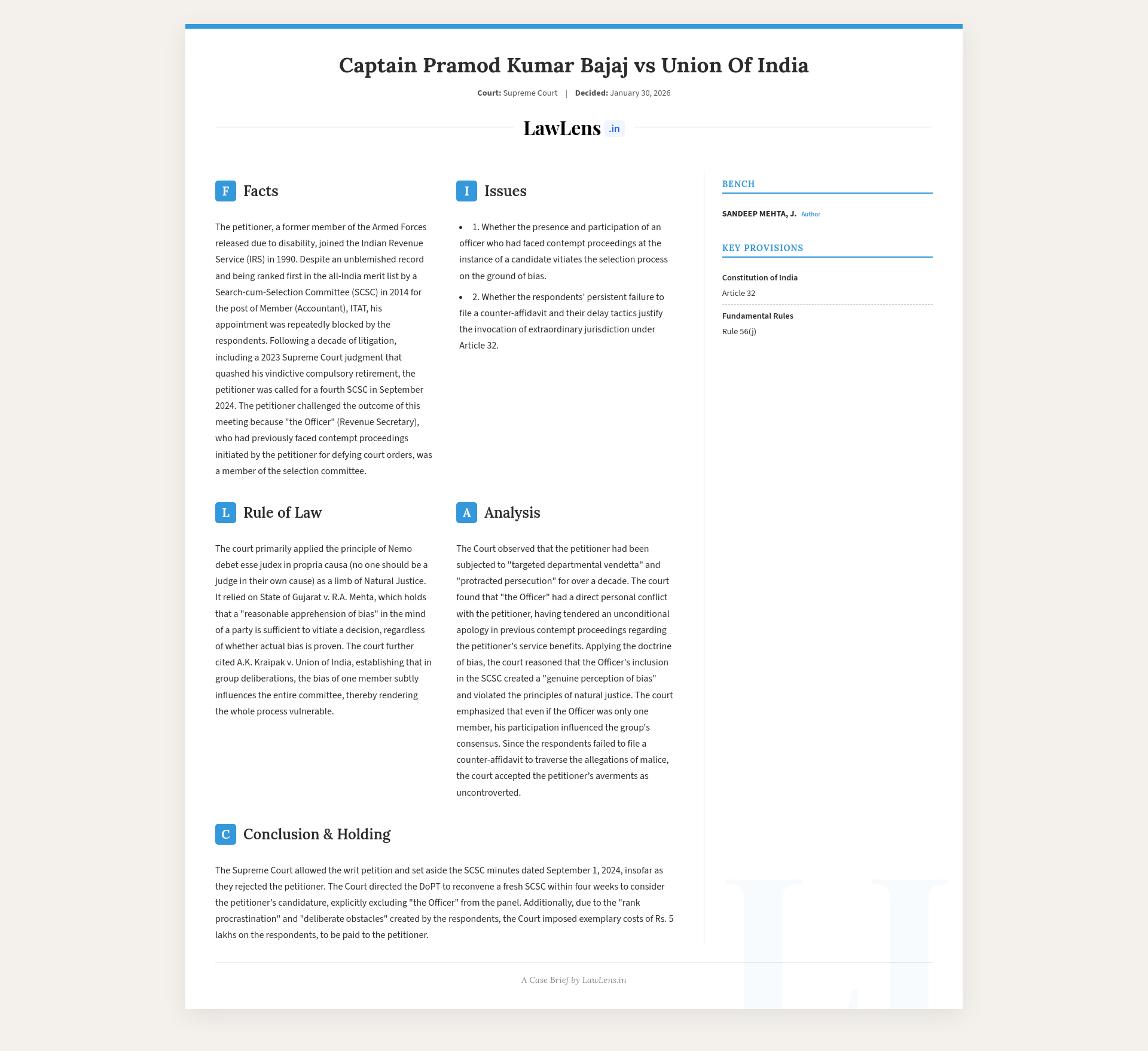
Captain Pramod Kumar Bajaj v. Union of India 2026 INSC 101 - Public Appointment - Rule Against Bias

Public Appointments – Selection - An authority exercising adjudicatory or selection functions must not only act fairly but must also appear to act fairly, for justice must manifestly be seen to be done. The rule against bias would certainly be attracted where the person/authority intrinsically involved in the evaluation process has a personal connection with, personal interest in, or prior involvement in the matter under consideration, or has earlier taken a position which he may be interested in sustaining. The doctrine is applied not only to avoid the possibility of a partial decision but also to preserve public confidence in the impartiality of the decision-making process- where statutory or administrative power is exercised for purposes extraneous to those for which it is conferred, or is influenced by irrelevant considerations, or is actuated by malice in law, such exercise cannot be sustained. Judicial review in such circumstances is directed not merely at the decision but at the decision-making process itself. (Para 42-44)
Case Info
Case name and neutral citation:The case is Captain Pramod Kumar Bajaj v. Union of India and Anr., reported as 2026 INSC 101.
Coram:The judgment is by a Division Bench of the Supreme Court of India comprising Justice Vikram Nath and Justice Sandeep Mehta (authored by Mehta, J.).
Judgment date:The judgment is dated 30 January 2026 at New Delhi.
Caselaws and citations referred
- S. Pratap Singh v. State of Punjab, 1963 SCC OnLine SC 10.
- Jaichand Lal Sethia v. State of W.B., 1966 SCC OnLine SC 96 (cited twice).
- E.P. Royappa v. State of Tamil Nadu, 1974 AIR 555.
- State of Gujarat v. R.A. Mehta, (2013) 3 SCC 1.
- S. Parthasarathi v. State of A.P., (1974) 3 SCC 459 : 1973 SCC (L&S) 580 : AIR 1973 SC 2701.
- State of Punjab v. V.K. Khanna, (2001) 2 SCC 330 : 2001 SCC (L&S) 1010 : AIR 2001 SC 343.
- N.K. Bajpai v. Union of India, (2012) 4 SCC 653.
- State of Punjab v. Davinder Pal Singh Bhullar, (2011) 14 SCC 770 : (2012) 4 SCC (Civ) 1034 : AIR 2012 SC 364.
- Km. Shailja Srivastava v. Banaras Hindu University, 1992 SCC OnLine All 465.
- A.K. Kraipak v. Union of India, (1969) 2 SCC 262 : AIR 1970 SC 150.
- G. Sarana v. University of Lucknow, (1976) 3 SCC 585 : AIR 1976 SC 2428.
- J. Mahapatra & Co. v. State of Orissa, (1984) 4 SCC 103 : AIR 1984 SC 1572.
- K. Chelliah v. Chairman, AIR 1973 Mad 122.
- Kirti Deshmankar v. Union of India, (1991) 1 SCC 104.
- Ashok Kumar Yadav v. State of Haryana, (1985) 4 SCC 417.
- J.D. Srivastava v. State of M.P. and Others, citation referred to illustratively in the discussion on mala fides.
- Express Newspapers Pvt. Ltd. and Others v. Union of India and Others, similarly mentioned in the line of authorities on mala fide exercise of power.
Statutes / laws and instruments referred:
- Constitution of India, particularly Article 32 (writ jurisdiction of the Supreme Court).
- Fundamental Rule 56(j) (compulsory retirement “in public interest”).
- Service and vigilance framework under:
- Central Board of Direct Taxes (CBDT).
- Department of Personnel and Training (DoPT).
- Appointments Committee of the Cabinet (ACC).
- Procedural context involving:
- Central Administrative Tribunal (CAT) (under the Administrative Tribunals Act, 1985, though the Act is not named in the extract).
- Income Tax Appellate Tribunal (ITAT) appointment process and Search‑cum‑Selection Committee (SCSC) norms (treated as part of the administrative/selection framework rather than explicit statutory provisions).
- The judgment also elaborates principles of natural justice, especially the rule against bias (nemo judex in causa sua) and mala fide exercise of power, drawing on the above case law.