Auroville Foundation vs Navroz Kersasp Mody 2025 INSC 347 - Environmental Law - Sustainable Development

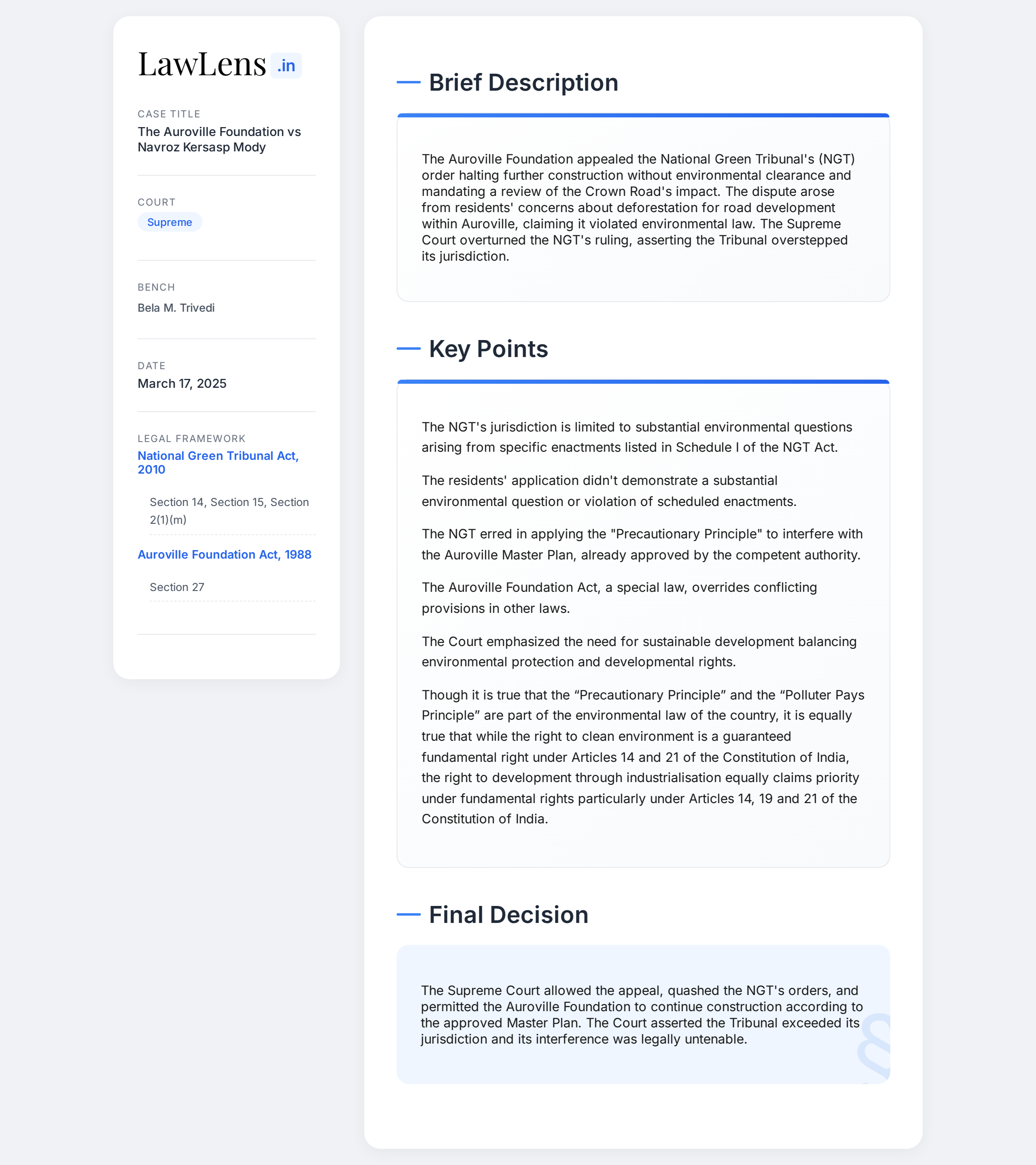
Environmental Law - Sustainable Development - “Sustainable Development” has been accepted as a viable concept to eradicate poverty and improve the quality of human life, while living within the carrying capacity of supporting ecosystems. “Sustainable Development” as defined by Brundtland Report means “development that meets the needs of the present without compromising the ability of the future generations to meet their own needs.” The “Sustainable Development” therefore has been held to be a balancing concept between Ecology and Development as a part of the customary international law- Though it is true that the “Precautionary Principle” and the “Polluter Pays Principle” are part of the environmental law of the country, it is equally true that while the right to clean environment is a guaranteed fundamental right under Articles 14 and 21 of the Constitution of India, the right to development through industrialisation equally claims priority under fundamental rights particularly under Articles 14,19 and 21 of the Constitution of India. There is therefore a need for “Sustainable Development” harmonising and striking a golden balance between the right to development and the right to clean environment. (Para 15-17)
National Green Tribunal Act - Section 14 - The Tribunal before exercising the jurisdiction has to satisfy itself that a substantial question pertaining to the violation of or implementation of any specific statutory environmental obligations contained in any of the enactments specified in Schedule I, is involved. (para 7)Though strict law of evidence may not be applicable to the cases filed before the Tribunal, the Applicant has to raise the substantial question in his Application specifically alleging the violation of a particular enactment specified in Schedule I. (Para 9)