Arshnoor Kaur vs Union of India 2025 INSC 954 -S.12 Army Act - Male Reservation

Sign in to read our notes on this judgment. Register @ citecase.in to subscribe !
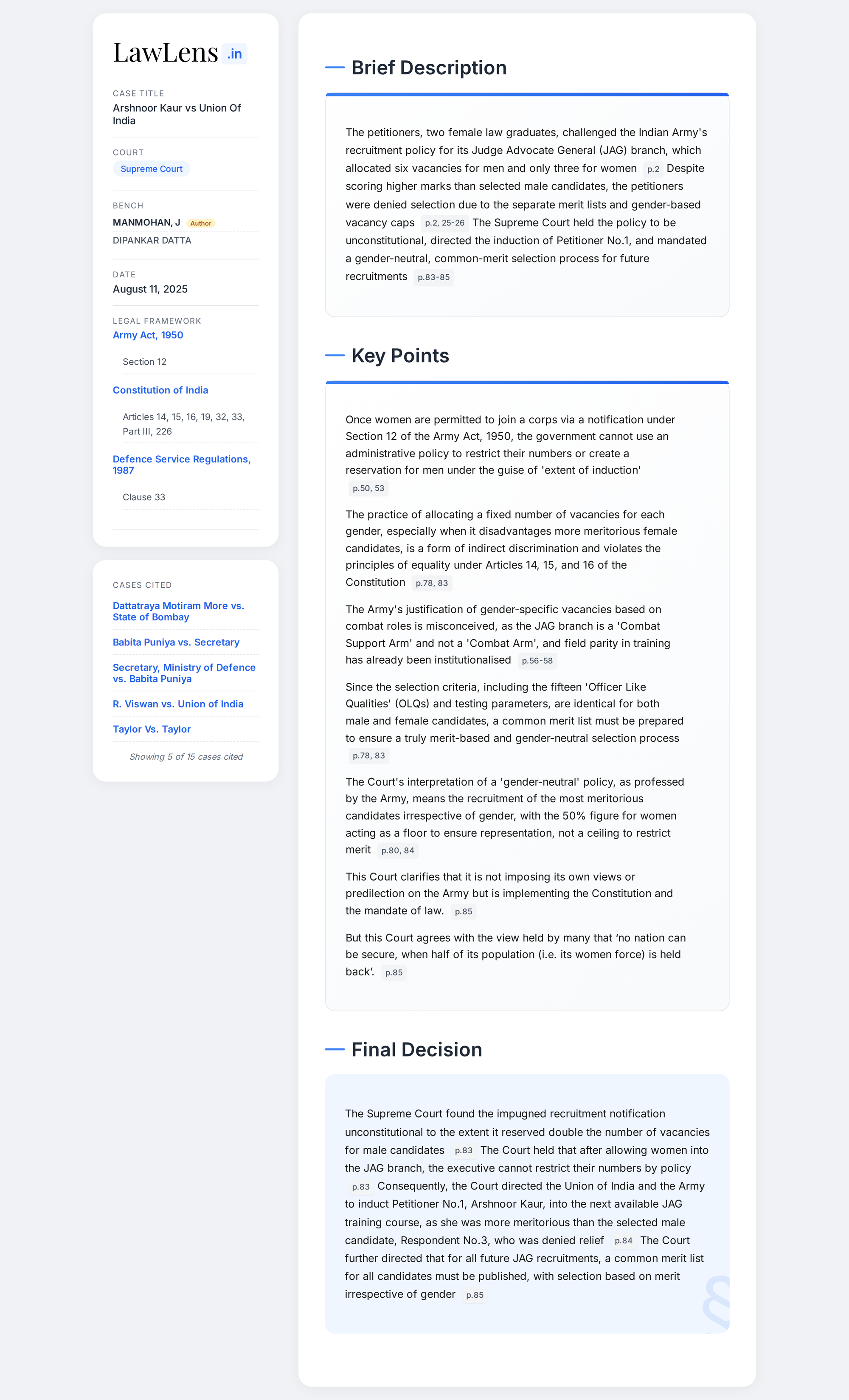
Army Act 1950 - Section 12 - Once the Service Headquarters decides to induct women officers in a particular branch or corp by way of a Notification under Section 12 of the Army Act, 1950, it cannot restrict their numbers and/or make a reservation for male officers by way of a policy or administrative instruction under the guise of ‘extent of induction’. (Para 50) [Context: SC held that the impugned notification to the extent that it provides for only three (03) vacancies for female candidates as against six (06) vacancies for male candidates is against the concept of equality as enshrined in the Constitution as it makes a reservation for male officers under the guise of ‘extent of induction’ - Union of India to henceforth conduct recruitment in the aforesaid manner as well as publish a common merit list for all JAG candidates (i.e. for all male and female candidates) and make the merit list public as well as the marks obtained by all candidates participating in the selection process]
Constitution of India - Article 33 - Since Article 33 is an exception to Fundamental Rights, this Court is of the view that any Act passed by Parliament under the said power would have to be strictly construed/interpreted. (Para 42)
Constitution of India - Article 32,226 - It is not open to the Union of India to contend that a person is not entitled to enforce his/her Fundamental Rights, in particular his/her Right to Equality, because he/she has waived it. It is always open to an aggrieved person to challenge any policy or notification or statutory provision by filing a writ petition under Article 226 or under Article 32 on the grounds that it violates his/her Fundamental Rights. (Para 69)
Constitution of India - Part III ; Army Act 1950 - Restrictions on the Fundamental Rights must be found in the Army Act, 1950 itself. Consequently, the extent to which restrictions can be imposed on Articles 14, 15 and 16 has to be clearly ‘spelt out’ in Section 12 of the Army Act and the Union of India is authorised to impose restrictions on these Fundamental Rights only to the extent of Section 12 of the Army Act, 1950 and no more. (Para 42)
Words and Expressions - ‘Gender-neutral’ in ordinary parlance means that no discrimination shall be made between candidates on the basis of gender or sex of an individual. The expression ‘gender-neutral’ is normally misunderstood and often thought to be synonyms with the expression ‘gender-equality’. 89. A simple analogy to address the difference would be that when an employer hires the same number of men and women, it would be deemed to be following the policy of ‘gender-equality’; on the other hand, if the employer hires the best candidate for the job regardless of gender/sex, it would be deemed to be following the policy of ‘gender-neutrality’- The concept of gender-neutrality does not just prohibit sex based classification but it ensures that the most meritorious candidate is selected for the job. Also, the principle of ‘gender-neutrality’ in service does not preclude or limit deployment in any operational area or role. (Para 88-90)
Quote - This Court agrees with the view held by many that ‘no nation can be secure, when half of its population (i.e. its women force) is held back’. (Para 116)
Case Info
Case Name and Neutral Citation
- Case Name: Arshnoor Kaur & Anr. v. Union of India & Ors.
- Neutral Citation: 2025 INSC 954
- Writ Petition (C) No.: 772 of 2023
Coram (Judges)
- Justice Dipankar Datta
- Justice Manmohan
Judgment Date
- Date: August 11, 2025
Caselaws and Citations Referred
- Dattatraya Motiram More Vs. State of Bombay
- ILR 1953 Bom 842
- R. Viswan and Ors. vs. Union of India and Ors.
- (1983) 3 SCC 401
- Babita Puniya vs. Secretary & Anr.
- 2010 SCC OnLine Del 1116
- Secretary, Ministry of Defence vs. Babita Puniya & Ors.
- (2020) 7 SCC 469
- K.S. Puttaswamy Vs. Union of India
- (2017) 10 SCC 1
- Basheshar Nath Vs. Commissioner of Income Tax Delhi & Rajasthan and Another
- 1958 SCC OnLine SC 7
- Taylor Vs. Taylor
- (1875) 1 Ch.D.426
- Nazir Vs. King Emperor
- AIR 1936 PC 253
- Babu Verghese Vs. Bar Council of Kerala
- (1999) 3 SCC 422
- Lieutenant Colonel Nitisha and Ors. vs. Union of India and Ors.
- (2021) 15 SCC 125
- Ontario Human Rights Commission v. Simpsons Sears Ltd.
- 1985 SCC OnLine Can SC 75 : (1985) 2 SCR 536
- Orsus v. Croatia
- 2010 ECHR 337
- Joanne Fraser v. Attorney General of Canada
- 2020 SCC 28 (Can SC)
- Action Travail des Femmes v. Canadian National Railway Co.
- 1987 SCC OnLine Can SC 37 : (1987) 1 SCR 1114
Statutes / Laws Referred
- Constitution of India
- Article 14 (Equality before law)
- Article 15 (Prohibition of discrimination)
- Article 15(3) (Special provision for women and children)
- Article 16 (Equality of opportunity in public employment)
- Article 33 (Power of Parliament to modify rights for Armed Forces)
- Article 226 (Writ jurisdiction of High Courts)
- Article 32 (Writ jurisdiction of Supreme Court)
- Army Act, 1950
- Section 12 (Ineligibility of females for enrolment or employment)
- Section 21 (Restrictions on Fundamental Rights for Armed Forces)
- Defence Service Regulations 1987 (DSR)
- Clause 33 (Role of JAG)
- Women’s Reservation Act 2023
#SupremeCourt today said that it agrees with the view held by many that ‘no nation can be secure, when half of its population (i.e. its women force) is held back’ https://t.co/jh1XIAtaMr pic.twitter.com/vqecGtv3Es
— CiteCase 🇮🇳 (@CiteCase) August 11, 2025
Suggested Readings: