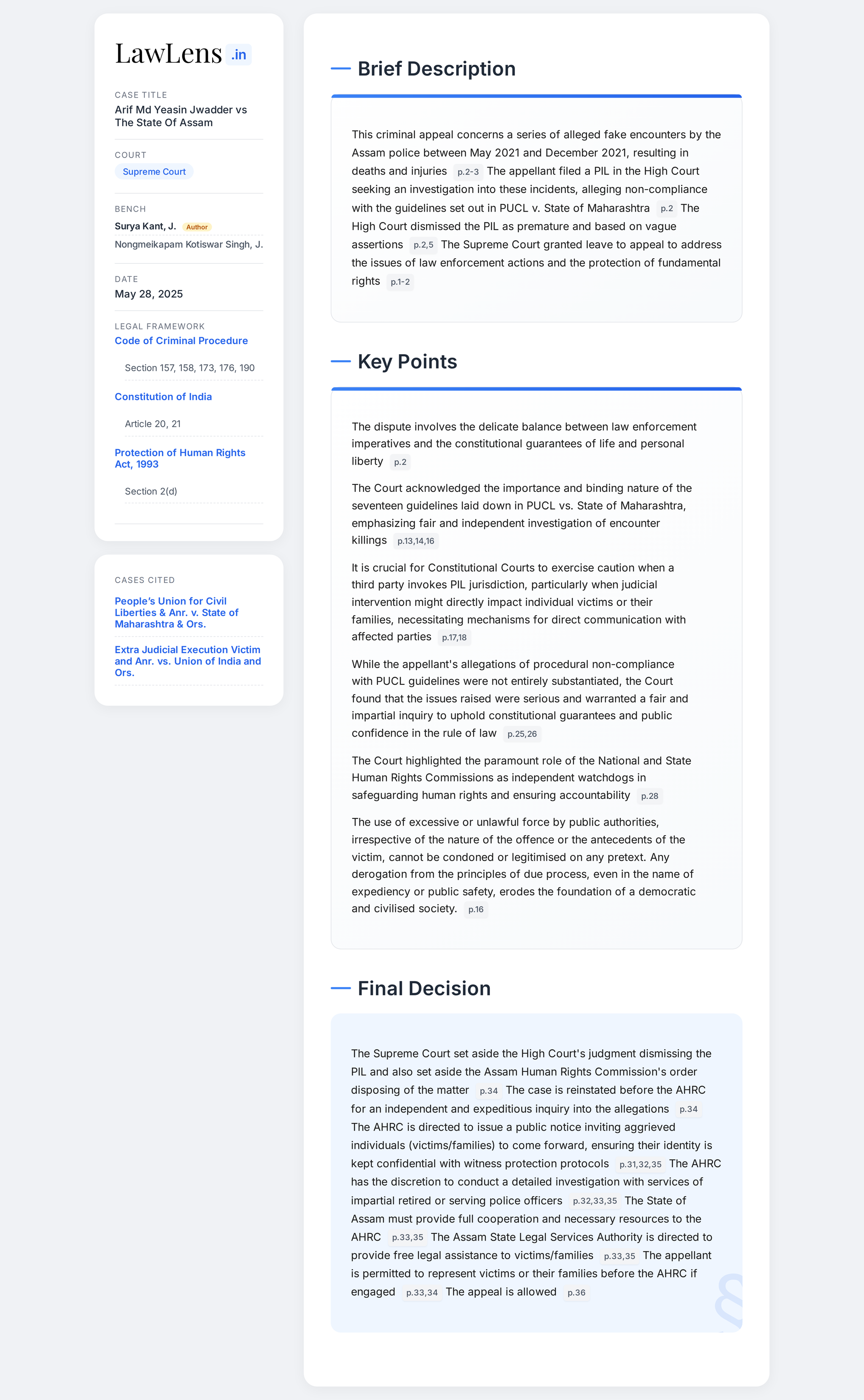
Arif Md. Yeasin Jwadder vs State of Assam 2025 INSC 785 - Fake Encounters

Fake encounters - Fake encounters are extra-judicial killings and must be subject to strict legal scrutiny- Referred to (Para 13)the use of excessive or unlawful force by public authorities, irrespective of the nature of the offence or the antecedents of the victim, cannot be condoned or legitimised on any pretext. Any derogation from the principles of due process, even in the name of expediency or public safety, erodes the foundation of a democratic and civilised society. [Context: AHRC directed to necessary inquiry into the allegations on fake encounters in the State of Assam independently and expeditiously, in accordance with law]
Constitution of India - Article 32, 226 - Where the alleged cause espoused by a third party in the form of a PIL relates to a specific individual or a closed set of individuals — particularly where the implications of judicial intervention may directly alter or jeopardize the legal position of the victim or their kin — it becomes imperative for the courts to tread with utmost circumspection- The danger of an unintended miscarriage of justice or irreversible prejudice being caused to an invisible and voiceless victim or their family, merely because a well-meaning but distanced individual has approached a Writ Court, cannot be discounted. In such situations, it is not sufficient for the court to proceed solely on the averments of the person advancing the cause before the court. Instead, it becomes obligatory for the court to independently explore mechanisms — institutional or otherwise — that can facilitate direct communication with the victim or their family, thereby enabling them to make an informed choice about participation or redressal through judicial means. (Para 20-21) The invocation of public interest jurisdiction, cannot become a substitute for procedural safeguards and the right of individual victims or their families to be heard. The risk of issuing general directions in the absence of independent assessment is not merely procedural — it strikes at the very heart of the principles of fairness and due process that underpin our judicial system. The jurisprudence developed by this Court over the decades reinforces the position that justice must be individualized where the consequences are personal and irreversible. (Para 24)