Anna Waman Bhalerao v. State of Maharashtra 2025 INSC 1114 - CrPC - Expeditious Disposal -Bail Applications

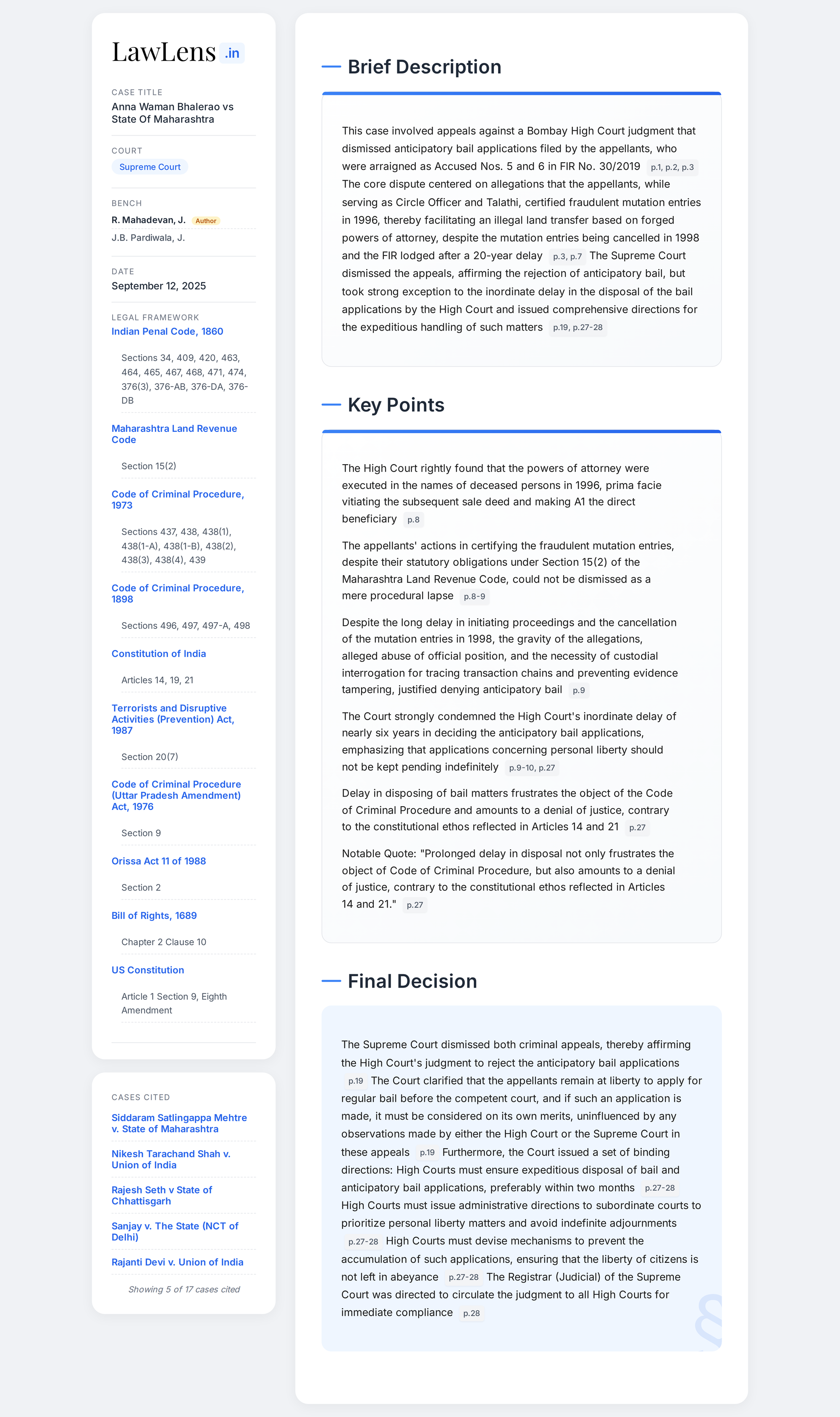
Code of Criminal Procedure 1973- Section 437-439 ; Bharatiya Nagarik Suraksha Sanhita 2023 - Section 481-483 - Bail and anticipatory applications must be decided expeditiously on their own merits, without relegating the parties to a state of indefinite pendency. Prolonged delay in disposal not only frustrates the object of Code of Criminal Procedure, but also amounts to a denial of justice, contrary to the constitutional ethos reflected in Articles 14 and 21- Directions issued: a) High Courts shall ensure that applications for bail and anticipatory bail pending before them or before the subordinate courts under their jurisdiction are disposed of expeditiously, preferably within a period of two months from the date of filing, except in cases where delay is attributable to the parties themselves. b) High Courts shall issue necessary administrative directions to subordinate courts to prioritise matters involving personal liberty and to avoid indefinite adjournments. c) Investigating agencies are expected to conclude investigations in longpending cases with promptitude so that neither the complainant nor the accused suffers prejudice on account of undue delay. d) Being the highest constitutional fora in the States, High Courts must devise suitable mechanisms and procedures to avoid accumulation of pending bail / anticipatory bail applications and ensure that the liberty of citizens is not left in abeyance. In particular, bail and anticipatory bail applications shall not be kept pending for long durations without passing orders either way, as such pendency directly impinges upon the fundamental right to liberty. (Para 17-8)
Question & Answers Generated Using NotebookLM
1. What is the core issue being addressed in the "Anna Waman Bhalerao v. State of Maharashtra" case?
The core issue revolves around the dismissal of anticipatory bail applications for two retired government officers (Circle Officer and Talathi) who were implicated in a land fraud case from 1996-1998, more than two decades after the alleged incident. Beyond the specific case, a significant theme is the inordinate and unacceptable delay in the judicial process, particularly concerning applications for personal liberty like bail and anticipatory bail.
2. What are the key allegations against Anna Waman Bhalerao and the co-appellant?
The appellants, serving as Circle Officer and Talathi, were accused of certifying fraudulent mutation entries in revenue records based on forged powers of attorney and a sale deed from 1996. These documents purportedly allowed the illegal transfer of land ownership, even though the original owners had died years prior. While not initially named in the FIR, they were later added as accused for allegedly abusing their official position to facilitate the fraudulent transaction. They maintained that they acted only in their official capacity, certifying documents that appeared facially valid, without personal gain, dishonest intention, or knowledge of the forgery.
3. What arguments did the appellants present in their defense for anticipatory bail?
The appellants argued that they were not initially named in the FIR, acted purely in their official capacity without knowledge of forgery or personal gain, and that the allegations, at best, constituted a procedural lapse, not criminal liability. They also emphasized the extraordinary delay of over 20 years in lodging the FIR, the prior cancellation of the disputed mutation entries in 1998, and their willingness to cooperate with the investigation. Furthermore, they highlighted their lack of criminal antecedents and retired status, asserting that custodial interrogation was unnecessary.
4. Why did the High Court reject the anticipatory bail applications, and what was the Supreme Court's stance?
The High Court found that the powers of attorney were executed long after the original owners' deaths, making the subsequent sale deed and mutation prima facie vitiated. It observed that the appellants, despite their statutory duties, facilitated the mutation, and their conduct couldn't be dismissed as a mere procedural lapse. The Supreme Court affirmed the High Court's decision, acknowledging the gravity of the allegations, the alleged abuse of official position, and the necessity of custodial interrogation to trace transactions and prevent evidence suppression, despite the significant delay in proceedings.
5. What historical and legal context underpins the concept of bail and anticipatory bail in India?
The concept of personal liberty and bail has deep historical roots, tracing back to the Magna Carta (1215), the Petition of Right (1628), and the Habeas Corpus Act (1679) in English law, which inspired the US Constitution's Eighth Amendment. In India, anticipatory bail (Section 438 CrPC) was introduced in 1973 based on the 41st Law Commission Report, recognizing the need to protect individuals from false implication by influential persons and to prevent unnecessary detention when an accused is unlikely to abscond or misuse liberty. While not a constitutional right, it's a statutory right safeguarding personal liberty, with wide discretion granted to High Courts and Sessions Courts.
6. What is the Supreme Court's strong directive regarding the disposal of bail and anticipatory bail applications?
The Supreme Court expressed severe displeasure over the "inordinate delay" and "indefinite pendency" of bail and anticipatory bail applications, even when interim protection is granted. It reiterated that such applications, concerning personal liberty, must be decided expeditiously, preferably within two months for regular bail and six weeks for anticipatory bail, as outlined in Satendra Kumar Antil v. CBI. Prolonged delay frustrates the purpose of the CrPC and amounts to a denial of justice, violating Articles 14 and 21 of the Constitution.
7. What specific directions did the Supreme Court issue to High Courts and subordinate courts?
The Supreme Court directed High Courts to ensure expeditious disposal of bail and anticipatory bail applications, preferably within two months (unless delay is due to the parties). It mandated administrative directions to subordinate courts to prioritize personal liberty matters and avoid indefinite adjournments. High Courts are also required to devise mechanisms to prevent the accumulation of such applications, ensuring that citizens' liberty is not left in abeyance. Additionally, investigating agencies are expected to conclude investigations in long-pending cases promptly.
8. What was the ultimate outcome for the appellants in "Anna Waman Bhalerao v. State of Maharashtra," beyond the anticipatory bail decision?
The Supreme Court dismissed the appeals, affirming the High Court's rejection of anticipatory bail. However, it clarified that the appellants retain the liberty to apply for regular bail before the competent court. Crucially, any such application should be considered on its own merits, uninfluenced by observations made by either the High Court or the Supreme Court in the anticipatory bail appeals. This allows for a fresh consideration of their case at a later stage, even while denying the pre-arrest protection.
#SupremeCourt directs High Courts to ensure that applications for bail and anticipatory bail pending before them or before the subordinate courts under their jurisdiction are disposed of expeditiously, preferably within a period of two months from the date of filing, except in… https://t.co/D7Qj0FyDPm pic.twitter.com/eABxjEwHF5
— CiteCase 🇮🇳 (@CiteCase) September 12, 2025