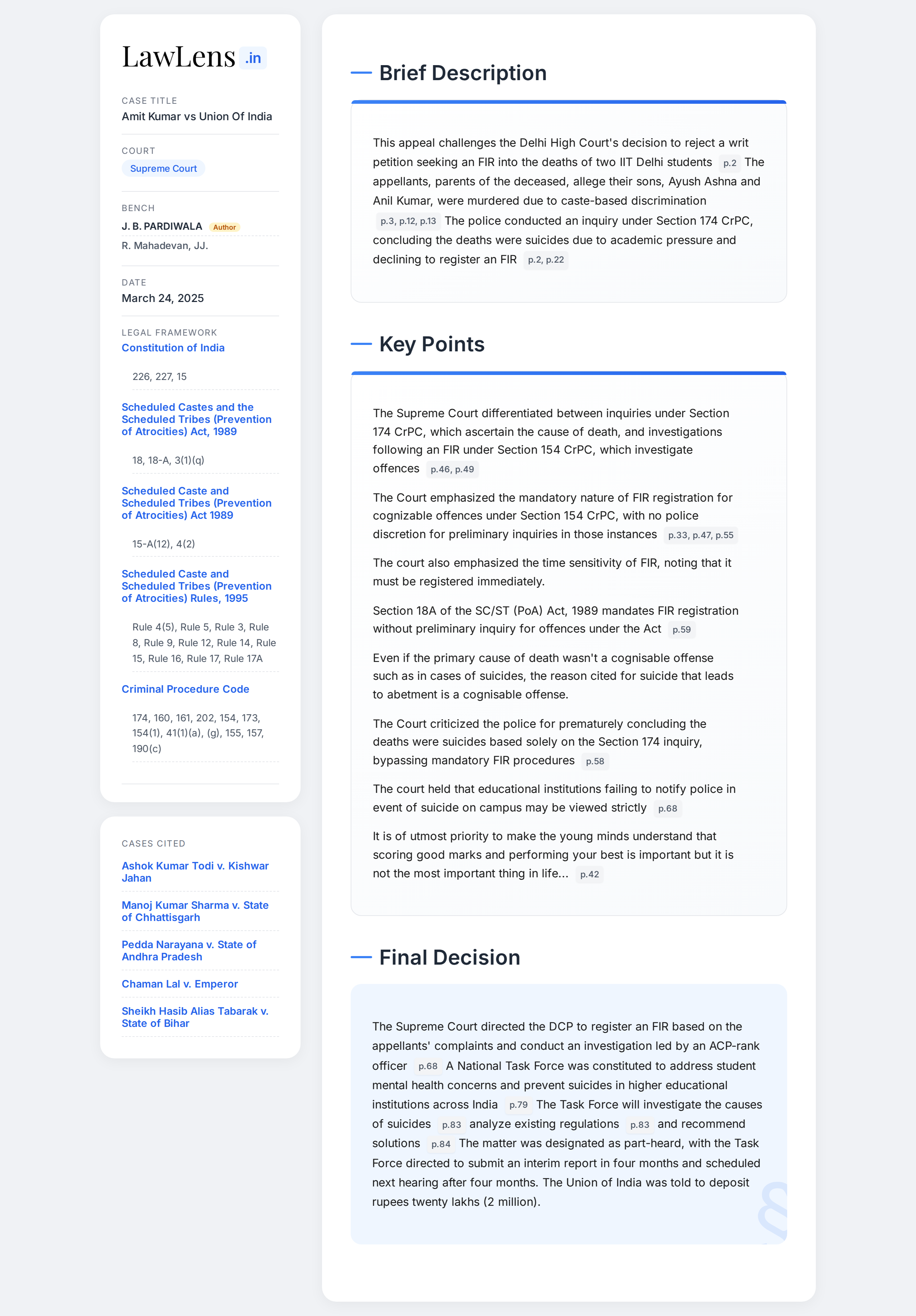
Amit Kumar vs Union Of India 2025 INSC 384 - Student Suicide - Ss. 154 & 174 CrPC

Code of Criminal Procedure 1973 - Section 154 - In the event of any unfortunate incident, such as a suicide occurring on campus, it becomes their unequivocal duty to promptly lodge an F.I.R. with the appropriate authorities. Such action is not only a legal obligation but also a moral imperative to ensure transparency, accountability, and the pursuit of justice. Simultaneously, it is incumbent upon the police authorities to act with diligence and responsibility by registering the FIR without refusal or delay. This ensures that due process of law is upheld, and a thorough investigation can be conducted to uncover the truth and address any underlying causes. (Para 47)
Code of Criminal Procedure 1973 - Section 154 and 174 - The investigations conducted under Sections 154 and 174 of the CrPC respectively are distinct in nature and purpose- The former begins with information about the commission of a cognizable offence referred to in Section 154(1), culminating in registration of F.I.R. and ending with filing of a chargesheet/challan before the competent court under Section 173 or a final report as the case may be- In contrast, an investigation under Section 174 of the CrPC focuses on ascertaining the apparent cause of death in cases of unnatural or suspicious deaths- The investigation after registration of F.I.R. under Section 154 of the CrPC is an investigation into an offence. In contrast, the investigation under Section 174 of the CrPC is an investigation or an “inquiry” into the apparent cause of death- Sections 174 to 176 of the CrPC only contemplate inquiry into the cause of death. Although the phrase ‘investigation’ is used in Section 174 of the CrPC, yet it is only an investigation in the nature of an inquiry. Sometimes, during the inquest, the police record the presence of witnesses who are also witnesses in the case. These statements are not meant as substitutes for statements under Section 161 of the CrPC. The inquest requirement under Section 174 does use the word investigation but if one considers the entire phraseology of Section 174 of the CrPC, one comes to the conclusion that the word investigation in Section 174 is not an investigation to find out who are the offenders. It is only to enable the police to come up with the “apparent cause of death”. This phrase in Section 174 should give us the clue as to the correct understanding of the role of the police in inquest panchnama. (Para 21-28)
Code of Criminal Procedure 1973 - Section 154 - i. Registration of an F.I.R. is mandatory under Section 154 of the Code, if the information discloses commission of a cognizable offence and no preliminary inquiry is permissible in such a situation. ii. If the information received does not disclose a cognizable offence but indicates the necessity for an inquiry, a preliminary inquiry may be conducted only to ascertain whether a cognizable offence is disclosed or not. iii. If the inquiry discloses the commission of a cognizable offence, the F.I.R. must be registered. In cases where preliminary inquiry ends in closing the complaint, a copy of the entry of such closure must be supplied to the first informant forthwith and not later than one week. It must disclose reasons in brief for closing the complaint and not proceeding further. iv. The police officer cannot avoid his duty of registering the offence if a cognizable offence is disclosed. Action must be taken against erring officers who do not register an F.I.R. if information received by them discloses a cognizable offence. v. The scope of preliminary inquiry is not to verify the veracity or otherwise of the information received but only to ascertain whether the information reveals any cognizable offence. vi. As to what type and in which cases preliminary inquiry is to be conducted will depend on the facts and circumstances of each case. The category of cases in which preliminary inquiry may be made are as under: a. Matrimonial disputes/ family disputes b. Commercial offences c. Medical negligence cases d. Corruption cases e. Cases where there is an abnormal delay in initiating criminal prosecution, for example, over three months delay in reporting the matter without satisfactorily explaining the reasons for delay. The aforesaid are only illustrations and not exhaustive of all conditions which may warrant preliminary inquiry. vii. While ensuring and protecting the rights of the accused and the complainant, a preliminary inquiry should be made time bound and in any case it should not exceed 7 days. The fact of such delay and the causes of it must be reflected in the General Diary entry. viii. Since the General Diary/Station Diary/Daily Diary is the record of all information received in a police station, we direct that all information relating to cognizable offences, whether resulting in registration of an F.I.R. or leading to an inquiry, must be mandatorily and meticulously reflected in the said Diary and the decision to conduct a preliminary inquiry must also be reflected, as mentioned above. (Para 46)
Student Suicides - Supreme Court constitutes National Task Force To Address The Mental Health Concerns Of Students And Prevent The Commission Of Suicides In Higher Educational Institutions - The remit of this Task Force is to prepare a comprehensive report that includes: i. Identification of the predominant causes which lead to commission of suicides by students: An examination of the various causes which lead to student suicides in Higher Educational Institutions, including but not limited to ragging, caste-based discrimination, gender-based discrimination, sexual harassment, academic pressure, financial burden, mental health related stigma, discrimination based on ethnicity, tribal identity, disability, sexual orientation, political views, religious belief or any other grounds. ii. Analysis of Existing Regulations: A thorough assessment of the effectiveness of current laws, policies, and institutional frameworks applicable to Higher Educational Institutions concerning ragging, caste-based and gender-based discrimination, sexual harassment, mental health support, support for students facing academic challenges, financial support to students in need of funds, etc. This analysis will evaluate whether these frameworks adequately address the challenges faced by students. iii. Recommendations for Strengthening Protections: Proposing necessary reforms to the existing legal and institutional frameworks to ensure stronger enforcement, accountability, and preventive measures. The Task Force shall also put forth recommendations to address existing gaps, create a more inclusive and supportive academic environment, and ensure equal opportunities for members of marginalized communities. (Para 69-74)