All India Judges Association vs Union Of India 2025 INSC 735 - 3 Year Minimum Practice Requirement - Judicial Service Exams

All the High Courts and the State Governments in the country shall amend the relevant service rules to the effect that candidates desirous of appearing in the examination for the post of Civil Judge (Junior Division) must have practiced for a minimum period of 3 years to be eligible for the said examination. (Para 89)
28 Nov 1986: Law Commission of India report recommended doing away of 3 year minimum practice requirement for judicial service exams.
24 Aug 1993: SC disagreed with this view.
11 Nov 1999: Shetty Commission report urged SC to reconsider this view.
21 Mar 2002: SC agreed with Shetty Commission and directed HCs to do away with minimum practice requirement.
20 May 2025: SC restores its 1993 view and direct HCs to reintroduce 3 year minimum practice requirement.
Most of the High Courts reported that appointment of fresh law graduates as judicial officers has led to many problems including behavioral and temperament problems. Except the High Courts of Rajasthan and Sikkim, no other High Court opposed such reintroduction of the pre-requisite of practice at the Bar (Para 80-81)-The opportunities available to a young lawyer, fresh from college will be minimal. However, the exposure to courts and more particularly litigants and their briefs would acquaint them with the onerous duties and responsibilities of every stakeholder in the judicial system. It would bring in a sensitivity to human problems, more clarity in the decision making process and educate them of the role of the Bar in justice dispensation. (para 82) neither knowledge derived from books nor pre-service training can be an adequate substitute for the first-hand experience of the working of the court-system and the administration of justice. This is possible only when a candidate is exposed to the atmosphere in the court by assisting the seniors and observing how the lawyers and the Judges function in the court. The candidate should be equipped to understand the intricacies of the functions of a Judge. The experience of various High Courts has also shown that such fresh law graduates, upon their entry in judicial service, begin to show behavioural and temperament problems. (Para 83)
To fulfill the said requirement, the Rules shall mandate that the candidate produces a certificate to that effect duly certified either by the Principal Judicial Officer of that Court or by an advocate of that Court having a minimum standing of 10 years duly endorsed by the Principal Judicial Officer of such a District or a Principal Judicial Officer at such a station. Insofar as the candidates who are practicing before the High Courts or this Court, they shall be certified by an advocate who has a minimum standing of 10 years duly endorsed by an officer designated by that High Court or this Court. The Rules shall also mandate that the candidates who are appointed to the post of Civil Judge (Junior Division) pursuant to their selection through the examination must compulsorily undergo at least 1 year of training before presiding in a Court. (Para 89)
The experience of the candidates which they have gained while working as Law Clerks with any of the Judges or Judicial Officers in the country should also be considered while calculating their total number of years of practice. (Para 89)
The number of years of practice completed by a candidate desirous of appearing in the examination for the post of Civil Judge (Junior Division) be calculated from the date of their provisional enrolment/registration with the concerned State Bar Council.(Para 89)
The said requirement of minimum years of practice shall not be applicable in cases where the concerned High Court has already initiated the selection process for the post of Civil Judge (Junior Division) prior to the date of this judgment and shall be applicable only from the next recruitment process. (Para 89)
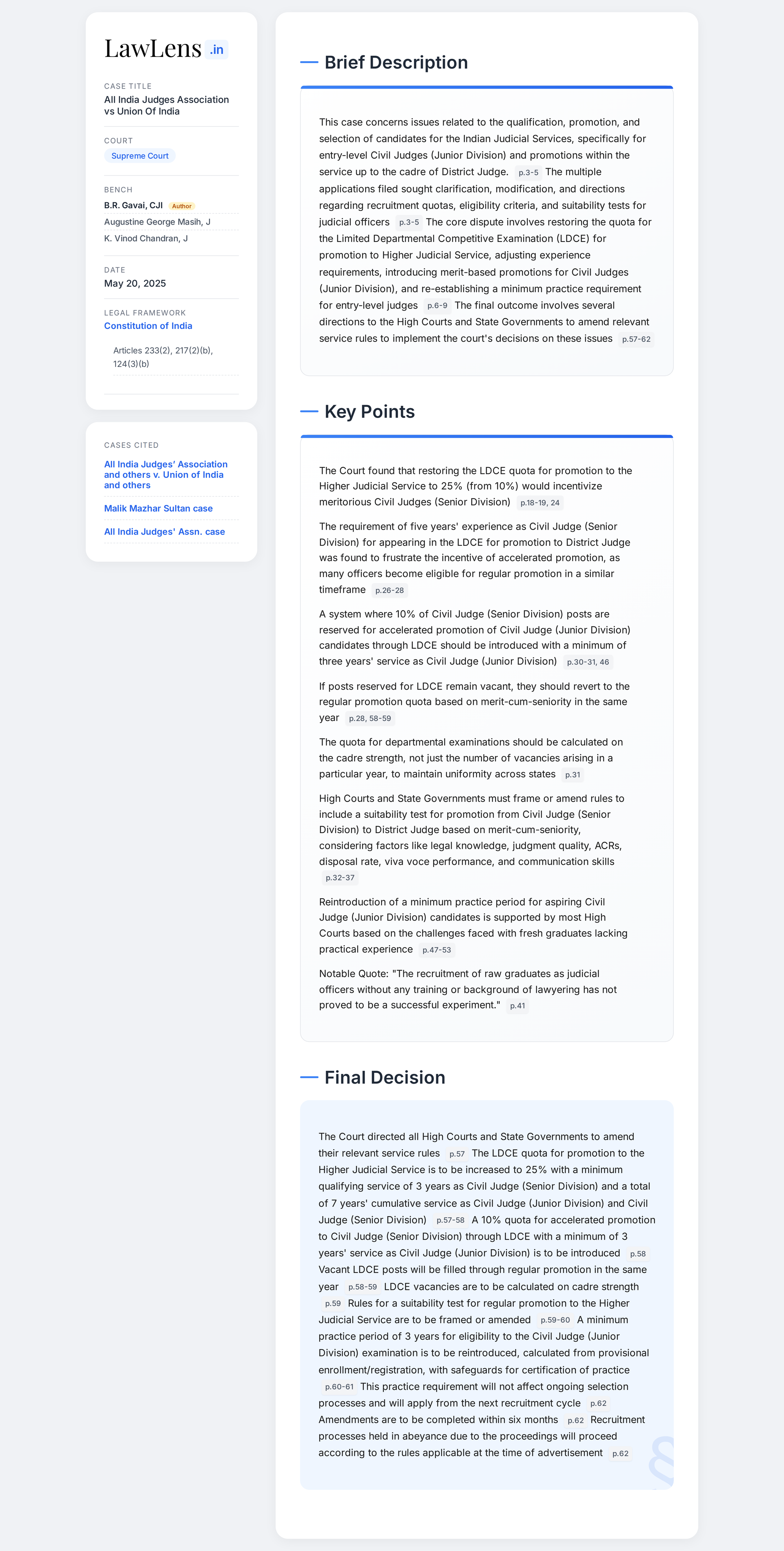
Other Directions issued : (i) All the High Courts and the State Governments in the country shall amend the relevant service Rules to the effect that the quota of reservation for LDCE for promotion from the cadre of Civil Judge (Senior Division) to the Higher Judicial Service is increased to 25%; (ii) All the High Courts and the State Governments in the country shall amend the relevant service rules to the effect that the minimum qualifying service required to appear in the LDCE for promotion from the cadre of Civil Judge (Senior Division) to the Higher Judicial Service be reduced to 3 years’ service as a Civil Judge (Senior Division) and the total service required to be undertaken, including service rendered as a Civil Judge (Junior Division) and Civil Judge (Senior Division), be set at a minimum of 7 years’ service; (iii) All the High Courts and the State Governments in the country shall amend the relevant service rules to the effect that 10% of the posts in the Cadre of Civil Judge (Senior Division) be reserved for accelerated promotion of Civil Judge (Junior Division) candidates through LDCE mechanism. The minimum qualifying service required for appearing in the said LDCE shall be three years’ service as Civil Judge (Junior Division); (iv) Needless to state that if any post reserved for LDCE for either Civil Judge (Senior Division) or for the Higher Judiciary remains vacant, the same shall be filled through regular promotion on the basis of ‘merit-cum-seniority’ in that particular year. Filling up of the vacant posts in the ratio considered for LDCE will have to be carried out from the simultaneous selection process carried out for regular promotions of the same year; (v) The High Courts and the Governments of the States where the vacancies for the LDCE are not being calculated based on the cadre strength shall amend the relevant service rules to the effect that the vacancies for LDCE be calculated on the basis of cadre strength; (vi) All the High Courts and the State Governments in the country where the Rules are not framed or if they are framed but are not adequate to judge the suitability of a candidate for being promoted to the Cadre of Higher Judicial Service from the Cadre of Civil Judge (Senior Division) shall frame fresh Rules or amend the existing Rules keeping in mind various factors like: (i) whether the candidate possesses updated knowledge of law; (ii) the quality of judgments rendered by the Judicial Officer; (iii) ACRs of the Judicial Officer of the preceding five years; (iv) disposal rate in the preceding five years; (v) performance of the Judicial Officer in the viva voce; and (vi) general perceptions and awareness as also communication skills; (vii) All the High Courts and the State Governments in the country shall amend the relevant service rules to the effect that candidates desirous of appearing in the examination for the post of Civil Judge (Junior Division) must have practiced for a minimum period of 3 years to be eligible for the said examination. To fulfill the said requirement, the Rules shall mandate that the candidate produces a certificate to that effect duly certified either by the Principal Judicial Officer of that Court or by an advocate of that Court having a minimum standing of 10 years duly endorsed by the Principal Judicial Officer of such a District or a Principal Judicial Officer at such a station. Insofar as the candidates who are practicing before the High Courts or this Court, they shall be certified by an advocate who has a minimum standing of 10 years duly endorsed by an officer designated by that High Court or this Court. We further direct that the experience of the candidates which they have gained while working as Law Clerks with any of the Judges or Judicial Officers in the country should also be considered while calculating their total number of years of practice. The Rules shall also mandate that the candidates who are appointed to the post of Civil Judge (Junior Division) pursuant to their selection through the examination must compulsorily undergo at least 1 year of training before presiding in a Court; (viii) It is directed that the number of years of practice completed by a candidate desirous of appearing in the examination for the post of Civil Judge (Junior Division) be calculated from the date of their provisional enrolment/registration with the concerned State Bar Council; (ix) It is further directed that the said requirement of minimum years of practice shall not be applicable in cases where the concerned High Court has already initiated the selection process for the post of Civil Judge (Junior Division) prior to the date of this judgment and shall be applicable only from the next recruitment process; and (x) All the amendments in terms of the aforesaid directions shall be carried out by the High Courts within a period of three months from the date of this judgment and the concerned State Governments shall consider and approve the same within a further period of three months.


Why Supreme Court thinks minimum practice requirement is necessary?
— CiteCase 🇮🇳 (@CiteCase) May 20, 2025
All High Courts reported that appointment of fresh law graduates as judicial officers has led to many problems including behavioral and temperament problems. https://t.co/gWtAZsqcQE pic.twitter.com/jK2TYGo8ep
Timeline of Flip-flops !
— CiteCase 🇮🇳 (@CiteCase) May 20, 2025
28 Nov 1986: Law Commission of India report recommended doing away of 3 year minimum practice requirement for judicial service exams.
24 Aug 1993: SC disagreed with this view.
11 Nov 1999: Shetty Commission report urged SC to reconsider this view.
21… https://t.co/gWtAZsqcQE pic.twitter.com/9ssy5HPBK3
Dear judiciary aspirants, do you know?
— CiteCase 🇮🇳 (@CiteCase) May 20, 2025
Only Rajasthan High Court and Sikkim High Court opposed reintroduction of minimum practice requirement.
All other High Courts endorsed it. https://t.co/gWtAZsqcQE pic.twitter.com/YJZhG5LdoQ