Ajmera Shyam vs Kova Laxmi 2025 INSC 992 - RP Act - Election - Non-Disclosure Of Assets

Sign in to read our notes on this judgment. Register @ citecase.in to subscribe !
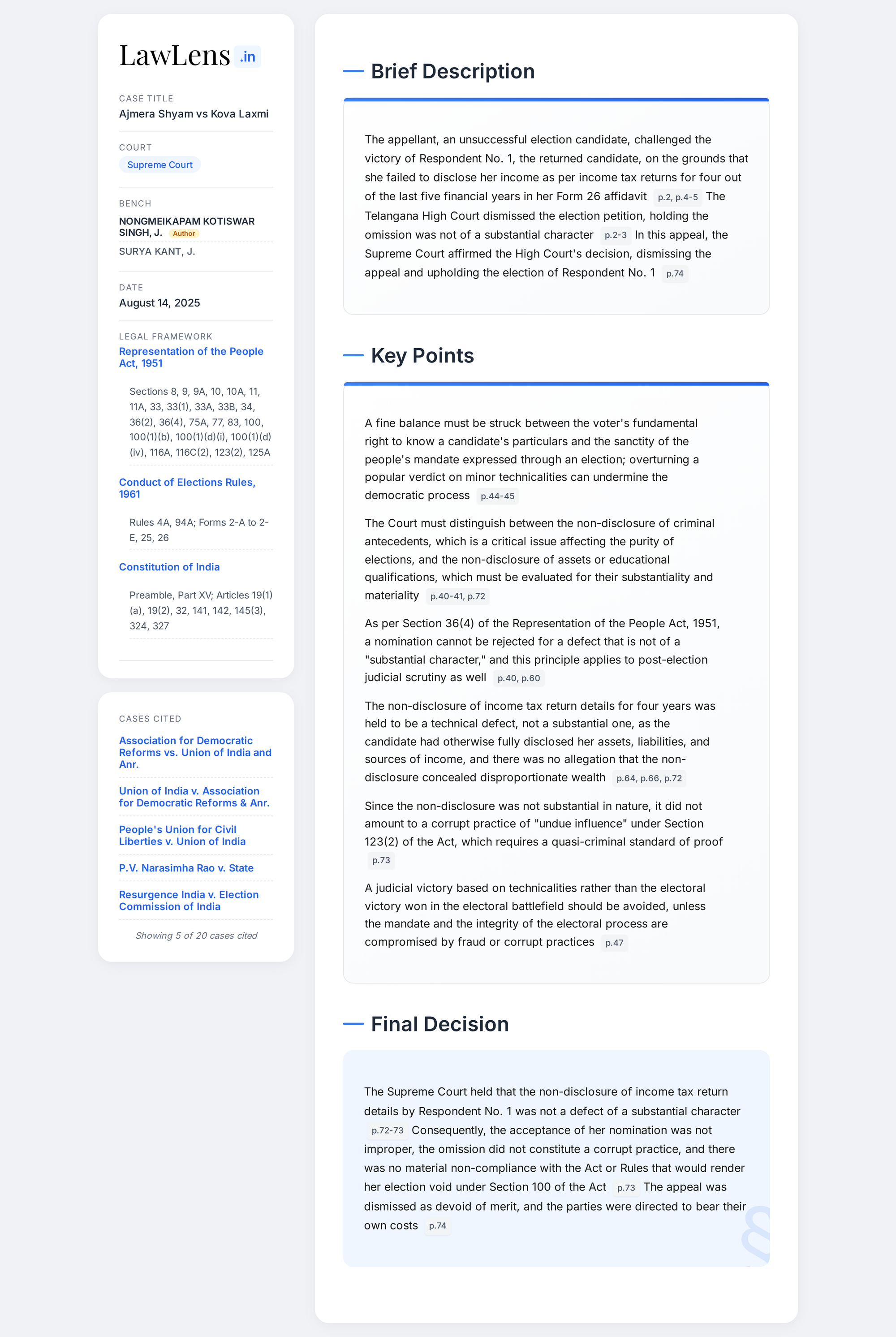
Representation of People Act -Section 100- Merely because a returned candidate has not disclosed certain information related to the assets, courts should not rush to invalidate the election by adopting a highly pedantic and fastidious approach, unless it is shown that such concealment or non-disclosure was of such magnitude and substantial nature that it could have influenced the election result- The true test, in our opinion, would be whether the non-disclosure of information about assets in any case is of consequential or inconsequential import, finding of which will be the basis for declaring the election valid or void as the case may be. (Para 10.34-10.35) [Context: In this case, the SC held that the non-disclosure of income in the income tax return for four financial years by Respondent No.1, is not a defect of substantial character. Therefore, the nomination could not have been rejected ]- While disclosure of criminal antecedents in the electoral process was the most critical element to maintain the purity of the electoral process which has to be scrupulously adhered to, disclosure of assets and educational qualifications were considered as attending supplementary requirements to strengthen the electoral process, of which there will be certain scope for consideration as to whether it is of substantial or inconsequential nature. (Para 11.1) non-disclosure of assets by candidates and/or their wives and dependents, which is not in conformity with the provisions of the Act and Rules, would render the acceptance of their nomination improper. Such non- disclosure would also amount to a corrupt practice. Therefore, the election of any candidate who has not disclosed their assets could be declared void under Section 100 of the Act. (Para 10.7)
Constitution of India - Article 19 - The right to know full particulars of the candidates as a vital part of Article 19(1)(a) of the Constitution of India. (Para 8.21) participation by voters who are well-informed not only of the affairs of the state but also with knowledge of the candidates' backgrounds invigorates the electoral process, reaffirming that election is one of the fundamental features of democracy. Voters obtain essential information about the candidates through the exercise of the fundamental right to know about them, derived from Article 19(1)(a) of the Constitution. This right to know the backgrounds of candidates, which corresponds to their obligation to disclose such information, must, however, be balanced with the people's mandate expressed through ballot boxes, which is central to democracy. (Para 9.10.5)
Legal Maxim - Vox Populi, Vox Dei- The voice of the people and collective wisdom should be respected which can even be placed on the highest pedestal of divine authority. (Para 9.10.4)
Election - There is no restriction on contesting an election due to having immense wealth or being impoverished in a democracy. (Para 9.8)
Income Tax Return - Filing of an Income Tax Return is intrinsically related to and based on a person's assets and sources of income. An Income Tax Return cannot be considered in isolation or independently of the person's assets. It merely provides a reference framework for the assets and sources of income from the perspective of Income Tax authorities for the purpose of levying income tax. The Income Tax Return in essence reflects a person's financial position, viz-a- viz the assets and sources of income. An income tax statement is a declaration in fiscal terms for assessment by the income tax authority, intended for taxation on the assets and income received by a person. It is not to be considered as a statement of fact of the existence of assets or source of income. (Para 10.23)
Case Info
Case Name and Neutral Citation
- Case Name: Ajmera Shyam v. Smt. Kova Laxmi & Ors.
- Neutral Citation: 2025 INSC 992
Coram (Judges)
- Coram: Surya Kant, J. and Nongmeikapam Kotiswar Singh, J.
Judgment Date
- Date of Judgment: August 14, 2025
Caselaws and Citations Referred
The judgment refers to several important Supreme Court decisions and legal authorities, including:
- Association for Democratic Reforms v. Union of India and Anr.(2001) 57 DRJ 82 (DB)
- Union of India v. Association for Democratic Reforms & Anr.(2002) 5 SCC 294
- People’s Union for Civil Liberties (PUCL) & Anr. v. Union of India(2003) 4 SCC 399
- Resurgence India v. Election Commission of India(2014) 14 SCC 189
- Lok Prahari v. Union of India & Ors.(2018) 4 SCC 699
- Krishnamoorthy v. Sivakumar(2015) 3 SCC 467; (2015) 2 SCC (Cri) 359; AIR 2015 SC 1921
- S. Rukmini Madegowda v. State Election Commission & Ors.(2022) 18 SCC 1
- Karikho Kri v. Nuney Tayang & Anr.2024 SCC Online SC 519
- Jagan Nath v. Jaswant Singh(1954) 1 SCC 57
- Madhukar G.E. Pankakar v. Jaswant Chobbildas Rajani & Ors.(1977) 1 SCC 70
- Santosh Yadav v. Narender Singh(2002) 1 SCC 160
- Jeet Mohinder Singh v. Harminder Singh Jassi(1999) 9 SCC 386
- Gajanan Krishnaji Bapat v. Dattaji Raghobaji Meghe(1995) 5 SCC 347
- Quamarul Islam v. S.K. Kanta1994 Supp (3) SCC 5; AIR 1994 SC 1733
- F.A. Sapa v. Singora(1991) 3 SCC 375; AIR 1991 SC 1557
- Manohar Joshi v. Damodar Tatyaba(1991) 2 SCC 342
- Ram Singh v. Col. Ram Singh1985 Supp SCC 611; AIR 1986 SC 3
- Kisan Shankar Kathore (supra)
Statutes / Laws Referred
- Representation of the People Act, 1951
- Section 116A
- Section 100 (including subsections 100(1)(a), 100(1)(b), 100(1)(d)(i), 100(1)(d)(iv))
- Section 8, 8A, 9, 9A, 10, 10A, 11, 33, 33A, 33B, 34, 36, 77, 125A, 141, 142
- Conduct of Election Rules, 1961
- Rule 4A
- Rule 94A
- Constitution of India
- Article 19(1)(a)
- Article 324
- Article 327
- Article 32
- Article 145(3)
- Prevention of Corruption Act
- Code of Civil Procedure
- Tamil Nadu Panchayats Act, 1994 (in referenced case law)
Merely because a returned candidate has not disclosed certain information related to the assets, courts should not rush to invalidate the election by adopting a highly pedantic and fastidious approach, unless it is shown that such concealment or non-disclosure was of such… https://t.co/SV8QDQRkJr pic.twitter.com/6N2e8a175L
— CiteCase 🇮🇳 (@CiteCase) August 18, 2025
What is the meaning of the maxim Vox Populi, Vox Dei? #SupremeCourt: https://t.co/SV8QDQRSyZ pic.twitter.com/IDIhtgnPxL
— CiteCase 🇮🇳 (@CiteCase) August 18, 2025
#SupremeCourt on ‘Fundamental Right’ of voters to know full particulars of the candidates contesting in Elections: https://t.co/SV8QDQRkJr pic.twitter.com/qH4DL17ACM
— CiteCase 🇮🇳 (@CiteCase) August 18, 2025
There is no restriction on contesting an election due to having immense wealth or being impoverished in a democracy.#SupremeCourtofIndia https://t.co/SV8QDQRkJr pic.twitter.com/QPvCkC9vpY
— CiteCase 🇮🇳 (@CiteCase) August 18, 2025