Supreme Court Daily Digest [27 November 2025]

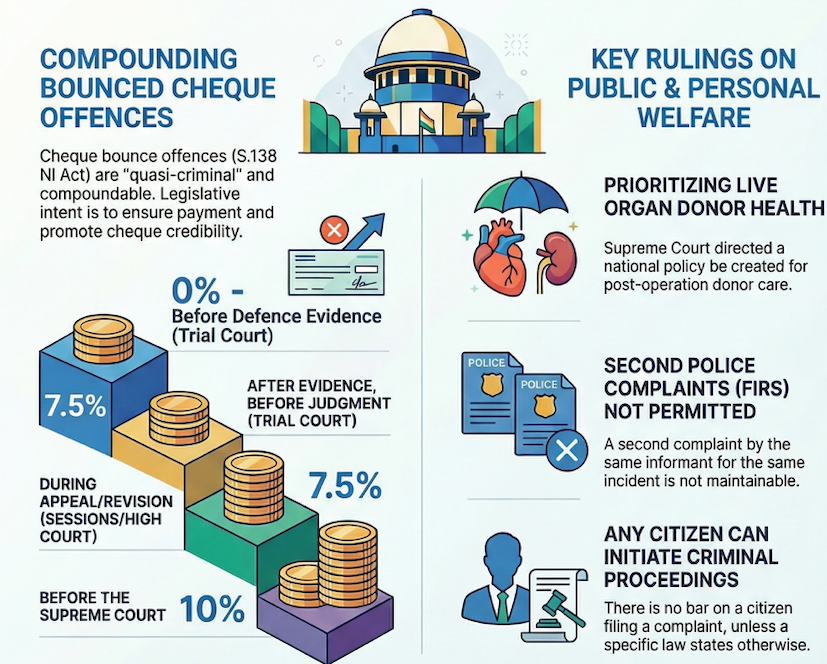
Indian Society of Organ Transplantation v. Union of India 2025 INSC 1361 -Transplantation of Human Organs Act
Transplantation of Human Organs Act, 1994 - SC requested all all the States/Union Territories, who have not yet adopted the 2011 amendment and/or the 2014 Rules to take into consideration the importance of the issue and adopt the same- Though the life of a recipient is required to be taken care of, equally the life of a live donor who parts with a valuable part of his body should not be neglected and should be adequately taken care of after the operation is carried out- NOTTO must come forward with a national policy which also addresses concerns with regard to the maintenance of the health of a live donor after the operation is carried out - Several Directions issued.
Virender Singh Dongwal v. Manju Aggarwal - S.138 NI Act - Quasi - Criminal
Negotiable Instruments Act - Section 138 - The offence under Section 138 of the NI Act is quasi-criminal in nature and is explicitly made compoundable under Section 147 of the Act. The legislative intent is to ensure the payment of money and promote the credibility of cheques- Referred to modified guidelines of compounding from Sanjabij Tari v. Kishore S. Borcar : (a) If the accused pays the cheque amount before recording of his evidence (namely defence evidence), then the Trial Court may allow compounding of the offence without imposing any cost or penalty on the accused. (b) If the accused makes the payment of the cheque amount post the recording of his evidence but prior to the pronouncement of judgment by the Trial Court, the Magistrate may allow compounding of the offence on payment of additional 5% of the cheque amount with the Legal Services Authority or such other Authority as the Court deems fit. (c) Similarly, if the payment of cheque amount is made before the Sessions Court or a High Court in Revision or Appeal, such Court may compound the offence on the condition that the accused pays 7.5% of the cheque amount by way of costs. (d) Finally, if the cheque amount is tendered before this Court, the figure would increase to 10% of the cheque amount. (Para 16-17)
Ranimol vs State of Kerala - CrPC/BNSS - Second Complaint After Negative Report
Code of Criminal Procedure 1973 - Section 200 - In this case, a detailed investigation has been conducted, and a negative report has been filed. Informant has not challenged the said negative report- SC held: By merely adding an offence for the same occurrence, and by the same informant, a second complaint through the invocation of Section 200 of the Code is certainly not maintainable- Quoted from Surender Kaushik vs State Of U.P : the lodgment of two FIRs is not permissible in respect of one and the same incident. The concept of sameness has been given a restricted meaning. It does not encompass filing of a counter FIR relating to the same or connected cognizable offence. What is prohibited is any further complaint by the same complainant and others against the same accused subsequent to the registration of the case under the Code, for an investigation in that regard would have already commenced and allowing registration of further complaint would amount to an improvement of the facts mentioned in the original complaint- The prohibition does not cover the allegations made by the accused in the first FIR alleging a different version of the same incident. Thus, rival versions in respect of the same incident do take different shapes, and in that event, the lodgment of two FIRs is permissible.
Lal Chandra Ram v. State of U.P. -Prevention of Damage to Public Property Act
Prevention of Damage to Public Property Act, 1984- In this case, HC quashed the proceedings on the ground that the Gram Pradhan was not the competent authority to lodge an FIR- Allowing appeal, SC observed: There is no provision in the Code of Criminal Procedure, 1973 which bars a citizen from filing a complaint for prosecution of a public servant or any other person who has allegedly committed an offence -Anyone can set out or put the criminal law into motion except where the statute enacting or creating an offence indicates to the contrary- There is no specific provision in the 1984 Act which limits the eligibility of the person making the complaint-None of the Acts referred to in the charge sheet indicate anything contrary to the above principle.