Aarsuday Projects & Infrastructure (P) Ltd v. Jogen Chowdhury 2026 INSC 93 - Art. 300A - Demolition Of Privately Owned Property - PIL
PIL Cannot Be Permitted To Become A Vehicle For Selective/Targeted Challenges; Direction For Demolition Can Be Issued Only In Cases Of Blatant & Substantive Illegalities & Violation: Supreme Court

You can read our notes on this judgment in our Supreme Court Daily Digests. If you are our subscriber, you should get it in our Whatsapp CaseCiter Community at about 9pm on every working day. If you are not our subscriber yet, you can register by clicking here:
Demolition - In the absence of any tangible evidence of fraud, misrepresentation, or deliberate circumvention of statutory requirements, such a procedural lapse, even if assumed to exist, for arguments sake, could not render the construction per se illegal, nor could it justify the issuance of a direction for demolition, which is an extremely draconian consequence reserved for cases of blatant and substantive illegalities and violation. (Para 36) [Context: It was contended that Gram Panchayat was not the competent authority to accord approval to the building plan and that such authority vested exclusively in the Panchayat Samiti]
Constitution of India - Article 300A - Any interference with privately owned property, including by way of demolition or deprivation of its beneficial use, must therefore rest on a clear statutory foundation and be preceded by due consideration of all relevant factual and legal circumstances. (Para 41) [Context: The Supreme Court set aside the Calcutta High Court’s order directing demolition of a multi‑storey building constructed by Aarsuday Projects near Visva‑Bharati, holding that there was no clear, scientific or contemporaneous material to show the plot itself was “khoai” land and that the developer had acted on approvals granted by the competent authorities.]
Constitution of India - Article 226 - Pubic Interest litigation -While writ jurisdiction serves an important constitutional purpose, the burden squarely lies on the writ petitioners to place clear, cogent, and reliable material on record in support of the allegations made. Courts exercising writ jurisdiction must remain circumspect while entertaining petitions that hinge upon disputed questions of fact, particularly where such disputes require detailed examination of evidence or adjudication of rival factual claims. Public interest litigation cannot be permitted to become a vehicle for selective or targeted challenges, nor can it be invoked to resolve contested factual issues which are not capable of determination on affidavits alone. (Para 52)
Case Info
Case name: M/s Aarsuday Projects & Infrastructure (P) Ltd v. Jogen Chowdhury & Ors. (with connected appeals)
Neutral citation: 2026 INSC 93
Coram: Vikram Nath, J. and Sandeep Mehta, J.
Judgment date: 29 January 2026
Caselaws and citations referred:
- Sushanta Tagore and Ors. v. Union of India and Ors., (2005) 3 SCC 16
- Chairman, Grid Corporation of Orissa Ltd. (GRIDCO) v. Sukamani Das, (1999) 7 SCC 298
- Shubhas Jain v. Rajeshwari Shivam, (2021) 20 SCC 454
Statutes / laws referred:
- Visva-Bharati Act, 1951
- West Bengal Town and Country (Planning and Development) Act, 1979
- West Bengal Panchayat Act, 1973 (sections 23, 94, 114, 114A referred in substance)
- West Bengal Panchayat (Gram Panchayat Administration) Rules, 2004 (including Rule 28)
- West Bengal Land Reforms Act, 1955 (Section 4C(2)(c) on conversion from danga to bastu)
- Environmental Impact Assessment Notification, 14 September 2006 (MoEF, GoI) and amendments (20,000 sq.m threshold)
- Constitution of India, Article 300A (right to property)
- Right to Information Act, 2005 (only as context for RTI reply)
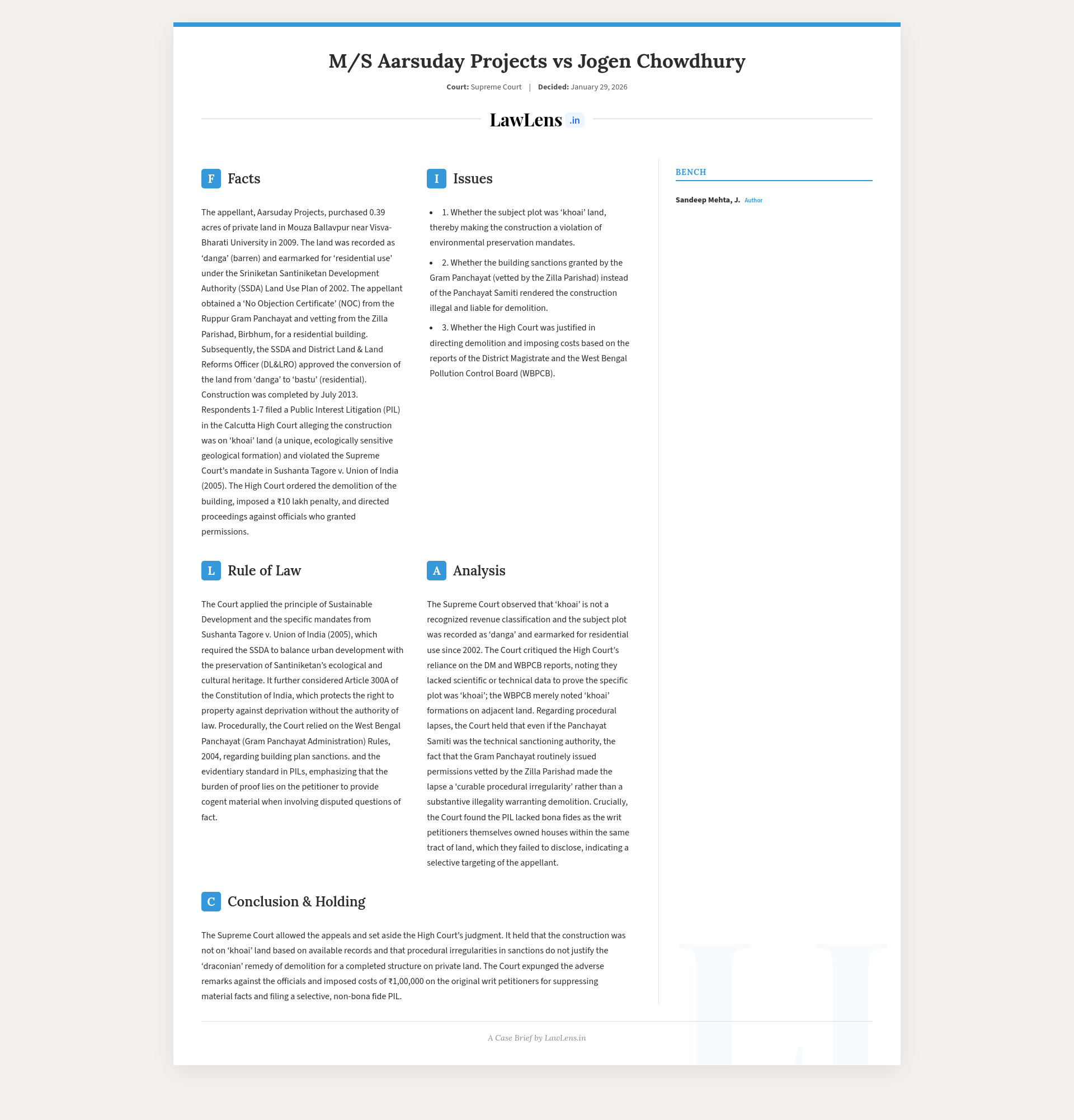
#SupremeCourt observed that direction for demolition should be issued only in cases of blatant and substantive illegalities and violation. https://t.co/JUbPWDDk90 pic.twitter.com/ZyVd34j4hP
— CiteCase 🇮🇳 (@CiteCase) January 29, 2026