XXX v. State of Kerala 2026 INSC 88 - S.175(4) BNSS - Complaint Against Public Servant Accused

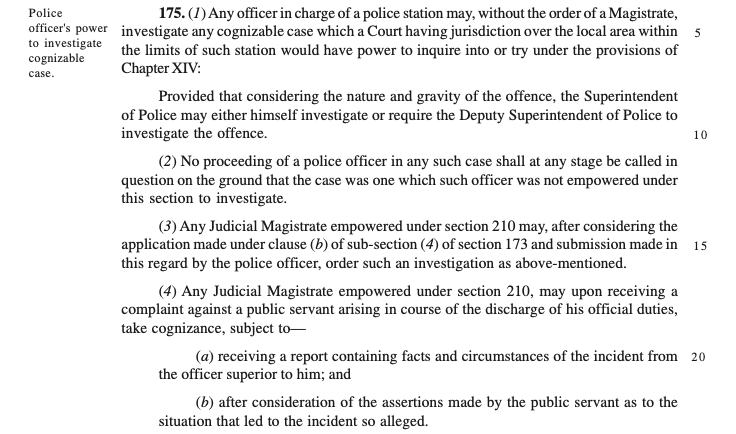
Bharatiya Nagarik Suraksha Sanhita 2023 (BNSS) - Section 175(4)- The opening words in sub-section (4) which reads “Any Magistrate empowered under Section 210, may, upon receiving a complaint against a public servant ……” have to be purposively read as ‘Any Magistrate empowered under Section 210, may, upon receiving a complaint in writing against a public servant of commission of offence arising in course of the discharge of his official duties, supported by an affidavit, order investigation, subject to ... ’ (Para 39)– Upon receiving a complaint under sub-section (4) of Section 175, BNSS alleging commission of an offence by a public servant arising in course of the discharge of his official duties, the magistrate may do either of the following- (1) Reading the complaint, if the judicial magistrate is prima facie satisfied that commission of the alleged act giving rise to an offence arose in course of discharge of official duties by the public servant, such magistrate may not have any option other than following the procedure prescribed under sub-section (4) of Section 175 of calling for reports from the superior officer and the accused public servant. Or (2) on a consideration of the complaint, where the judicial magistrate entertains a prima facie doubt depending upon the circumstances as to whether the offence alleged to have been committed by the public servant arose in course of discharge of his official duties, such magistrate might err on the side of caution and proceed to follow the procedure prescribed in sub-section (4) of Section 175 Or (3) where the judicial magistrate is satisfied that the alleged act of offence was not committed in the discharge of official duties and/or it bears no reasonable nexus thereto, and also that the rigours of sub-section (4) of Section 175 are not attracted, the complaint may be dealt with in accordance with the general procedure prescribed under sub-section (3) of Section 175. The judicial magistrate would continue to retain the authority to reject an application under sub-section (3) of Section 175, lodged against a public servant, where such magistrate finds that the allegations made therein are wholly untenable, manifestly absurd, or so inherently improbable that no reasonable person could conclude that any offence is disclosed. However, it is needless to observe, such an order of rejection ought not to be based on whims and fancy but must have the support of valid reasons- in an appropriate case, the judicial magistrate has called for a report from the concerned superior officer under clause (a) of sub-section (4) of Section 175, but such officer fails to comply with the direction or does not submit the report within a reasonable period of time- the judicial magistrate is not obliged to wait indefinitely for compliance and 43 may proceed further in accordance with sub-section (3) of Section 175 after considering the version of the accused public servant under clause (b) of sub-section (4) of Section 175, if on record. What would constitute ‘reasonable time’ cannot be determined in rigid or inflexible terms and must necessarily depend upon the facts and circumstances of each case before the judicial magistrate who has to take the call. (Para 42-48)
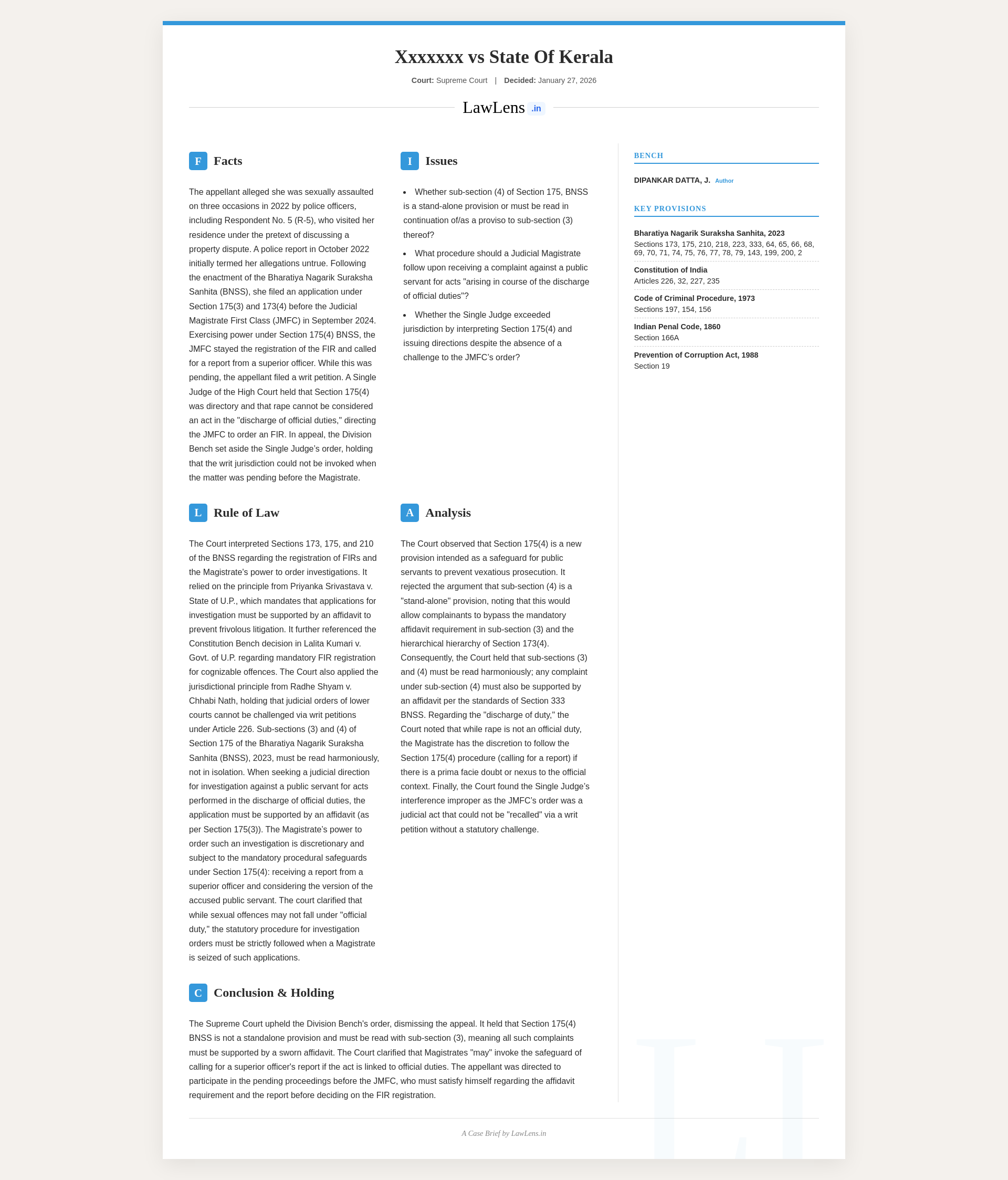
Bharatiya Nagarik Suraksha Sanhita 2023 (BNSS) - Section 175 (3) , 333 - An affidavit, such as the one referred to in subsection (3) of Section 175, must fulfil the conditions provided in Section 333, BNSS. (Para 41)
Bharatiya Nagarik Suraksha Sanhita 2023 (BNSS) - Section Section 218 - Section 218 operates at the stage of taking cognizance when the “previous sanction” of the concerned Government is required. (Para 40)
Interpretation of Statutes - Proviso - A proviso is an internal aid to construction. It is appended to a section of an enactment or any sub-section of a section. A proviso to a particular provision of a statute only embraces the field which is covered by the main provision. It carves out an exception to the main provision to which it has been enacted as a proviso and to no other. A test one may apply to determine whether a provision is a proviso rather than a separate provision is to ask whether if the “main” provision is removed, would the concerned provision still be capable of being applied. If yes, then the provision cannot normally be considered a proviso. (Para 32-36) Sub-Section - Ordinarily, sub-sections of a section of an Act usually deal with related, parallel aspects with one sub-section dealing with a general principle and the other providing for a specific aspect, on its own terms. (Para 37.2)
Constitution of India - Article 226 - The writ court will, normally, grant relief that is prayed; and, though discretion to grant relief under Article 226 is wide, the writ court cannot, ignoring and keeping aside the norms and principles governing grant of relief, proceed to grant a relief not even prayed by the petitioner. (Para 51)
Constitution of India - Article 226 - Seeking a declaratory relief that the acts of offence committed by the accused public servants did not arise in the discharge of official duties by them without the order of the JMFC (calling for a report) being challenged would have necessarily required the writ court to embark on a fact-finding exercise in that behalf, as if it were a court of a magistrate. A writ court is a court exercising high prerogative writ jurisdiction; such court could not have been urged by the appellant to convert itself into a court for conducting sort of a magisterial inquiry. (Para 56)
Constitution of India - Article 226 - A judicial order in a civil matter cannot be challenged in a writ petition under Article 226 of the Constitution- the principle has been extended to judicial orders passed in criminal matters. (Para 52)
Summary: Supreme Court upheld the Kerala High Court Division Bench’s reversal of the Single Judge, holds that the Single Judge exceeded writ jurisdiction by effectively directing recall of a judicial order of the Magistrate.
Case Info
Case name: XXX v. State of Kerala & Ors, Criminal Appeal No. 4629 of 2025 (arising out of SLP (Crl) No. 5175 of 2025), Supreme Court of India, Criminal Appellate Jurisdiction.Neutral citation: 2026 INSC 88.
Coram: Justice Dipankar Datta and Justice Manmohan.Judgment date: 27 January 2026 (NEW DELHI; JANUARY 27, 2026).
Key case laws and citations referred:
- Lalita Kumari v. Govt. of U.P., (2014) 2 SCC 1.
- Priyanka Srivastava v. State of U.P., (2015) 6 SCC 287.
- Anil Kumar v. M.K. Aiyappa, (2013) 10 SCC 705.
- Manju Surana v. Sunil Arora, (2018) 5 SCC 557.
- Om Prakash Ambadkar v. State of Maharashtra, 2025 SCC OnLine SC 238.
- Ranjit Singh Bath v. Union Territory Chandigarh, 2025 SCC OnLine SC 1479.
- Radhe Shyam v. Chhabi Nath, (2015) 5 SCC 423.
- Pradnya Pranjal Kulkarni v. State of Maharashtra, 2025 SCC OnLine SC 1948.
- Krishna Priya Ganguly v. University of Lucknow, (1984) 1 SCC 307.
- Om Prakash v. Ram Kumar, (1991) 1 SCC 441.
- Bharat Amratlal Kothari v. Dosukhan Samadkhan Sindhi, (2010) 1 SCC 234.
- Ram Narain Sons Ltd. v. Asstt. CST, (1955) 2 SCR 483.
- State of Rajasthan v. Vinod Kumar, (2012) 6 SCC 770.
- S. Sundaram Pillai v. V.R. Pattabiraman, (1985) 1 SCC 591.
- Grasim Industries Ltd. v. State of M.P., (1999) 8 SCC 547.
- Laxminarayan R. Bhattad v. State of Maharashtra, (2003) 5 SCC 413.
- IRDP v. P.D. Chacko, (2010) 6 SCC 637.
- CCE v. Hari Chand Shri Gopal, (2011) 1 SCC 236.
- Kedarnath Jute Mfg. Co. Ltd. v. CTO, AIR 1966 SC 12.
- Union of India v. VKC Footsteps (India) (P) Ltd., (2022) 2 SCC 603.
- Paras Nath Singh, (2009) 6 SCC 372.
- Subramanian Swamy v. Manmohan Singh, (2012) 3 SCC 64.
Statutes / provisions referred:
- Bharatiya Nagarik Suraksha Sanhita, 2023: Sections 173(3)–(4), 175(1)–(4), 210, 218(1) (third proviso), 223, 333.
- Bharatiya Nyaya Sanhita, 2023: Sections 64–71, 74–79, 143, 199, 200 (for sexual offences in the third proviso to Section 218(1), BNSS).
- Code of Criminal Procedure, 1973: Sections 154(1), 154(3), 156(1)–(3), 197(1).
- Indian Penal Code, 1860: Section 166A(c).
- Prevention of Corruption Act, 1988: Section 19.
- Constitution of India: Articles 32, 226, 227, 235.
- Notaries Act, 1952.
#SupremeCourt interprets and explains how to read Section 175(4) of BNSS [Complaint against public servants] https://t.co/AFV7adWNqB pic.twitter.com/KKvKp8U5aM
— CiteCase 🇮🇳 (@CiteCase) January 27, 2026
#SupremeCourt reiterates that a judicial order in a civil or criminal matter cannot be challenged in a writ petition under Article 226 of the Constitution ! https://t.co/AFV7adWNqB pic.twitter.com/CKZ8sIWAWg
— CiteCase 🇮🇳 (@CiteCase) January 27, 2026