Bernard Lyngdoh Phawa v. State of Meghalaya 2026 INSC 85 - Evidence Act - Confession - Last Seen Together

You can read our notes on this judgment in our Supreme Court Daily Digests. If you are our subscriber, you should get it in our Whatsapp CaseCiter Community at about 9pm on every working day. If you are not our subscriber yet, you can register by clicking here:
Indian Evidence Act 1872 - Section 24- A confession can form a legal basis of a conviction if the Court is satisfied that it was true and was voluntarily made- However, a Court shall not base a conviction on such a confession without corroboration - A confession has to be a direct acknowledgment of guilt of the offence in question and such as would be sufficient by itself for conviction. If it falls short of such a plenary acknowledgment of guilt it would not be a confession even though the same is of some incriminating fact which taken with other evidence tends to prove his guilt. (Para 29) The exculpatory statements made by one accused to absolve himself from the liability and accuse c0-accused of having caused the death, cannot at all be relied on against co-accused. (Para 28)
Indian Evidence Act 1872 - Section 106 - The last seen together theory projected by the prosecution should be proximate to the death of the victim. (Para 13)
Summary: The Supreme Court set aside the Meghalaya High Court’s conviction of the accused for murder and Section 201 IPC, and restored the trial court’s acquittal. It held that the prosecution’s circumstantial case completely failed: the “last seen” theory was not proved, the alleged recoveries (body, rope, belongings, mobile) were unreliable or unconnected to the crime, the medical evidence was inconclusive as to homicide, and the confessional statements were procedurally suspect, largely exculpatory, and uncorroborated.
Case Info
Case details
Case name and neutral citation:Bernard Lyngdoh Phawa v. State of Meghalaya, 2026 INSC 85, Crl.A. No. 3738 of 2023 etc.
Coram:Justice Sanjay Kumar and Justice K. Vinod Chandran (author of the judgment).
Judgment date:27 January 2026, New Delhi.
Case laws and citations referred
The judgment expressly cites and relies on:
- Sharad Birdhichand Sarda v. State of Maharashtra, (1984) 4 SCC 116 – five golden principles of circumstantial evidence.
- Chandrappa & Others v. State of Karnataka, (2007) 4 SCC 415 – appellate court’s powers in appeal against acquittal.
- Mohammed Ajmal Mohammad Amir Kasab v. State of Maharashtra, (2012) 9 SCC 1 – voluntariness and use of confessional statements; right to legal aid at first production before Magistrate.
- Manoharan v. State by Inspector of Police, Variety Hall Police Station, Coimbatore, (2020) 5 SCC 782 – principles on use of confession and need for corroboration.
- Pyarelal Bhargava v. State of Rajasthan, AIR 1963 SC 1094 – confession cannot be sole basis without corroboration.
- Kanda Pandyachi @ Kandaswamy v. State of Tamil Nadu, (1971) 2 SCC 641 – what amounts to “confession” (must be a plenary acknowledgment of guilt).
Statutes / laws referred
The Court refers to and applies:
- Indian Penal Code, 1860 (IPC):
- Section 302 – Murder.
- Section 201 – Causing disappearance of evidence of offence.
- Code of Criminal Procedure, 1973 (CrPC):
- Section 164 – Recording of confessions and statements by Magistrate.
- General discussion also around legal aid obligations connected to Section 304 CrPC (through Kasab).
- Indian Evidence Act, 1872:
- Section 27 – Discovery based on information received from accused (re recoveries of body/rope).
- Constitution of India:
- Article 21 – Right to life and personal liberty.
- Article 22(1) – Right to consult and be defended by a legal practitioner.
- Article 39A – Free legal aid and access to justice (all in context of duty to inform accused of legal aid when produced before Magistrate, as per Kasab).
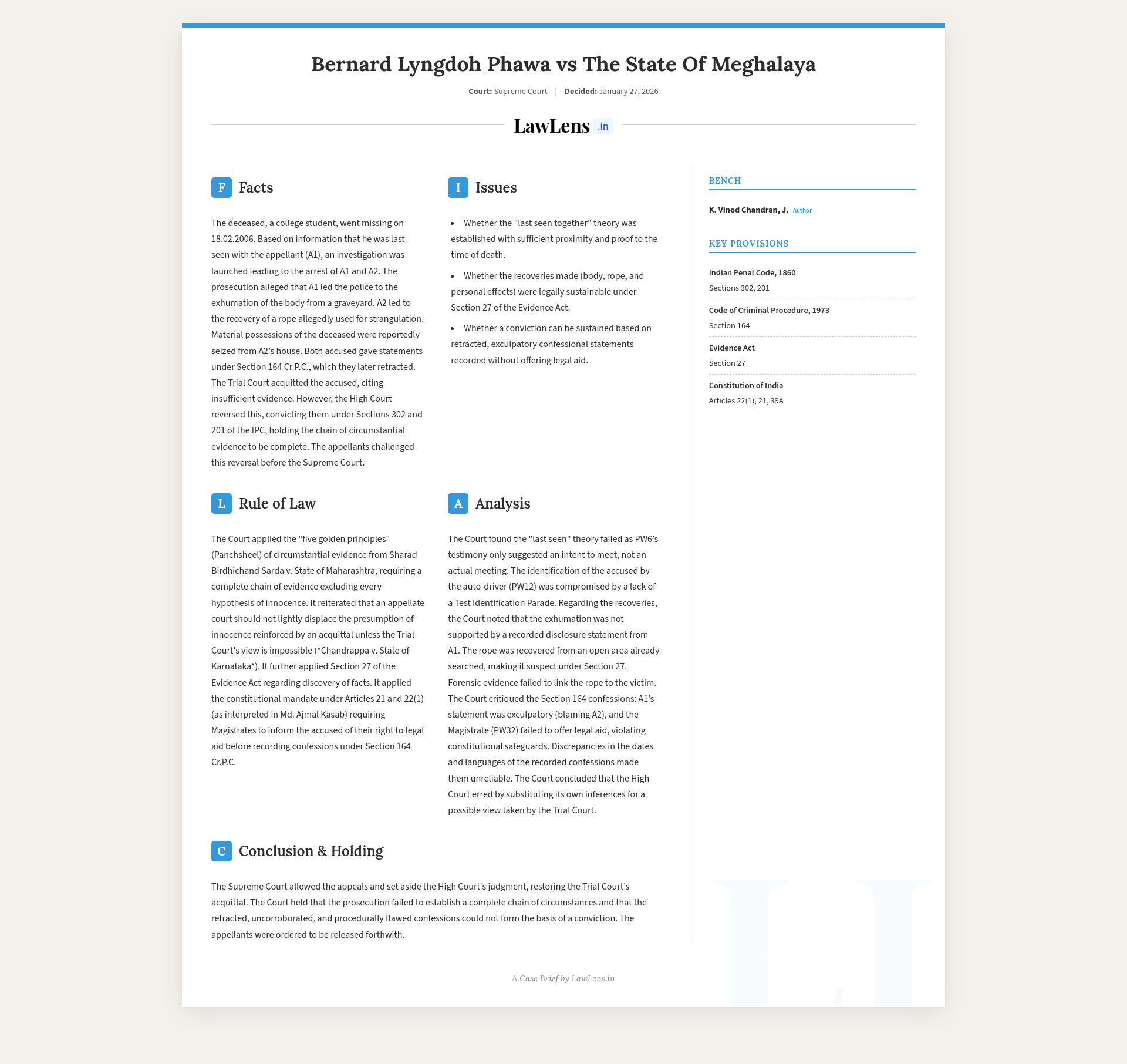
#SupremeCourt on exculpatory confession statements: https://t.co/kw8E5nfrll pic.twitter.com/f5pY5BcIef
— CiteCase 🇮🇳 (@CiteCase) January 27, 2026