Raj Singh Gehlot v. Amitabha Sen 2026 INSC 77 - Writ Petition - Burden Of Proof - S.14 NGT Act

You can read our notes on this judgment in our Supreme Court Daily Digests. If you are our subscriber, you should get it in our Whatsapp CaseCiter Community at about 9pm on every working day. If you are not our subscriber yet, you can register by clicking here:
Constitution of India - Article 226 - In a writ petition, which is decided on affidavits, the burden of establishing the existence of the facts asserted squarely lies upon the writ petitioner, and such burden can be discharged only by placing clear and unimpeachable material on record. (Para 66) Gross delay in approaching the High Court can constitute a material and decisive factor, which by itself can disentitled the writ petitioners to any sort of discretionary relief under Article 226. (Para 70)
National Green Tribunal Act - Section 14- Every question or dispute raised by an applicant before the Tribunal pertaining to the environment cannot be treated as a substantial question. It has to be a substantial question relating to environment as contemplated in Section 2(1)(m), and such substantial question must arise out of the implementation of any of the enactment/enactments specified in Schedule I. Though strict law of evidence may not be applicable to the cases filed before the Tribunal, the applicant has to raise the substantial question in his application specifically alleging the violation of a particular enactment specified in Schedule I. (Para 106)
Case Info
Case Details
- Case name: Raj Singh Gehlot & Ors. v. Amitabha Sen & Ors.; with connected Civil Appeals including Kohler India Corporation Pvt. Ltd. v. State authorities, and Chief Town Planner v. Amitabha Sen & Ors.
- Neutral citation: 2026 INSC 77
- Coram: J. B. Pardiwala, J.; Sandeep Mehta, J. (Judgment authored by Mehta, J.)
- Judgment date: January 20, 2026
Caselaws and citations referenced
- Indian Council for Enviro-Legal Action v. Union of India, (2011) 8 SCC 161.
- State of Punjab v. Gurdial Singh, (1980) 2 SCC 471.
- Uddar Gagan Properties Ltd. v. Sant Singh, (2016) 11 SCC 378.
- Kerala State Coastal Zone Management Authority v. State of Kerala, Maradu Municipality & Ors., (2019) 7 SCC 248.
- Rameshwar & Ors. v. State of Haryana & Ors., (2018) 6 SCC 215.
- Bharat Singh v. State of Haryana, AIR 1988 SC 534.
- Auroville Foundation v. Navroz Kersasp Mody, (2025) 4 SCC 150.
- State of M.P. v. Centre for Environment Protection Research & Development, (2020) 9 SCC 781.
- H.P. Bus-Stand Management & Development Authority v. Central Empowered Committee, (2021) 4 SCC 309.
Statutes and laws referred
- Haryana Development and Regulation of Urban Areas Act, 1975 (including Section 3 and inserted Section 3(3A) via Haryana Development and Regulation of Urban Areas (Second Amendment and Validation) Act, 2020).
- Haryana Development and Regulation of Urban Areas Rules, 1976 (Form LC-1; Rule 16; Rule 4 on open spaces).
- Haryana Apartment Ownership Act, 1983 (Sections 2, 6, 11, 13, 24-A).
- General Clauses Act, 1897 (Section 21).
- Punjab General Clauses Act, 1956 (Section 20).
- National Green Tribunal Act, 2010 (Section 14; Section 2(1)(m)).
- Code of Civil Procedure, 1908 (Order I Rule 10; Order XXXIX Rule 2).
- Code of Criminal Procedure, 1973 (Section 173(2)).
- Indian Penal Code, 1860 (Sections 420, 120B).
- Environment (Protection) Act, 1986 (context for CRZ and environmental regulation).
- Punjab Scheduled Roads and Controlled Areas (Restriction of Unregulated Development) Act, 1963.
- Haryana Urban Development Authority Act, 1977.
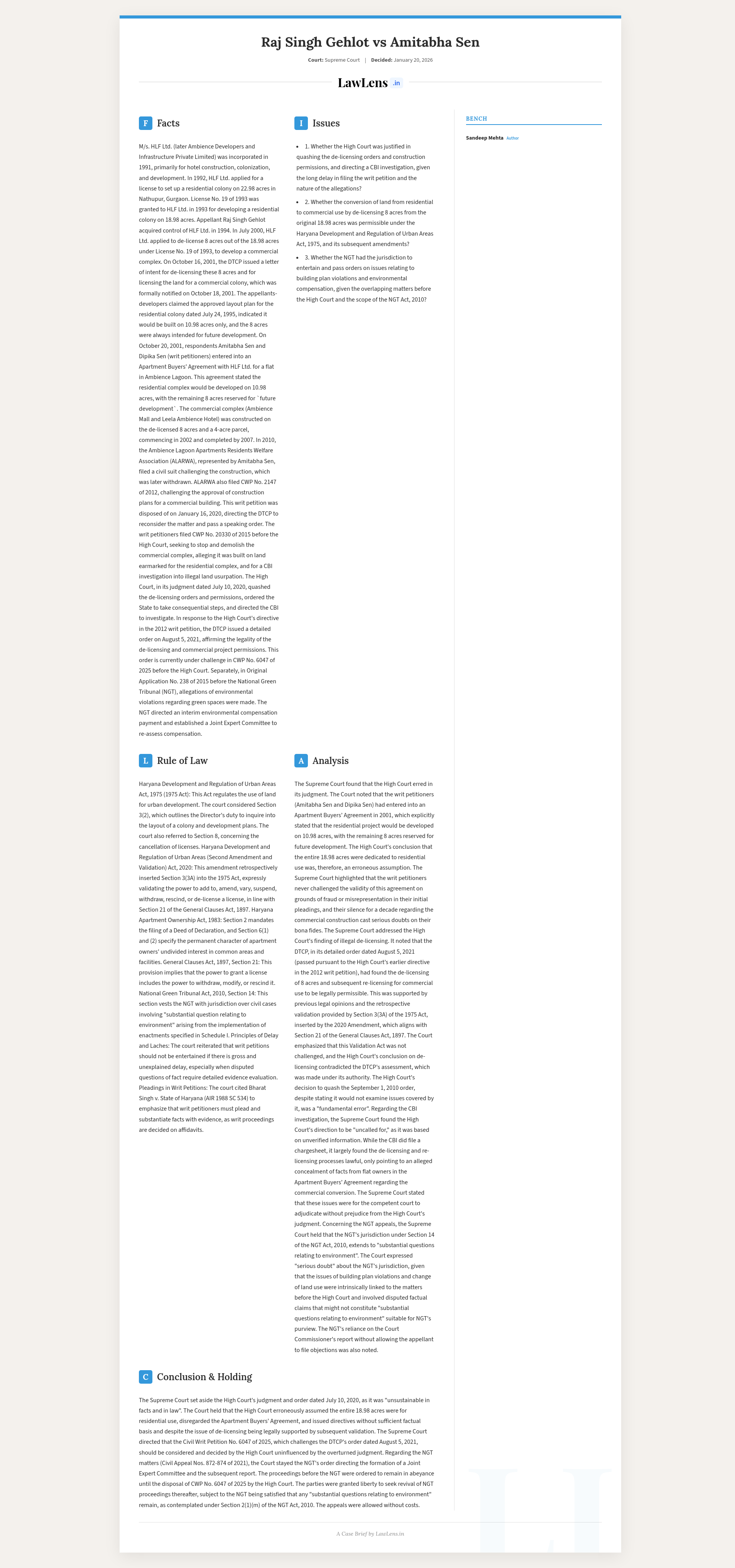
#SupremeCourt on Burden of Proof in a writ petition ! https://t.co/aGWGlxPZ0S pic.twitter.com/Q8Fy8Z1eqv
— CiteCase 🇮🇳 (@CiteCase) January 20, 2026