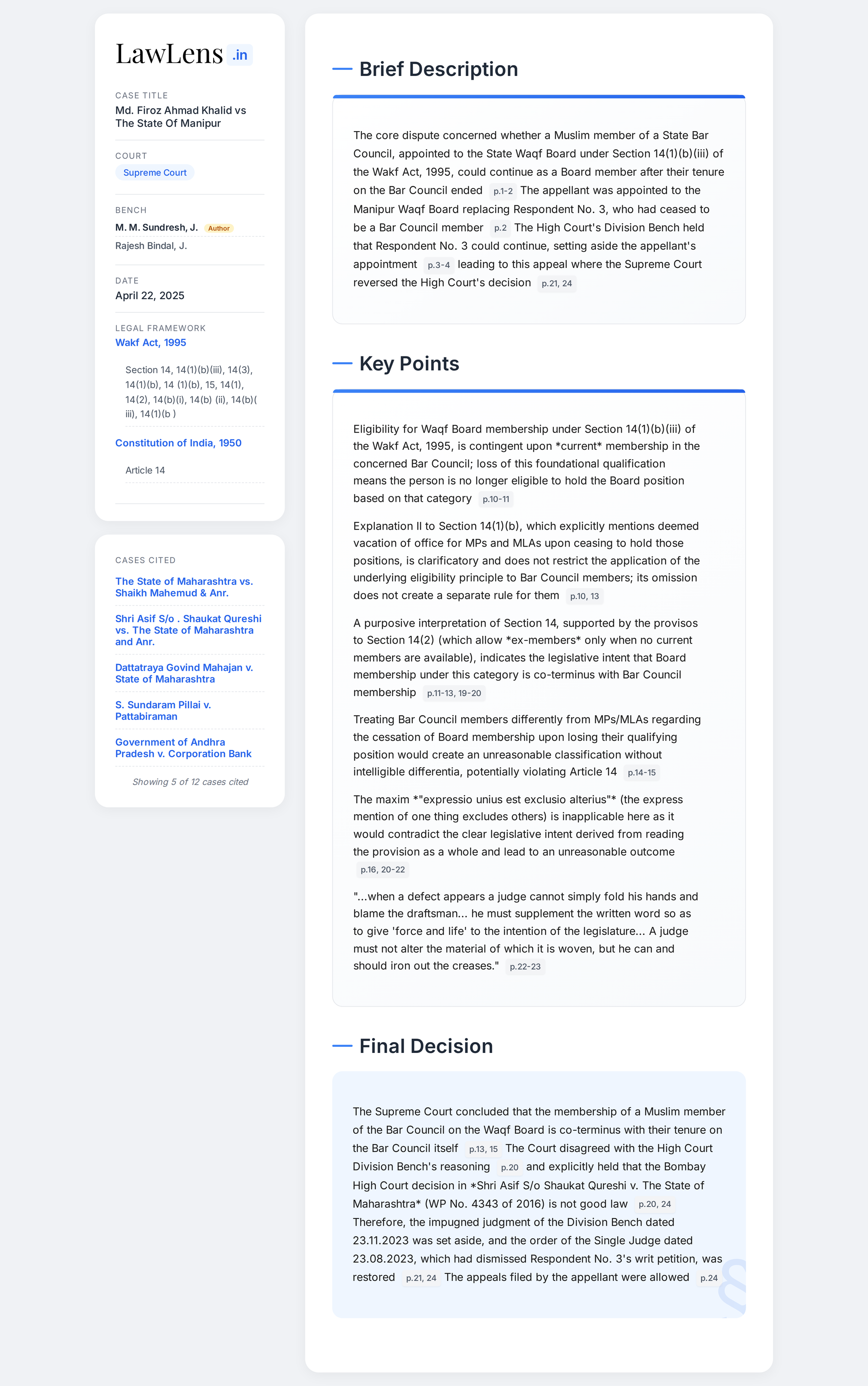
Md. Firoz Ahmad Khalid vs State Of Manipur 2025 INSC 535 - S. 14 Waqf Act - Muslim Member In Bar Council

Waqf Act 1995 - Section 14 - Ex-Member of the Bar Council would constitute the electoral college only when there is no eligible Member as provided for in Section 14(1)(b)(iii) and the proviso contained therein. This means that if there is no serving Muslim Member in the Bar Council and also no Senior Muslim advocate who is available, only then would an ex-Member of the Bar Council be eligible to be a Member of the Board- An existing Muslim Member of the Board from the Bar Council, would cease to be a Member of the Board, upon the completion of their tenure as a Member of the Bar Council, when there is another Muslim Member available to replace them from within the Bar Council- There is no conscious intention on the part of the Legislature to omit the applicability of Explanation II to Section 14(1)(b) of the 1995 Act, to Muslim Members of the Board elected from the Bar Council. (Para 13) - the term of a Member of the Bar Council serving on the Board, is co-terminus with their membership in the Bar Council itself (Para 15)
Interpretation of Statutes - To interpret a legislative provision, what must be primarily considered is its substantive part. An explanation simply performs a clarifying function. In other words, the substantive part of a provision cannot be understood solely from the point of view of an explanation. - An explanation, which is simply in the nature of a clarification as regards certain categories, cannot be read in a manner which is violative of the substantive part of the provision. Although normally, a proviso cannot be used to understand the substantive part of the provision, there is no absolute bar in doing so, particularly in cases where the statute is peculiar and the proviso does not create any exception. For the aforementioned purpose, an explanation can also be understood through the proviso. In other words, if a proviso or an explanation, as the case may be, is phrased in a manner which throws more light on the objective behind the substantive part of the provision, there would be no difficulty in appreciating the same. Ultimately, a proviso or an explanation may be used for several purposes. Therefore, what is required is that Courts appreciate the context of such usage before rendering an interpretation to a provision vis-a-vis the proviso or explanation contained therein. (Para 14)
Constitution of India - Article 14 -A classification would be reasonable only when there is an intelligible differentia which has a rational nexus with the object sought to be achieved through the statute. (Para 15)